



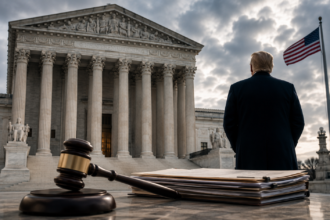
The Trump birthright citizenship order has moved from a campaign talking point to one of the most closely watched constitutional disputes in modern American history. Since President Donald Trump signed Executive Order 14160 on his first day back in office, federal courts have repeatedly blocked it, and the U.S. Supreme Court has now taken up the case directly. The outcome will determine whether a president can redefine the 14th Amendment’s guarantee of citizenship at birth. It will also shape U.S. immigration policy, executive power, and the rights of millions of families for generations.
This explainer breaks down what the order does, why the 14th Amendment is central to the dispute, what each side argues, and what could happen once the Supreme Court rules.
What Is Trump’s Birthright Citizenship Order?
Trump’s birthright citizenship order is Executive Order 14160, titled “Protecting the Meaning and Value of American Citizenship,” signed on January 20, 2025. It directs federal agencies to stop recognizing automatic U.S. citizenship for children born on U.S. soil if neither parent is a U.S. citizen or lawful permanent resident. The order targets children of undocumented immigrants and children of parents who are in the country temporarily, such as on student, work, or tourist visas. Federal courts blocked the order’s implementation while litigation continued, so the administration has not broadly enforced it. The Supreme Court is now reviewing its constitutionality in the case Trump v. Barbara.
Why Birthright Citizenship Matters in U.S. Politics
Birthright citizenship is one of the few constitutional guarantees that touches nearly every American family at some point, whether through ancestry, immigration history, or community ties. Politically, it sits at the intersection of three issues that consistently shape U.S. elections: immigration enforcement, constitutional interpretation, and the limits of presidential authority.
For supporters of stricter immigration policy, the order represents an attempt to close what they describe as a loophole that incentivizes unauthorized entry into the country. For civil rights organizations, legal scholars, and immigrant communities, the order represents an unprecedented attempt to rewrite a constitutional guarantee through executive action rather than through Congress or a constitutional amendment.
Because the case touches immigration enforcement, constitutional law, and executive power all at once, it has become a focal point for U.S. politics coverage heading into future election cycles, and it will likely remain part of campaign messaging on both sides.
What Birthright Citizenship Means Under the 14th Amendment
Birthright citizenship is the legal principle that a child born on U.S. soil generally receives U.S. citizenship at birth, regardless of the immigration status of the child’s parents. This principle is rooted in the Citizenship Clause of the 14th Amendment, ratified in 1868.
The Citizenship Clause states that all persons born or naturalized in the United States, and subject to the jurisdiction thereof, are citizens of the United States and of the state where they reside. The amendment was adopted after the Civil War specifically to overturn the Supreme Court’s 1857 decision in Dred Scott v. Sandford, which had denied citizenship to Black Americans.
In 1898, the Supreme Court addressed the meaning of “subject to the jurisdiction thereof” directly in United States v. Wong Kim Ark. The Court ruled that a child born in the United States to Chinese immigrant parents who were not eligible for citizenship themselves was nonetheless a U.S. citizen by birth. For more than a century, that ruling has been treated as the controlling precedent establishing that birthright citizenship applies broadly to children born on U.S. soil, with only narrow historical exceptions, such as children of foreign diplomats or members of an occupying foreign army.
Trump’s executive order argues for a narrower reading of “subject to the jurisdiction thereof,” contending that it should require a deeper legal connection, sometimes described as “domicile,” between the parents and the United States. Critics argue this reinterpretation conflicts with both the plain text of the amendment and the Wong Kim Ark precedent.
Why the Supreme Court Case Matters
The Supreme Court case, formally titled Trump v. Barbara, is significant because it asks the nation’s highest court to decide, for the first time in over a century, exactly who qualifies for citizenship under the 14th Amendment’s Citizenship Clause.
The case reached the Supreme Court after a class-action lawsuit filed in New Hampshire on behalf of children who would lose citizenship eligibility under the order. A federal district judge blocked the order and certified a nationwide class protecting affected children. After the federal government asked the Supreme Court to review the case, the justices agreed to hear it on an expedited basis. Oral arguments took place on April 1, 2026, drawing national attention partly because President Trump attended in person, the first sitting president on record to attend Supreme Court oral arguments.
According to available reporting on the arguments, several justices, including some appointed by Trump, pressed the administration’s Solicitor General on how the order would be enforced and whether it conflicts with the Court’s reasoning in Wong Kim Ark. A ruling is expected by the end of the Court’s term, around late June or early July 2026.
Because no sitting president has previously attempted to limit birthright citizenship through executive action, the ruling will set a precedent not just for immigration law, but for how far executive orders can go in reinterpreting constitutional text.
Trump’s Argument: Executive Power and Immigration Control
Supporters of the order argue that birthright citizenship, as currently applied, creates an incentive for unauthorized immigration and so-called “birth tourism,” in which people travel to the United States specifically so a child can be born a citizen. The administration’s legal argument, presented by the Solicitor General, contends that the phrase “subject to the jurisdiction thereof” was historically understood to require a deeper allegiance to the United States than simply being present in the country, and that this should be interpreted through a “domicile” framework.
Supporters also frame the issue as a matter of national sovereignty and orderly immigration enforcement. They argue that officials should apply the 1868 understanding of citizenship to today’s global mobility, where travel to the United States is far easier than it was at the time of ratification, as the administration’s brief stated. Lawmakers and legal scholars who support the order have filed briefs arguing that the executive branch can clarify how existing immigration and nationality statutes apply.
Critics’ Argument: Constitutional Limits and Citizenship Rights
Critics, including the American Civil Liberties Union, the Legal Defense Fund, and dozens of legal scholars across the political spectrum, argue that the Citizenship Clause’s text is unambiguous and that Wong Kim Ark already settled the question of how it applies to children of immigrants, regardless of their parents’ legal status. They contend that the only recognized exceptions are narrow historical categories, such as children of foreign diplomats, and that the order does not fit within any of them.
Critics also argue that a constitutional guarantee cannot be narrowed through executive order; doing so would require either an act of Congress changing underlying statutes within constitutional bounds, or a constitutional amendment. They warn that if the order is upheld, it could leave tens of thousands of U.S.-born children each month without citizenship, potentially without access to Social Security numbers, passports, or certain federal benefit programs, and at risk of statelessness if no other country recognizes them as citizens either.
Legal experts on both sides agree on one point: this case is not only about immigration policy. It is also a test of how much authority a president can exercise unilaterally over a constitutional question that has, until now, been treated as settled.
Key Entities Behind the Case
| Entity | Type | Why It Matters |
| Donald Trump | Person / U.S. President | Signed Executive Order 14160 and is the named party in Trump v. Barbara |
| Supreme Court of the United States | Federal Judicial Institution | Will issue the controlling ruling on the order’s constitutionality |
| 14th Amendment | Constitutional Provision | Contains the Citizenship Clause at the center of the dispute |
| U.S. Constitution | Foundational Legal Document | Establishes the framework within which executive power and citizenship rights operate |
| Department of Justice | Federal Agency | Represents the executive branch’s legal position before the courts |
| Federal Courts | Judicial System | Multiple district courts and appeals courts have blocked the order pending Supreme Court review |
| Immigration Policy | Policy Area | The order is framed as an immigration enforcement measure |
| Executive Order 14160 | Legal Instrument | The specific order attempting to redefine birthright citizenship eligibility |
| Birthright Citizenship | Legal Principle | The constitutional guarantee being challenged |
| Congress | Legislative Branch | Has codified birthright citizenship in federal statute and could act independently of the Court’s ruling |
Possible Outcomes of the Supreme Court Case
| Possible Outcome | What It Means | Political Impact | Legal Impact |
| The court strikes down the order entirely | Birthright citizenship continues as understood since Wong Kim Ark | Seen as a defeat for the administration’s immigration agenda | Reaffirms Wong Kim Ark as a binding precedent |
| Court narrows the order’s scope | Some categories of children remain protected, while others may not | Mixed reactions from both sides; likely continued litigation | Creates new tests for “jurisdiction” and “domicile” |
| The court upholds the order | Children of undocumented or temporary-status parents could lose automatic citizenship | Major political flashpoint heading into future elections | Would mark the first major reinterpretation of the Citizenship Clause in over a century |
| The Court avoids the constitutional question | Rules narrowly on statutory grounds (the Immigration and Nationality Act) instead | Delays a definitive political resolution | Leaves the core constitutional question unresolved for future cases |
According to available reporting on oral arguments, several justices raised the possibility of resolving the case on statutory grounds without reaching the constitutional question directly, a legal approach known as constitutional avoidance. Whether the Court takes that path or rules squarely on the 14th Amendment remains to be seen.
How This Could Affect Immigration Policy
If the order is ultimately upheld in any form, the practical effects would extend far beyond the families immediately involved. Federal agencies such as the Social Security Administration would need to determine, at the time of a birth, whether a child qualifies for citizenship, a process that legal critics argue raises serious practical and due-process concerns. Hospitals, state vital records offices, and federal benefit programs like Medicaid, SNAP, and the Children’s Health Insurance Program could all be affected by new verification requirements.
State governments would also face new administrative burdens, since birth certificates and citizenship determinations are typically handled at the state level but would need to align with a federal citizenship standard. Immigration attorneys and policy analysts widely expect that, regardless of the outcome, the ruling will influence future executive action on
immigration, since it will clarify how far a president can go in reinterpreting constitutional and statutory text without new legislation.
Why This Case Is Also About Presidential Power
Beyond immigration, Trump v. Barbara is fundamentally a separation-of-powers case. The order was challenged almost immediately after it was signed, and federal district courts issued nationwide injunctions blocking its enforcement. In a related 2025 case, Trump v. CASA, Inc., the Supreme Court limited the ability of federal district courts to issue nationwide injunctions, but it did not rule on whether the birthright citizenship order itself was constitutional. That procedural ruling reshaped how challengers had to bring their case, leading directly to the class-action structure used in Barbara.
This sequence shows a broader pattern in U.S. politics: opponents often challenge executive orders in federal court, judges temporarily halt enforcement through injunctions, and the Supreme Court ultimately decides both procedural questions, such as the scope of injunctions, and substantive constitutional questions. How the Court rules in this case will likely influence how lower courts handle future challenges to executive orders on other politically charged issues.
How This Topic Fits Into the Bigger U.S. Politics Cluster
The Trump birthright citizenship order does not exist in isolation. It connects directly to several ongoing storylines in U.S. Politics, including:
- U.S. immigration policy, since the order is framed as an enforcement tool against unauthorized immigration and temporary-visa “birth tourism”
- Supreme Court cases, as this ruling will sit alongside other major decisions shaping the Court’s current term
- Executive power, as the case tests the boundaries of what a president can accomplish through executive orders without new legislation
- Constitutional law, since the case requires the Court to interpret the 14th Amendment text that has not been substantively revisited since 1898
- 2026 U.S. elections, since immigration and constitutional authority remain central campaign themes for elections coverage
- Trump administration policies, as this order is one of several second-term executive actions tied to immigration enforcement
- Federal-state legal battles, since states have been directly involved in challenging the order in multiple jurisdictions
Readers can follow our U.S. Politics, Supreme Court, and Government sections for more updates as the ruling approaches.
Timeline: Birthright Citizenship and Trump’s Executive Order Debate
- 1868: The 14th Amendment is ratified, establishing the Citizenship Clause.
- 1898: The Supreme Court rules in United States v. Wong Kim Ark that children born in the U.S. to immigrant parents are citizens by birth.
- January 20, 2025: President Trump signs Executive Order 14160, seeking to limit birthright citizenship for children of undocumented or temporarily present parents.
- Early 2025: Multiple federal judges issue injunctions blocking the enforcement of the order nationwide.
- June 27, 2025: The Supreme Court rules in Trump v. CASA, Inc. that federal courts generally cannot issue nationwide injunctions without ruling on the order’s constitutionality.
- July 10, 2025: A federal court in New Hampshire blocks the order again and certifies a nationwide class of affected children in what becomes Barbara v. Trump.
- December 5, 2025: The Supreme Court agrees to hear Trump v. Barbara.
- April 1, 2026: The Supreme Court hears oral arguments; President Trump attends in person.
- Late June–Early July 2026: A Supreme Court ruling is expected before the end of the Court’s term.
What Readers Should Watch Next
- Follow Supreme Court updates directly through official channels as the ruling approaches.
- Check official government sources, including U.S. Citizenship and Immigration Services guidance, for any procedural changes.
- Consult a qualified immigration lawyer if the order’s outcome may affect your family. This article does not replace individualized legal advice.
- Track related Fresh Global News coverage in the U.S. Politics and Supreme Court sections for the final ruling and its aftermath.
Conclusion
The Trump birthright citizenship order has forced the Supreme Court to answer a question many Americans assumed was settled more than a century ago: who is a citizen at birth? The case touches constitutional law, immigration policy, and the limits of executive power all at once, and its outcome will affect far more than the families directly named in the lawsuit.
Whether the Court reaffirms the broad protections established in Wong Kim Ark or opens the door to a narrower reading of the 14th Amendment, the ruling expected by the end of June or early July 2026 will shape U.S. citizenship law, immigration enforcement, and the boundaries of presidential authority for years to come.
FAQs
Q1. Can a president end birthright citizenship by executive order?
It is Executive Order 14160, signed January 20, 2025, which seeks to deny automatic U.S. citizenship to children born on U.S. soil if neither parent is a U.S. citizen or lawful permanent resident. The order has been blocked by federal courts and is currently before the Supreme Court.
Q2. Can a president end birthright citizenship by executive order?
That is precisely the question before the Supreme Court in Trump v. Barbara. Critics argue a constitutional guarantee cannot be altered by executive order alone, while the administration argues it is properly interpreting existing constitutional and statutory language. A ruling is expected by late June or early July 2026.
Q3. What does the 14th Amendment say about birthright citizenship?
The 14th Amendment’s Citizenship Clause states that all persons born or naturalized in the United States, and subject to its jurisdiction, are citizens of the United States. It was ratified in 1868 to overturn the Dred Scott decision.
Q4. Why is the Supreme Court involved?
Federal courts blocked the order almost immediately after the president signed it. After a series of legal challenges, the Supreme Court agreed to resolve the underlying constitutional question directly in Trump v. Barbara, with oral arguments held April 1, 2026.
Q5. How could this affect immigrant families?
If upheld, the order could affect thousands of U.S.-born children each month, or tens of thousands each year, potentially limiting access to citizenship documentation, Social Security numbers, passports, and certain federal benefits. Affected families should consult a qualified immigration attorney for guidance specific to their situation.
Q6. What happens if the Supreme Court limits the order?
If the Court strikes down or narrows the order, existing birthright citizenship protections would likely remain largely intact, consistent with the precedent set in Wong Kim Ark. The exact effect would depend on the scope of the Court’s ruling.