



Key Takeaways
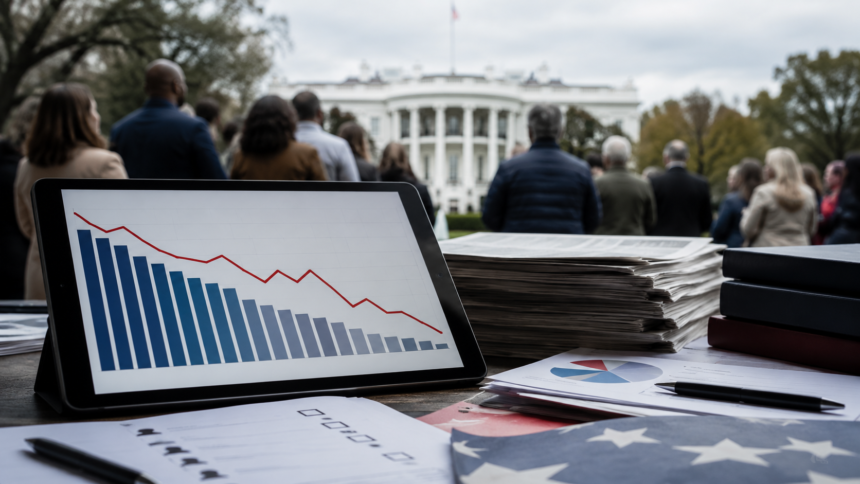
- Trump’s approval rating in 2026 is generally in the high-30s to low-40s across major polls and polling averages, down from roughly 47% at the start of his second term.
- The economy, especially tariff-driven inflation, high food and housing costs, and interest rate pressure, is the single biggest driver of disapproval.
- Independent voters have shifted significantly, with approval among independents falling to around 34%, below the historical threshold linked to midterm wave elections.
- Republican base support remains high at roughly 87%, meaning partisan polarization keeps the floor stable even as the national average declines.
- Approval ratings are snapshots, not predictions; they can shift quickly with economic data, major news events, foreign policy developments, or legislative outcomes.
What Is Trump’s Approval Rating in 2026?
According to compiled national polling averages from sources including Gallup, Reuters/Ipsos, YouGov, Quinnipiac, and Morning Consult, Trump’s approval rating in 2026 stands at approximately 39–40%, with disapproval averaging around 57%. His net approval, the difference between approval and disapproval, sits at roughly -18 points as of mid-2026, according to the Silver Bulletin polling average.
These numbers vary across individual pollsters depending on methodology, sample population, and timing, but the broader trend is consistent: approval has declined from a post-election high of approximately 47–48% in January 2025.
The numbers reflect voter concern around several core issues: the cost of living, tariff-driven inflation, immigration enforcement, and public trust in the federal government.
Note: Polling numbers in this article should be updated with the latest verified data before publication, as approval ratings change frequently.
Why Trump’s Approval Rating Matters in U.S. Politics
A presidential approval rating is more than a daily news headline. It functions as one of the most reliable real-time indicators of a president’s political standing, and its effects ripple across nearly every dimension of American governance.

Here is why the Trump approval rating in 2026 matters:
- Public Sentiment Signal: Approval ratings reflect how ordinary voters, not political insiders, feel about the direction of the country and the performance of the executive branch.
- Congressional Strategy: Republican lawmakers pay close attention to presidential approval numbers when deciding whether to align with or distance themselves from White House policy priorities.
- Donor and Fundraising Impact: Party committees and individual candidates often adjust fundraising strategy based on whether the president’s numbers are helping or hurting their message.
- Media Framing: News organizations frequently use approval ratings as a narrative anchor, shaping how policy decisions and controversies are reported.
- Voter Turnout and Mobilization: Both parties use approval data to motivate their base, Republicans to defend a sitting president, Democrats to energize anti-Trump voters.
- Midterm Election Forecasting: Historically, presidential approval below 50% is correlated with significant seat losses for the president’s party in congressional elections.
What Approval Rating Actually Means
Polling terminology can be confusing. Here is a quick reference to the key terms used in presidential approval polling:
| Term | Meaning | Why It Matters |
| Approval Rating | Percentage of respondents who say they approve of the president’s job performance | The headline number most widely cited in news coverage |
| Disapproval Rating | The percentage who say they disapprove of the president’s performance | Often higher than approval; reflects opposition intensity |
| Net Approval | Approval minus disapproval (can be negative) | Shows overall momentum, a -18 net is politically significant |
| Favorability Rating | How positively or negatively someone views the president as a person | Different from job performance, measures personal image |
| Job Performance Rating | How voters rate specific policy areas (economy, immigration, etc.) | Breaks approval into issue-level detail |
| Registered Voters vs. Likely Voters | Registered voters = anyone on the rolls; Likely voters = those expected to vote | Likely voter polls often favor one party over the other |
| Adults (All Adults) | Broadest population sample; includes non-voters | Tends to produce slightly lower approval for Republican presidents |
| Margin of Error | Statistical range of uncertainty (typically ±2–4 points) | A 40% approval with ±3 means the real number is 37–43% |
Latest Trump Poll Numbers 2026: What the Data Shows
As of mid-2026, Trump’s approval rating is generally in the high-30s to low-40s across major polls and polling averages. A June 2026 Reuters/Ipsos poll reported 36% approval, while RealClearPolling showed Trump underwater in its multi-poll average. Individual polls vary by sample type, field dates, and methodology.
| Pollster / Source | Approx. Date | Approval | Disapproval | Sample / Type | Key Takeaway |
| Reuters/Ipsos | June 12–15, 2026 | 36% | Not specified in article summary | 1,537 U.S. adults | Trump’s approval ticked up slightly but remained low, with cost-of-living concerns still weighing on voters. |
| Gallup | 2025–present second-term average | 41% average | Varies by survey | Gallup presidential approval tracker | Gallup shows Trump’s second-term average at 41%, with a second-term high of 47% in January 2025. |
| Economist/YouGov | June 13–15, 2026 | 39% | 56% | U.S. adult citizens | YouGov showed Trump’s approval rebounding, but still underwater by double digits. |
| RealClearPolling Average | May 20–June 18, 2026 | 40.6% | 56.9% | Multi-poll average | RealClearPolling’s average showed Trump underwater by about 16 points. |
| Morning Consult | June 20–22, 2026 | 45% | 53% | Tracking poll / registered voters | Morning Consult showed better numbers than some other polls, but still negative overall. |
| Polling Average Trend | Mid-June 2026 | High-30s to low-40s | Mid-to-high 50s | Multi-poll trend | The broader trend shows Trump’s approval remains weak, especially outside his Republican base. |
Key polling sources for this article include Reuters/Ipsos, Gallup presidential approval data, Economist/YouGov polling, RealClearPolling’s Trump approval average, and Morning Consult tracking data.
Why Voters May Be Turning Against Trump
Polling data and analyst commentary point to several overlapping reasons why Trump’s approval rating has declined from its inauguration-period high. These are not necessarily partisan conclusions, they reflect patterns visible in multiple independent polls across ideological lines.
Cost of Living and Everyday Prices
Some voters say that while economic data shows continued employment, what they feel at the grocery store, at the gas pump, and in their monthly rent tells a different story. Polling often shows that voter perception of the economy is closely tied to the prices they pay for everyday necessities, not to macroeconomic indicators like GDP growth.
Tariff-Driven Inflation Concerns
Analysts argue that the administration’s broad tariff policy, which accelerated through late 2025 and into 2026, has contributed to consumer price pressure. The data suggest that PCE inflation, a key Federal Reserve measure, rose to approximately 4.5% in Q1 2026, raising concerns about a stagflation pattern not seen since the 1970s. Bureau of Labor Statistics inflation data
Government Trust and Institutional Concerns
Polling often shows that voters who express concern about the independence of government institutions, courts, regulatory agencies, law enforcement are more likely to disapprove of presidential performance. Legal battles, executive orders, and controversies over agency restructuring have contributed to this dimension of disapproval.
Independent Voter Fatigue
The data suggests that voters who do not identify strongly with either party, often called independents or swing voters, are among the most sensitive to economic conditions and policy uncertainty. As of mid-2026, independent approval of Trump is estimated at approximately 34%, down roughly 14 points from his 48% inaugural-period independent support.
Suburban and College-Educated Voter Shifts
Analysts argue that suburban voters, particularly those with college degrees, have been among the most mobile in their presidential approval. This demographic group, which includes many who voted for Trump in 2024, has shown sensitivity to economic stability, institutional norms, and policy unpredictability.
Economy and Inflation: The Biggest Pressure Point
Across modern presidential history, no single variable predicts approval ratings as reliably as economic conditions, particularly inflation and the cost of daily life.
President Trump’s approval trajectory in 2026 fits this historical pattern. According to multiple pollsters and analysts, the steepest approval declines in early-to-mid 2026 have tracked closely with economic anxiety indicators:
- Inflation: Consumer price inflation remained elevated in early 2026, driven in part by new tariffs on imported goods. Voters, especially those without large investment portfolios, experience inflation primarily through grocery bills, rent, gas prices, and healthcare costs.
- Housing Costs: The housing affordability crisis that built through 2023–2025 has not resolved significantly. High interest rates on mortgages have kept many potential buyers out of the market while renters face continued price pressure.
- Gas Prices: Energy costs remain a politically sensitive indicator. Even short-term spikes generate outsized negative sentiment in approval polling.
- Wages vs. Prices: Some voters say that while wages have risen, they have not kept pace with the price increases they experience for housing, food, and utilities, creating a feeling of economic decline even in a technically growing economy.
- Consumer Confidence: Multiple consumer confidence surveys through 2025–2026 have shown declining optimism about the economic future, which tends to suppress presidential approval regardless of lagging macroeconomic indicators.
- Interest Rates: The Federal Reserve’s decision to hold rates steady whileinflation concerns linked by some analysts to tariffs and import costs builds creates a cost-of-living squeeze that voters often attribute fairly or not, to the sitting president.
Analysts argue that even if macroeconomic data improves in the second half of 2026, voter approval often lags behind because the felt experience of price levels, not the statistical direction of inflation, is what most people actually notice.
Immigration and Border Policy: A Dividing Issue
Immigration policy represents one of the most complex dimensions of Trump’s approval picture, because it moves approval in opposite directions depending on which voters are being measured.
- Supporters and the Republican Base: Polling consistently shows that Trump’s core Republican supporters strongly approve of stricter border enforcement, deportation policy, and efforts to reduce unauthorized immigration. For this group, immigration policy may actually reinforce approval.
- Critics and Democratic Voters: Opponents of the administration’s immigration approach, including its enforcement tactics, asylum processing changes, and deportation operations, view these policies negatively. This group is already unlikely to approve regardless of immigration policy.
- Independent and Swing Voters: The data suggest that independents are more divided. Those who prioritize border security may approve of enforcement measures, while those concerned about due process, humanitarian conditions, or family separation may disapprove. The net effect on independent approval appears to be negative according to polling through 2025–2026.
- Legal and Constitutional Battles: Court challenges to immigration enforcement measures have created sustained news coverage that keeps the issue politically charged. Supreme Court decisions on related cases have added another layer of uncertainty.
For readers interested in detailed coverage of immigration policy developments and their legal dimensions, see Fresh Global News’s ongoing coverage of U.S. immigration policy.
Independent Voters and Swing-State Opinion
Independent voters, those who do not register with or strongly identify with either the Republican or Democratic Party, are widely considered the most electorally decisive segment of the American electorate. Understanding how they view Trump’s performance in 2026 is critical to interpreting what his approval rating actually means politically.
Key factors about independent voters:
- They are less motivated by partisan loyalty and more responsive to economic conditions, presidential competence, and perceived stability.
- Their approval or disapproval of a sitting president tends to move more than that of strong partisans on either side.
- Historical data shows that presidents who sustain independent approval below 40% over an extended period face significant electoral headwinds for their party in congressional races.
- As of mid-2026, Trump’s independent approval is estimated at approximately 34%, down from 48% at inauguration and below the 36% threshold that historically preceded Democratic wave gains in 2018.
- In swing states, including Arizona, Georgia, Nevada, and Pennsylvania, independent approval is particularly significant because these states determine Senate and electoral college outcomes.
Analysts argue that the independent voter shift is the most politically consequential element of Trump’s 2026 approval decline, because Republican base numbers are structurally stable at roughly 87%.
Republican Base Support: Is Trump Still Strong With His Core Voters?
Despite declining national approval averages, Donald Trump maintains strong support among Republican voters. Gallup and other pollsters consistently show Republican approval of Trump at approximately 87%, a figure that reflects the deeply partisan nature of modern American politics.
Several factors sustain base support even when national approval declines:
- Party Identity: For many Republican voters, supporting Trump has become synonymous with Republican Party identity, meaning disapproval carries a social and political cost within conservative communities.
- Conservative Media Ecosystem: Media outlets widely consumed by Republican base voters often frame economic, immigration, and political events in ways that reinforce support for the administration.
- Immigration and Cultural Issues: For Republican base voters who prioritize border security, cultural conservatism, and skepticism of institutional power, Trump’s policy agenda aligns with strongly held values.
- Economic Nationalism: Trade policy, including tariffs, is viewed favorably by portions of the Republican base who believe it protects American manufacturing and workers, even if it generates broader inflation concerns.
- Primary Pressure: Republican members of Congress who might privately disagree with specific policies often face primary election pressure from Trump-aligned voters, which discourages public distancing.
The implication for approval polling: because Republican approval holds high and Democratic approval holds low, the primary variable that moves the national average is how independents feel.
Democratic Opposition and Negative Partisanship
A significant portion of Trump’s historically high disapproval rating, which has reached approximately 48% in the ‘strongly disapprove’ category according to Silver Bulletin data, reflects the intensity of Democratic opposition rather than only voter disappointment among swing or moderate groups.
Key dynamics in Democratic disapproval:
- Negative Partisanship: Political scientists use this term to describe how modern voters are increasingly motivated by opposition to the other party’s leader, rather than enthusiasm for their own. Democratic disapproval of Trump is structurally high regardless of specific policy outcomes.
- Media Ecosystems: Democratic-leaning voters consume news that tends to emphasize policy criticism, legal controversies, and institutional concerns, reinforcing disapproval.
- Issue-Based Opposition: Specific policies, including immigration enforcement, healthcare changes, tariffs, and government agency restructuring, generate active opposition from Democratic voter groups.
- Political Polarization: The 80-point gap between Republican approval (87%) and Democratic approval (approximately 7%) represents what analysts describe as the widest partisan approval gap ever recorded in American polling history.
This polarization means that the national approval average of approximately 39–40% is mathematically the result of very high Republican support averaging with very low Democratic support, with independents in between.
How Trump’s Approval Rating Could Affect Congress
Presidential approval ratings are among the strongest predictors of midterm congressional outcomes available to political analysts more than six months before an election. The political implications of Trump’s 2026 approval numbers extend beyond the White House.
- Republican Lawmakers: Members of Congress in competitive districts monitor presidential approval closely. Low approval may lead some to seek distance from controversial White House policies, while those in safe Republican districts may maintain close alignment.
- Democratic Messaging: Democratic candidates and party committees use unfavorable presidential approval numbers in advertising, fundraising appeals, and voter mobilization efforts.
- Candidate Recruitment: Political parties tend to attract stronger candidates to run in favorable political environments. Low presidential approval historically makes recruiting competitive candidates easier for the opposition party.
- Senate Implications: The states with competitive 2026 Senate races, including Arizona, Georgia, and Nevada, are places where presidential approval directly affects candidate prospects. A double-digit presidential approval deficit among independents creates structural headwinds.
- Legislative Strategy: When a president’s approval is low, legislative priorities become harder to advance because wavering members of Congress have less political incentive to take difficult votes in support.
For ongoing coverage of congressional politics and government developments, see Fresh Global News’s Government section.
Trump Approval Rating by Issue
Presidential approval is not a single measurement; it varies significantly by issue area. Here is how key issues are likely affecting Trump’s overall approval picture in 2026:
| Issue | Why It Matters to Voters | Possible Effect on Approval |
| Economy & Tariffs | Directly affects daily purchasing power; tariff-driven inflation is widely felt | Negative, economic anxiety is the leading driver of approval decline |
| Inflation & Cost of Living | Grocery, rent, and energy costs remain elevated for most households | Negative, felt experience of prices often outweighs macroeconomic statistics |
| Immigration | Emotional, values-driven issue; sharply divides voter coalitions | Mixed, boosts base support, but hurts independents and swing voters |
| Healthcare | Costs, coverage access, and prescription prices remain top concerns | Negative among those without employer coverage; neutral for insured voters |
| Crime & Public Safety | Perceptions of crime affect confidence in government performance | Variable, depends on local conditions and how media frames national trends |
| Foreign Policy | Trade disputes, military alliances, the Middle East, and the Ukraine conflict | Negative among internationalist voters; mixed among the nationalist base |
| Government Performance | Trust in federal agencies, civil service, and institutional competence | Negative, concerns about agency restructuring affect moderates and independents |
| Social & Cultural Issues | Abortion rights, education policy, gender policy | Polarizing, increases base support but alienates suburban moderates |
| Constitutional Controversies | Executive power use, court battles, election integrity claims | Negative among independents and college-educated voters; neutral for strong Republicans |
How Polling Can Be Misleading
Not all polls are created equal, and the range of approval numbers across different polls, which can sometimes span 5 to 10 percentage points for the same president, is often confusing to readers. Here is what you need to know to read polling data critically:
- Sample Population Matters: A poll of all U.S. adults will typically produce different numbers than a poll of registered voters, which in turn differs from a poll of likely voters. These distinctions affect the result.
- Online vs. Phone Polling: Internet-based panels (like YouGov) reach different demographics than random-digit-dial telephone polls (like some Gallup surveys). Neither method is perfectly representative on its own.
- Question Wording: Subtle differences in how approval questions are phrased, ‘Do you approve or disapprove?’ vs. ‘How would you rate the job the president is doing?’, can affect responses.
- Timing of Events: A major economic report, foreign policy crisis, or significant legal ruling can shift poll numbers by 2–5 points within days. Always check when a poll was conducted relative to major news events.
- Margin of Error: A poll showing 40% approval with a ±3 margin of error means the true figure could be anywhere from 37% to 43%. Single polls should never be treated as precise.
- Poll Averages Are More Reliable: Averaging multiple polls, as organizations like RealClearPolitics and Silver Bulletin do, reduces the noise from any single survey and provides a more accurate trend line.
- Polls Are Snapshots, Not Predictions: An approval rating in June 2026 does not predict what voters will do in November 2026 or what approval will be in January 2027. Economic conditions, events, and political dynamics can change quickly.
What Readers Should Watch Next
For anyone tracking Trump’s approval rating in 2026, the following indicators and developments are the most likely to move polling numbers in the coming months:
- Monthly Inflation Reports (CPI and PCE): If consumer price inflation declines meaningfully, economic approval could improve. A continued increase would likely deepen disapproval.
- Jobs Reports (BLS Monthly): Strong employment data historically provides a short-term approval boost, even during periods of broader economic concern.
- Federal Reserve Interest Rate Decisions: Rate cuts could ease housing and credit costs, improving economic sentiment. Continued holds or rate increases would sustain financial pressure on households.
- Immigration Enforcement Developments: High-profile cases, court decisions, or policy shifts on immigration, including Supreme Court rulings, can move approval among both base and swing voters.
- Major Legislation: Congressional action on spending, healthcare, or tax policy would become a new lens through which voters evaluate presidential performance.
- Foreign Policy Events: Conflicts involving U.S. alliances or economic partners, particularly developments in Ukraine, the Middle East, or U.S.-China trade relations, can shift foreign policy approval quickly.
- Court Rulings: Decisions from the Supreme Court on executive power, immigration, or other contested policies will generate news cycles that affect public opinion.
- Public Speeches and Communications: How the president communicates on economic and social issues, in rallies, press conferences, and social media, shapes the media environment around approval.
Entity Reference: Key Figures and Organizations in This Article
| Entity | Type | Relevance to Trump Approval Rating 2026 |
| Donald Trump | Political figure (45th and 47th U.S. President) | Central subject: approval ratings measure his second-term job performance |
| Republican Party | U.S. political party | Trump’s party base approval (~87%) provides the floor for his national average |
| Democratic Party | U.S. political party | Primary opposition; Democratic disapproval (~93%) drives the ceiling of disapproval |
| Independent Voters | Voter group / political identity | The swing segment, their approval (now ~34%) is the most electorally decisive figure |
| U.S. Congress | Federal legislative branch | Affected by presidential approval, Republican lawmakers balance alignment vs. distance |
| White House | Executive branch/institution | Policy source: Administration decisions directly shape the issues driving approval changes |
| Gallup | Polling organization | Longest-running presidential approval tracker; provides historical comparison data |
| Reuters/Ipsos | Polling organization/news agency | Widely cited; tracks economy and foreign policy as top voter concerns |
| Pew Research Center | Research institution | Provides in-depth polling on policy issue attitudes and voter demographics |
| YouGov | Polling organization | Online panel; tracks weekly changes; widely used for U.S. and international comparisons |
| RealClearPolitics | Polling aggregator | Standard reference for multi-poll averages; widely used by journalists and candidates |
| Silver Bulletin (Nate Silver) | Polling aggregator/analyst | Weighs polls by quality; shows net approval trends and historical context |
| U.S. Economy | Economic system/policy area | Primary driver of presidential approval; inflation and tariffs are key variables in 2026 |
| Inflation / Cost of Living | Economic indicator | Leading factor in voter dissatisfaction; felt directly by most households daily |
| Immigration Policy | Policy area | Divisive issue; boosts base approval while hurting independent and swing voter support |
How This Fits Into the U.S. Politics Content Cluster
This article sits within Fresh Global News’s broader coverage of U.S. Politics and is part of the political analysis and voter sentiment content cluster. For related coverage:
- U.S. Politics Hub: https://freshglobalnews.com/politics/us-politics/
- Government Coverage: https://freshglobalnews.com/politics/government/
- Elections Analysis: https://freshglobalnews.com/politics/elections/
- Supreme Court Developments: https://freshglobalnews.com/politics/supreme-court/
- Politics Overview: https://freshglobalnews.com/politics/
Conclusion
Trump’s approval rating in 2026 is one of the most consequential political metrics in the United States, not because it is a simple score, but because it reflects the intersection of economic conditions, policy debates, partisan identity, and voter trust in the direction of the country.
The data as of mid-2026 shows a president whose national approval average has declined from its post-election high, driven primarily by economic anxiety, particularly inflation and cost-of-living pressure, and a significant erosion of support among independent voters. At the same time, Republican base support remains structurally stable, and partisan polarization keeps both the approval floor and disapproval ceiling at historically extreme levels.
What happens next to Trump’s approval rating will depend on economic reports, inflation data, Federal Reserve decisions, legislative outcomes, and events that cannot be fully anticipated. Approval ratings can shift quickly, and the next several months of economic and political developments will be critical in determining whether the current trends deepen, stabilize, or reverse.
For ongoing coverage of U.S. presidential politics, approval data, and policy developments, follow Fresh Global News.
Frequently Asked Questions
Q1. What is Trump’s approval rating in 2026?
As of mid-2026, Trump’s approval rating averages approximately 39–40% in major polling compilations, with disapproval averaging around 57%. His net approval (approval minus disapproval) sits at roughly -18 points according to the Silver Bulletin polling average. Individual polls vary; always check the pollster, date, and sample population before interpreting a specific number.
Q2. Why is Trump’s approval rating changing?
The primary driver of approval decline in 2026 is economic anxiety, particularly inflation driven in part by broad tariff policies, elevated housing costs, and consumer concern about household budgets. Secondary factors include voter concerns about government performance, institutional controversies, and immigration enforcement debates. Independent voters, who are less bound by party loyalty, have shown the sharpest decline in approval.
Q3. What issues affect Trump’s approval rating the most?
The economy, specifically inflation, cost of living, housing affordability, and consumer confidence, is the single most powerful issue affecting presidential approval in 2026. Immigration policy is the second most polarizing issue, boosting base approval while hurting independent voter sentiment. Foreign policy, healthcare, and government performance also register in issue-level polling.
Q4. Do approval ratings predict election results?
Approval ratings are among the strongest available predictors of midterm election outcomes, but they are not guarantees. Historically, presidents with approval below 50% and independent approval below 40% have consistently lost congressional seats at midterm elections. However, candidate quality, redistricting, turnout dynamics, and late-breaking events can significantly affect actual results. Approval ratings are indicators, not certainties.
Q5. Why do different polls show different Trump approval numbers?
Polls differ because they survey different populations (all adults vs. registered voters vs. likely voters), use different field dates, question wording, weighting methods, sample sizes, and sponsors. Online panel polls tend to produce different results than random telephone polls. No single poll is definitive; polling averages that aggregate multiple surveys are generally more reliable than individual snapshots.
Q6. How often should approval ratings be updated?
Individual polling firms typically release approval data on a weekly or monthly cycle. Aggregators like RealClearPolitics and Silver Bulletin update their averages continuously as new polls are released. For editorial purposes, approval data cited in articles should be verified and updated before publication, as numbers can shift meaningfully within a 2–4 week window, especially following major economic reports or news events.