



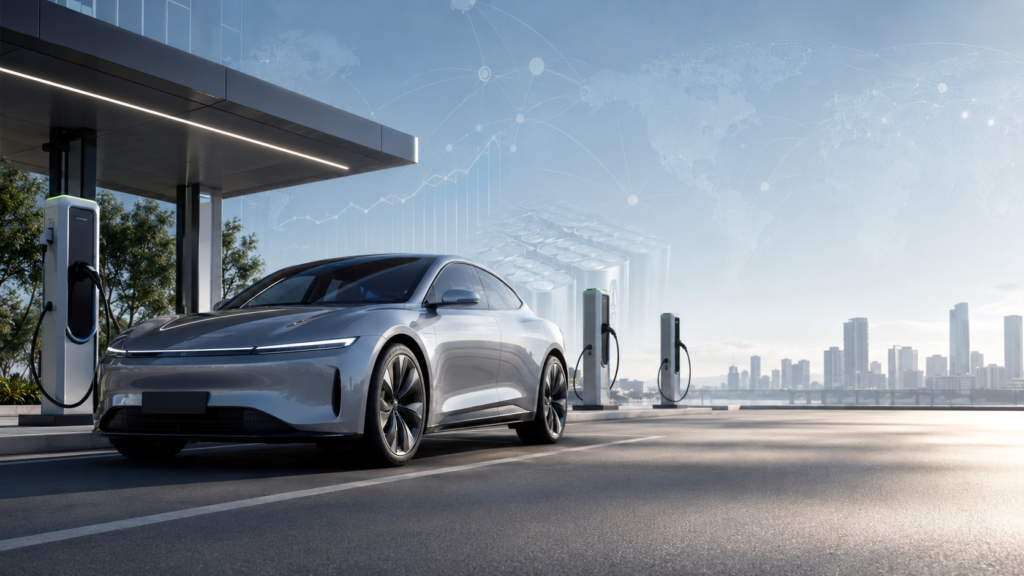
The electric vehicle market is entering a new and more complicated phase in 2026. For years, the story of EVs was a story of hype: bold targets, futuristic concepts, and promises of a fast transition away from gasoline. That story has changed.
Today, the electric vehicle market is shaped by harder questions. How much does a battery cost to build? A driver needs to know if they can find a reliable charging station on a long trip. Buyers wonder whether government incentives will still exist next year. Automakers, meanwhile, are still trying to prove they can make money on EVs at all.
According to the International Energy Agency’s Global EV Outlook 2026, global electric car sales are expected to reach 23 million units this year, accounting for close to 30 percent of all new cars sold worldwide. That is a significant milestone, but the path to get there has not been smooth, and the road ahead is even less certain. Readers should verify the latest figures directly from sources such as the IEA, BloombergNEF, Reuters, and individual automaker earnings reports, since EV market data is updated frequently.
This article breaks down the key trends shaping the electric vehicle market in 2026, from battery prices and charging infrastructure to automaker strategy and regional competition.
Electric Vehicle Market in 2026: Why It Matters Now
2026 is shaping up to be a pivotal year for the electric vehicle market for several overlapping reasons.

First, global competition has intensified. Chinese automakers, led by BYD, have expanded their reach far beyond domestic borders, and Chinese-made EVs now account for a large share of vehicles sold in markets outside China, Europe, and the United States. Western and Asian automakers are responding with their own pricing and product strategies.
Second, consumer demand has matured. Early EV buyers were often enthusiasts willing to pay a premium for new technology. The market is now moving toward mainstream buyers who are more price-sensitive and more focused on practical concerns such as charging access and total ownership cost.
Third, government policy is shifting unevenly across regions. Some governments are expanding incentives, while others, notably the United States, have scaled back support. This divergence is creating very different growth patterns across markets.
Fourth, battery prices remain central to affordability. Lower battery costs, driven partly by the wider use of lithium iron phosphate (LFP) chemistry, are gradually narrowing the price gap between EVs and traditional combustion vehicles.
Finally, emissions pressure has not disappeared. Regulators in Europe and elsewhere continue to tighten CO2 and fuel economy standards, which keeps pushing automakers toward electrification even when short-term sales growth slows.
Taken together, these forces mean that 2026 is less about whether EVs will succeed and more about which companies, regions, and technologies will define the next phase of the transition.
EV Sales Are Growing, But the Market Is Becoming More Complex
Global EV sales are still rising in 2026, but the growth is no longer evenly distributed. Some markets are accelerating quickly, while others are slowing down or even contracting.
Industry data point to a mixed picture in early 2026. Global electric car sales reportedly declined slightly in the first quarter compared with the same period the previous year, largely due to policy-driven slowdowns in China and the United States. Yet this overall figure masks much stronger performance elsewhere.
Reports indicate that:
- European EV sales rose sharply year-on-year in early 2026, supported by reinstated purchase subsidies in some countries.
- Markets across Asia Pacific outside China saw very strong year-on-year growth.
- Latin America also recorded substantial growth in EV sales.
- Dozens of countries logged record-breaking monthly EV sales during the first quarter.
At the same time, the United States has seen a different trend. EV penetration there remains far lower than the global average, weighed down by reduced federal incentives, higher import duties on affordable Chinese models, and continued consumer preference for larger vehicles. Canada has experienced a similar pullback following the end of a rebate program.
What this means: The electric vehicle market is no longer a single global story. It is becoming a set of regional stories, each shaped by local policy, affordability, and infrastructure. Readers should treat any single global statistic with caution and look at regional breakdowns for a clearer picture. All figures here should be verified against the latest IEA, BloombergNEF, or Reuters reporting.
Battery Prices Are Still the Biggest Factor in EV Affordability
If there is one variable that determines whether an electric vehicle is affordable, it is the cost of the battery pack. Batteries remain the single most expensive component in an EV, and battery cost trends ripple directly into vehicle pricing.
Why battery prices matter
A battery pack typically represents a substantial share of an EV’s total manufacturing cost. When battery prices fall, automakers gain room to either lower vehicle prices or improve profit margins. When battery prices rise, due to raw material shortages or supply chain disruptions, that pressure usually gets passed on to buyers.
What’s driving battery costs down
Several factors have contributed to a decline in average battery prices in recent years:
- Wider adoption of LFP (lithium iron phosphate) batteries. LFP chemistry avoids costlier materials like cobalt and nickel, making it cheaper to produce, even though it typically offers somewhat lower energy density than nickel-based chemistries.
- Lower raw material costs. Prices for key battery inputs such as lithium have fluctuated significantly in recent years, and periods of lower raw material costs have helped ease battery pack pricing.
- Manufacturing scale. As battery production has expanded, particularly in China, manufacturers have benefited from economies of scale.
- Vertical integration. Some automakers and battery makers, including CATL and BYD, have invested heavily in controlling more of the supply chain, from raw materials to cell production.
The other side of the equation
Battery prices have not fallen uniformly everywhere, and cost pressures can re-emerge quickly if raw material markets tighten or if trade policies change, such as new tariffs on battery materials or finished cells. Automakers in markets without strong domestic battery supply chains may also face higher costs than competitors in China, where the battery ecosystem is heavily concentrated.
Key terms readers should know: lithium-ion batteries, battery packs, LFP batteries, nickel-cobalt-manganese (NCM) batteries, energy density, raw material supply chains.
Verification note: Specific battery price figures (such as cost per kilowatt-hour) change frequently and should be confirmed through BloombergNEF battery price surveys, IEA reports, or company financial disclosures.
Charging Infrastructure Is Now a Make-or-Break Issue
Battery prices determine whether a buyer can afford an EV. Charging infrastructure often determines whether they are willing to buy one at all.
The charging landscape in 2026
Public charging networks have expanded significantly in recent years, with industry trackers reporting strong year-on-year growth in the number of public charging connectors worldwide. China continues to account for the largest share of new installations, while Europe and the United States have both seen rapid growth in ultra-fast charging connectors.
However, growth in new charger installations is reportedly slowing somewhat compared to prior years, even as overall connector counts keep climbing. This suggests the industry is moving from a rapid build-out phase toward a more measured expansion focused on reliability and coverage gaps.
Why charging access shapes adoption
Charging behavior generally falls into a few categories, each with different infrastructure needs:
- Home charging: The most convenient option for owners with private driveways or garages, but unavailable to many apartment and condo residents.
- Public charging: Essential for urban drivers without home charging access, and highly dependent on local network density and reliability.
- Highway fast charging: Critical for long-distance travel and a frequent pain point when stations are out of service, occupied, or unevenly distributed.
- Workplace and fleet charging: Increasingly important as businesses electrify delivery and service fleets.
The reliability problem
Charger reliability remains an ongoing concern in several markets. Broken connectors, payment system failures, and inconsistent charging speeds can undermine consumer confidence even where charger numbers look strong on paper. This is one reason analysts increasingly emphasize charging reliability rather than just charger count as a true measure of market readiness.
What this means for adoption: A region can have impressive charger statistics and still struggle with EV adoption if drivers do not trust the network to work when they need it. Apartment dwellers and renters, in particular, remain an underserved segment in many markets.
Verification note: Charger counts, growth rates, and reliability statistics vary by source and update frequently. Readers should consult BloombergNEF’s Electric Vehicle Outlook, the IEA’s Global EV Outlook, or national charging infrastructure agencies for current figures.
Automakers Are Rethinking Their EV Strategies
Competition among automakers has intensified, and strategies are diverging rather than converging.
- Tesla remains a globally recognized EV brand with substantial production volume, but it no longer holds the singular market dominance it once did, as more competitors enter the field with a wider range of models and price points.
- BYD has expanded aggressively, leveraging vertical integration across batteries and vehicles, along with a broad lineup spanning affordable to premium segments, including plug-in hybrids.
- Toyota has pursued a more diversified approach, balancing hybrid vehicles alongside a more gradual battery-electric rollout.
- Hyundai and Kia continue to expand their EV lineups while also investing in hybrid technology as a bridge for markets not yet ready for full electrification.
- Ford and General Motors have adjusted EV investment timelines in response to demand shifts, while also expanding into battery and energy storage businesses.
- Volkswagen continues to invest in EV platforms across its brand portfolio while navigating cost pressures and competition from lower-priced Chinese models.
- BMW and Mercedes-Benz have generally pursued a premium-focused EV strategy alongside continued investment in plug-in hybrids.
- Nissan, an early EV pioneer, continues to refine its electric lineup amid intensifying global competition.
What this means: No single strategy has emerged as the clear winner. Some automakers are betting on hybrids as a transitional technology, others are pushing further into pure battery-electric vehicles, and others are diversifying across both. This divergence reflects genuine uncertainty about how fast different markets will electrify, not a lack of commitment to EVs.
Verification note: Automaker strategies, production numbers, and sales figures should be confirmed through official company earnings reports and reputable financial and trade press such as Reuters and Bloomberg.
China, Europe, and the United States Are Driving Different EV Trends
The global EV market is increasingly defined by three very different regional trajectories, plus a fast-growing group of emerging markets.
China
China remains the world’s largest EV market and manufacturing hub by a wide margin. Reports indicate China accounts for the majority of global EV sales and a very large share of global battery cell production, with companies like CATL and BYD playing central roles in the battery supply chain. China has also become a major EV exporter, shipping vehicles to markets across Asia, Latin America, and parts of Europe.
Europe
Europe has emerged as a high-growth market, supported by strict emissions regulations and, in some countries, reinstated purchase incentives. Sales growth in early 2026 reportedly outpaced China on a percentage basis in several reports, even though China’s absolute sales volume remains far larger. Charging infrastructure expansion, particularly fast charging along highways, continues to be a policy priority across the European Union.
United States
The U.S. market presents a more complicated picture. EV penetration remains considerably lower than the global average, and reduced federal incentives, along with high tariffs on Chinese-made EVs, have limited access to some of the most affordable models available elsewhere in the world. American consumer preference for larger vehicles, such as trucks and SUVs, has also shaped which EV models perform best domestically.
Emerging markets
Markets across Southeast Asia, Latin America, and parts of South Asia have shown some of the fastest percentage growth rates in the world, often supported by imported or locally assembled Chinese vehicles, as well as domestic manufacturers in countries like Vietnam. Price sensitivity remains a defining factor, and affordable models, including electric two- and three-wheelers, often see faster adoption than passenger cars in these regions.
What this means: There is no longer one global EV market story. There are several regional stories moving at different speeds, shaped by different policies, price points, and infrastructure realities.
Verification note: Regional sales shares and growth rates should be verified through the IEA Global EV Outlook, BloombergNEF, and national automotive associations such as ACEA in Europe.
EV Buyers Are Looking Beyond Range
For years, range anxiety dominated conversations about electric vehicles. That concern has not disappeared, but buyer priorities have broadened considerably.
Today’s EV shoppers are weighing a wider set of factors:
- Charging speed: How long it takes to add meaningful range, not just total range on a full charge.
- Battery warranty: Coverage length and degradation guarantees, since battery health affects long-term value.
- Resale value: A growing concern as more used EVs enter the secondary market and early buyers look to upgrade.
- Repair costs: Including the cost and availability of replacement batteries and specialized service.
- Software updates: As vehicles become more software-defined, the quality and frequency of updates increasingly factor into the ownership experience.
- Safety ratings: Standard considerations that apply across all vehicle types, EV or otherwise.
- Upfront price: Still the most significant barrier for mass-market buyers.
- Total cost of ownership: A combination of purchase price, charging costs, maintenance, insurance, and resale value.
What this means: The EV buying decision has matured from a single-issue question about range into a multi-factor evaluation similar to how buyers assess traditional vehicles. This shift reflects a market moving from early adopters toward mainstream consumers.
Solid-State Batteries and New Battery Tech Could Shape the Next Phase
Beyond near-term price trends, several emerging battery technologies could influence the EV market’s longer-term trajectory. It is important to approach these technologies with measured expectations rather than hype.
Solid-state batteries
Solid-state batteries replace the liquid electrolyte found in conventional lithium-ion batteries with a solid material. In theory, this could enable higher energy density, faster charging, and improved safety. Several automakers and battery makers have announced testing and pilot programs, but mass-market commercial deployment at scale remains a work in progress, and timelines should be treated cautiously.
Sodium-ion batteries
Sodium-ion technology offers a potentially cheaper alternative to lithium-based chemistries, since sodium is more abundant than lithium. Energy density is generally lower than lithium-ion, which may make sodium-ion better suited to certain vehicle segments or stationary storage applications rather than long-range passenger EVs.
LFP batteries
As noted earlier, LFP batteries have already become mainstream in cost-conscious EV segments due to their lower material costs, even though they typically trade off some energy density compared to nickel-based chemistries.
Battery recycling
As the first large wave of EV batteries approaches end-of-life, recycling is gaining attention as both an environmental necessity and a potential source of recovered raw materials. A mature battery recycling industry could eventually ease pressure on raw material supply chains, though this industry is still developing.
What this means: None of these technologies are likely to transform the EV market overnight. They represent incremental and parallel paths toward cheaper, safer, and more sustainable batteries over the coming years, rather than a single breakthrough moment.
Verification note: Battery technology timelines and claims should be verified against peer-reviewed research, company technical disclosures, and reporting from established technology and energy publications.
Key Challenges Facing the Electric Vehicle Market
- High upfront prices remain a barrier for many mass-market buyers, despite gradual declines.
- Charging gaps, particularly for apartment dwellers, rural drivers, and long-distance travelers.
- Battery raw material supply risks, including geographic concentration of mining and processing.
- Grid pressure is rising as rising EV electricity demand requires significant investment in grid capacity and management.
- Consumer hesitation is driven by unfamiliarity, charging concerns, or skepticism about resale value.
- Repair costs, including higher insurance premiums in some markets tied to battery and component replacement costs.
- Policy uncertainty, as incentive programs shift or expire across different countries and election cycles.
- Competition from hybrid vehicles, which offer some emissions benefits without requiring a full shift to charging infrastructure.
Key Opportunities in the EV Market
- Cheaper batteries, driven by LFP adoption, manufacturing scale, and potential new chemistries.
- Better charging networks, as investment continues in fast charging and reliability improvements.
- More affordable EV models, as automakers target mass-market price points rather than only premium segments.
- Stronger competition, which tends to drive innovation and pricing pressure in favor of consumers.
- Fleet electrification, including commercial vans, trucks, and ride-hailing fleets, which can adopt EVs at scale with predictable usage patterns.
- Battery recycling, which could ease raw material constraints over time.
- Government incentives, where they remain in place or expand, continuing to lower the effective cost of EV ownership.
- Software-defined vehicles, which can generate new revenue streams for automakers through over-the-air updates and connected services.
Electric Vehicle Market Trends to Watch in 2026
| Trend | Why It Matters | Who It Affects |
| Battery price competition | Lower battery costs directly reduce EV sticker prices and improve automaker margins | Buyers, automakers, battery suppliers |
| Charging network expansion | More chargers reduce range anxiety and support adoption beyond early adopters | Drivers, charging companies, utilities |
| Affordable EV models | Mass-market pricing is essential to move EVs beyond premium buyers | First-time EV buyers, automakers |
| Hybrid vs. EV debate | Some automakers are leaning on hybrids as a bridge technology, affecting EV growth pace | Automakers, policymakers, consumers |
| China’s EV export growth | Chinese exports are reshaping competitive dynamics in markets outside China | Global automakers, importing countries |
| Automaker cost-cutting | Margin pressure is pushing automakers to redesign EV platforms for efficiency | Automakers, suppliers, investors |
| Battery recycling | Recovered materials could ease long-term raw material supply pressure | Battery makers, automakers, environment |
| Solid-state battery testing | Could eventually improve range, charging speed, and safety, though timelines are uncertain | Automakers, battery developers |
| Public charging reliability | Trust in charging networks is becoming as important as charger count | Drivers, charging network operators |
| Government incentive changes | Shifting subsidies can accelerate or slow EV adoption rapidly in a given market | Buyers, automakers, policymakers |
What This Means for Drivers
For everyday consumers, these trends translate into a few practical realities.
Vehicle prices for EVs are likely to keep gradually narrowing the gap with comparable gasoline vehicles in many markets, though the pace will vary by region and depend heavily on incentive availability. Charging convenience will continue to depend heavily on where a driver lives. Urban apartment dwellers and rural drivers may continue to face more friction than suburban homeowners with driveway access.
Maintenance costs for EVs are generally lower than for combustion vehicles due to fewer moving parts, though battery-related repairs, when needed, can be expensive. Range is becoming less of a concern for most daily driving needs as battery technology improves, but long-distance travel still depends on charging network reliability.
Insurance costs for EVs have, in some markets, run higher than for comparable combustion vehicles, partly reflecting battery and component replacement costs. Buying decisions increasingly require comparing total cost of ownership rather than just the sticker price, factoring in fuel or electricity savings, maintenance, insurance, and resale value.
What This Means for Automakers and Investors
At an industry level, the trends outlined above carry significant implications.
Profit margins on EVs remain under pressure for many automakers, particularly outside China, where battery supply chains are less vertically integrated. Supply chain strategy, including securing battery materials and manufacturing capacity, has become a core competitive differentiator rather than a back-office concern.
Competition is intensifying not just on price but on software, charging partnerships, and brand trust. Battery partnerships and joint ventures, between automakers and battery makers, are becoming increasingly common as companies seek to control costs and supply security. Charging partnerships, including cross-brand charging network access agreements, are reshaping how automakers differentiate their ownership experience.
Software revenue, including subscription features and over-the-air updates, represents a growing area of interest for automakers looking to build recurring revenue streams beyond the initial vehicle sale. Investors are likely to continue scrutinizing which automakers can balance EV investment with near-term profitability, rather than rewarding growth and market share alone.
Fresh Global News Analysis: The Bigger Picture
The electric vehicle market is moving from a phase defined by early adoption and ambition into a phase defined by mainstream competition and operational discipline.
In the early years of EV growth, success was often measured by headlines, model announcements, and sales growth percentages. Increasingly, success is being measured by more grounded metrics: can a company produce EVs profitably, can it secure a reliable battery supply, can it offer charging access that customers actually trust, and can it retain buyer confidence through resale value and reliability.
The companies most likely to thrive in this next phase will probably be those that can combine several capabilities at once, rather than excelling at just one. Affordable pricing, without battery reliability and charging access to back it up, may not be enough to win long-term loyalty. Likewise, advanced technology, without a realistic price point, may struggle to reach mass-market buyers.
Regional divergence is likely to remain a defining feature of the market rather than a temporary phase. China, Europe, the United States, and emerging markets are operating under different policy environments, different infrastructure realities, and different consumer preferences. A strategy that works in one region may not translate directly to another.
This does not mean the EV transition is stalling. Global sales volumes continue to set records even amid uneven regional performance. It means the transition is becoming more nuanced, more competitive, and more dependent on execution rather than ambition alone.
Key Takeaways
- Global EV sales are still growing in 2026, but growth is increasingly uneven across regions, with some markets accelerating sharply while others slow down.
- Battery prices, particularly the wider adoption of LFP chemistry, remain the single biggest factor influencing EV affordability.
- Charging infrastructure reliability is becoming just as important as the raw number of available chargers.
- Automakers are pursuing diverging strategies, with some emphasizing hybrids as a bridge technology and others pushing further into battery-electric vehicles.
- China, Europe, and the United States are following distinctly different EV growth trajectories, shaped by policy, affordability, and infrastructure.
- EV buyers increasingly evaluate vehicles on charging speed, warranty, resale value, and total cost of ownership, not range alone.
- Emerging battery technologies, including solid-state and sodium-ion batteries, may improve EVs over time, but mass deployment timelines remain uncertain.
- The next phase of the EV market is likely to reward companies that combine affordability, reliable batteries, charging access, and consumer trust, rather than any single advantage alone.
Conclusion
The electric vehicle market in 2026 is no longer defined by a simple question of whether EVs will succeed. The data, drawn from sources such as the IEA and BloombergNEF, makes clear that global EV adoption continues to set records even amid regional slowdowns and policy shifts.
The more pressing question now is which companies, which countries, and which technologies will shape the next era of electric mobility. Battery costs, charging reliability, automaker strategy, and government policy are all moving pieces in a market that has matured well beyond its early hype cycle.
For drivers, automakers, and investors alike, the electric vehicle market in 2026 demands a closer, more nuanced look than the broad headlines often provide. Fresh Global News will continue tracking these developments as the year unfolds.
All statistics referenced in this article should be independently verified through primary sources such as the International Energy Agency (IEA), BloombergNEF, Reuters, official automaker earnings reports, and relevant government energy departments, as EV market data updates frequently.
Frequently Asked Questions
Q1. What is the electric vehicle market?
The electric vehicle market refers to the global industry surrounding the production, sale, and use of vehicles powered partly or entirely by electricity, including battery electric vehicles (BEVs) and plug-in hybrid electric vehicles (PHEVs). It encompasses automakers, battery suppliers, charging infrastructure providers, and related policy and regulatory frameworks.
Q2. Why is the electric vehicle market important in 2026?
2026 is significant because EV adoption has moved past the early adopter phase into mainstream competition, with regional markets diverging sharply based on policy support, battery costs, and charging infrastructure. How automakers and governments respond this year will likely shape the pace of the global transition for years to come.
Q3. Are EV battery prices falling?
Battery prices have generally trended downward in recent years, helped by wider adoption of LFP chemistry and lower raw material costs, though prices can fluctuate based on material markets and trade policy. Readers should consult sources such as BloombergNEF’s battery price surveys for current figures.
Q4. Why is charging infrastructure important for EV growth?
Charging access and reliability directly influence whether consumers feel confident buying an EV, particularly for drivers without home charging options. Even strong charger growth numbers can fail to drive adoption if networks are unreliable or unevenly distributed.
Q5. Which countries are leading the EV market?
China currently leads the EV market by sales volume and battery manufacturing capacity, with Europe showing strong percentage growth and the United States lagging behind the global adoption rate. Emerging markets in Southeast Asia and Latin America are also growing rapidly. Current rankings should be verified through the IEA’s Global EV Outlook.
Q6. What are the biggest challenges for electric vehicles in 2026?
Key challenges include high upfront prices for many buyers, charging infrastructure gaps, battery raw material supply risks, grid capacity pressure, policy uncertainty, and competition from hybrid vehicles in markets not yet ready for full electrification.