



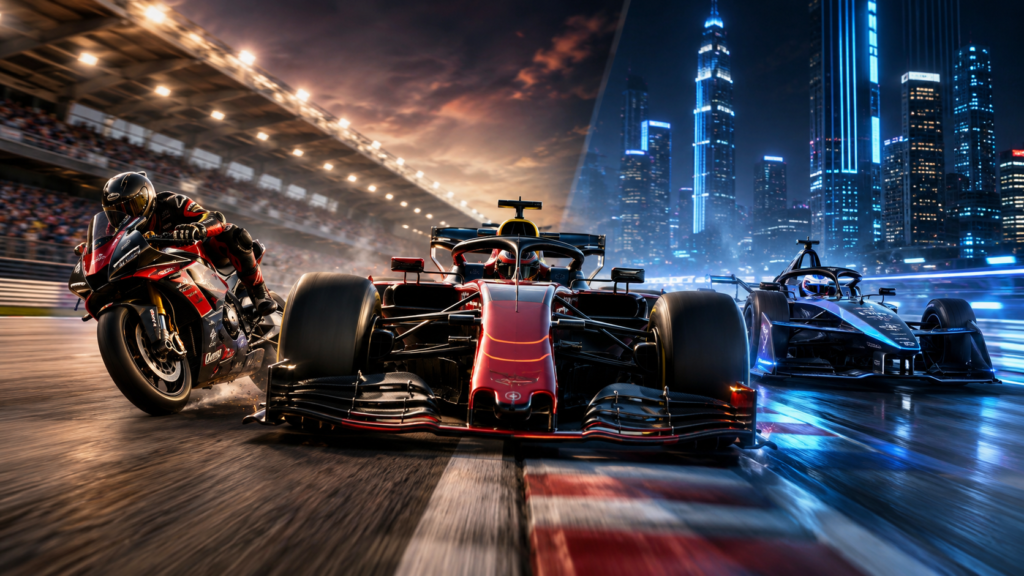
Motorsports racing is heading into one of its most transformative stretches in years. In one week, Formula 1, MotoGP, and Formula E confirmed major changes. These updates could reshape racing for seasons to come.
Formula 1’s governing body has approved technical and testing changes aimed at improving the quality of racing. MotoGP has confirmed a major rider move. Double champion Francesco Bagnaia will leave Ducati for Aprilia. And Formula E has unveiled its next-generation Gen4 car, a new sprint race format, and its largest-ever calendar.
Together, these developments show a clear shift. Motorsports racing is becoming more technical, more competitive, and more global.
Formula 1: New Rules to Fix Racing Concerns
The FIA’s World Motor Sport Council met in Macau. It approved several Formula 1 regulation changes after drivers and teams raised concerns early in the 2026 season.
Extra Pre-Season Testing From 2027
Teams currently get three days of pre-season testing. That allocation will increase to four days from 2027, with the FIA citing the complexity of the new generation of Formula 1 cars and power units introduced under the 2026 regulations.

Engine Rules Rebalanced for 2027 and 2028
The World Motor Sport Council also ratified engine rule changes for 2027 and 2028. The updates adjust engine output, fuel energy flow, energy recovery deployment, and energy management flexibility.
The power unit balance will move away from a 50:50 split between the combustion engine and battery. By 2028, it will shift closer to 60:40, with more focus on efficiency and sustainable performance.
Why the Changes Were Needed
The revisions followed concerns from drivers and teams early in the 2026 season. Several drivers said the new power units required too much energy management. They argued this forced more lifting and coasting, which made some racing situations feel artificial.
FIA President Mohammed Ben Sulayem said the process of refining the regulations does not stop once new cars hit the track. “As with every major regulatory change, the process does not end when the cars first take to the track. Continuous dialogue and collaboration are essential to ensuring that the regulations meet the needs of the sport, its drivers, and its fans.”
What it means: These changes signal that F1 is willing to adjust its rules mid-cycle rather than waiting years to fix problems. For fans, it should mean less artificial energy-saving and more genuine wheel-to-wheel racing from 2027 onward. Readers should check the official Formula 1 and FIA websites for any further technical updates, as details can continue to evolve.
MotoGP: Bagnaia’s Move to Aprilia Reshapes the Grid
MotoGP’s rider market has delivered one of its most significant shake-ups in years.
Bagnaia Leaves Ducati for Aprilia
Francesco Bagnaia will officially leave the factory Ducati squad at the end of the 2026 MotoGP season and join rival Aprilia from 2027. The two-time MotoGP champion has signed a four-year contract with Aprilia, running through the 2030 season.
Bagnaia will partner with Marco Bezzecchi at Aprilia, forming an all-Italian rider line-up for the Noale-based manufacturer. He replaces Jorge Martin, who is moving to Yamaha for 2027.
Acosta Steps Into Bagnaia’s Old Seat
Bagnaia is expected to be replaced at Ducati by KTM rider Pedro Acosta, who will become Marc Marquez’s teammate from 2027.
Why This Move Matters
Bagnaia ends his Ducati partnership having won the 2022 and 2023 riders’ titles, but he has been second-best to Marquez since the Spaniard joined the factory team in 2025. Meanwhile, Aprilia has leapfrogged Ducati in the 2026 standings, led by Bezzecchi and Martin.
The timing also overlaps with a bigger shift in the sport. The 2027 MotoGP season will bring sweeping technical regulation changes, including a move to 850cc engines, and Bagnaia’s switch arrives as Aprilia looks to lead that transition.
What it means: Bagnaia’s move changes the balance between Ducati, Aprilia, KTM, and the rest of the MotoGP grid. It comes as the series heads into a new technical era.
Ducati’s factory team will also have no Italian rider for the first time in over a decade. Aprilia, meanwhile, is building an all-Italian project around two of the sport’s biggest names.
Fans should follow official team and MotoGP statements for final confirmation of the remaining 2027 seats.
Formula E: The Gen4 Era Begins
Formula E is preparing for what it describes as its biggest season yet, built around a new generation of cars and a reworked race format.
A Faster, More Powerful Car
The new GEN4 car will produce 600 kW, equivalent to more than 815 horsepower, and will feature active all-wheel drive, an active differential, dual aerodynamic configurations, and next-generation regenerative braking. The car has a top speed of 208mph and is 87kg heavier than its predecessor.
A New “E-Prix Unleashed” Format
Formula E’s traditional E-Prix format will last 45 minutes. It will continue to focus on energy management, strategy, and Pit Boost.
The new E-Prix Unleashed format will run for 30 minutes. It will work as a sprint race designed to show the full performance of the Gen4 cars without Pit Boost.
Eight double-header events will feature both formats on the same weekend. These events will take place in Jeddah, Monaco, Berlin, Zandvoort, Brands Hatch, Jarama, Shanghai, and Tokyo.
A Record-Breaking Calendar
Formula E and the FIA have announced a 21-race calendar across 13 global cities for the 2026-27 season, the series’s most expansive yet. New additions include the Circuit of The Americas in Austin and Zandvoort Circuit in the Netherlands, alongside a new home for the London E-Prix at Brands Hatch.
The season opens with a night-time double-header in Jeddah, Saudi Arabia, on December 18 and 19, 2026.
| Formula E 2026-27 Highlights | Detail |
| Total Races | 21 races across 13 cities |
| Season Opener | Jeddah, Saudi Arabia (Dec 18-19, 2026) |
| New Venues | Austin (COTA), Zandvoort, Brands Hatch (London) |
| Gen4 Power Output | 600 kW (815+ hp) |
| E-Prix (Standard) | 45 minutes, energy management focus |
| E-Prix Unleashed (Sprint) | 30 minutes, performance focus |
| Double-Header Locations | Jeddah, Monaco, Berlin, Zandvoort, Brands Hatch, Jarama, Shanghai, Tokyo |
Why This Could Help Electric Racing Grow
A faster car, a sprint-style format, and a bigger calendar are all designed to widen Formula E’s audience. FIA Circuit Sport Department Director Marek Nawarecki said the sporting regulations were adapted in partnership with Formula E and competitors specifically to highlight the Gen4 car’s performance.
By combining a strategic 45-minute race with a high-speed 30-minute sprint on the same weekend, Formula E is offering two very different viewing experiences, one for fans who enjoy tactical racing, and one for fans who want raw speed. Race events are also grouped by continent across the Americas, Europe, and the Asia Pacific to reduce freight mileage and emissions.
What it means: Formula E’s Gen4 era is a deliberate attempt to close the performance gap with traditional motorsport while keeping its sustainability identity intact. A bigger calendar and a new sprint format could help the series reach more fans, particularly younger viewers drawn to faster, shorter racing formats. Readers should check Formula E’s official website for confirmed race times and any calendar adjustments closer to the season.
Fresh Global News Analysis
What stands out across Formula 1, MotoGP, and Formula E is that none of these changes are happening in isolation. Each series is responding to the same underlying pressures: fans and drivers want racing that feels genuine, manufacturers want technical platforms that support their long-term goals, and championships want formats that travel well on broadcast and social media.
Formula 1’s rule adjustments show a willingness to listen to driver feedback mid-cycle rather than waiting for a full regulation reset. MotoGP’s rider market, headlined by Bagnaia’s move to Aprilia, demonstrates how quickly the competitive order can shift even among the sport’s most established names. Formula E’s Gen4 launch reflects a broader push by electric racing to prove it can deliver both technical sophistication and entertainment value.
For motorsports racing as a whole, the combined effect is a sport that is becoming more competitive across multiple disciplines at once, more commercially ambitious through expanded calendars and new formats, and increasingly focused on attracting younger, global audiences who consume sport differently than previous generations.
What It Means for Fans, Teams, and the Industry
- Fans: More competitive racing across F1, MotoGP, and Formula E, plus new formats designed to be easier to follow and more exciting to watch.
- Drivers and riders: Clearer rules in F1 after early-season complaints, and a reshaped MotoGP grid with new team dynamics from 2027.
- Teams and manufacturers: Ducati, Aprilia, and KTM enter a new MotoGP technical era with a different rider lineup, while Formula E manufacturers adapt to the more powerful Gen4 platform.
- Sponsors and broadcasters: A bigger Formula E calendar and new sprint format offer more content and broadcast windows, while MotoGP’s rider drama provides strong storylines heading into 2027.
- The sport’s future: All three series are positioning themselves for a more technical, more competitive, and more globally accessible next decade of motorsports racing.
Key Takeaways
- Formula 1 will expand pre-season testing to four days from 2027 and rebalance its engine rules following driver concerns about excessive energy management.
- MotoGP’s 2027 grid will look different after Francesco Bagnaia’s move from Ducati to Aprilia, with Pedro Acosta replacing him at Ducati.
- Formula E’s Gen4 era begins in the 2026-27 season with a more powerful car, a new “E-Prix Unleashed” sprint format, and a record 21-race calendar.
- All three series are adjusting rules, rosters, or formats in response to fan and competitor feedback.
- Readers should follow official F1, FIA, MotoGP, and Formula E channels for the latest confirmed details, as some elements may still evolve.
Conclusion
Motorsports racing is clearly entering a new competitive cycle. Formula 1 is refining its technical rules to improve the on-track product, MotoGP is reshaping its rider market ahead of a major regulation change, and Formula E is preparing its most ambitious season yet with the Gen4 car. Together, these shifts point toward a future where motorsports racing is faster, more closely contested, and more accessible to fans around the world. As these stories continue to develop, Fresh Global News will keep tracking the official updates from F1, MotoGP, and Formula E.
Frequently Asked Questions
Q1. Why is motorsports racing changing now?
F1, MotoGP, and Formula E are each responding to feedback from drivers, riders, and fans, while also preparing for new technical regulations that arrive in the next two seasons. The result is a wave of changes across motorsports racing happening at the same time.
Q2. What Formula 1 changes are coming?
Pre-season testing will expand from three to four days starting in 2027, and the FIA has approved changes to rebalance engine output between the internal combustion engine and the energy recovery system across 2027 and 2028.
Q3. How will MotoGP riders’ moves affect the sport?
Francesco Bagnaia’s move from Ducati to Aprilia changes the competitive picture among MotoGP’s top manufacturers, while Pedro Acosta’s move to Ducati alongside Marc Marquez creates a new factory pairing from 2027.
Q4. What is Formula E’s Gen4 era?
Gen4 is Formula E’s next-generation car, offering significantly more power and performance than its predecessor. It launches in the 2026-27 season alongside a new race format and an expanded calendar.
Q5. Why does Formula E’s new race format matter?
The new “E-Prix Unleashed” sprint format is designed to showcase the Gen4 car’s full performance, complementing the traditional 45-minute E-Prix format that focuses on strategy and energy management.
Q6. What does this mean for racing fans?
Fans can expect more competitive and varied racing across Formula 1, MotoGP, and Formula E, with new formats and rule changes aimed at making motorsports racing more exciting and accessible.