



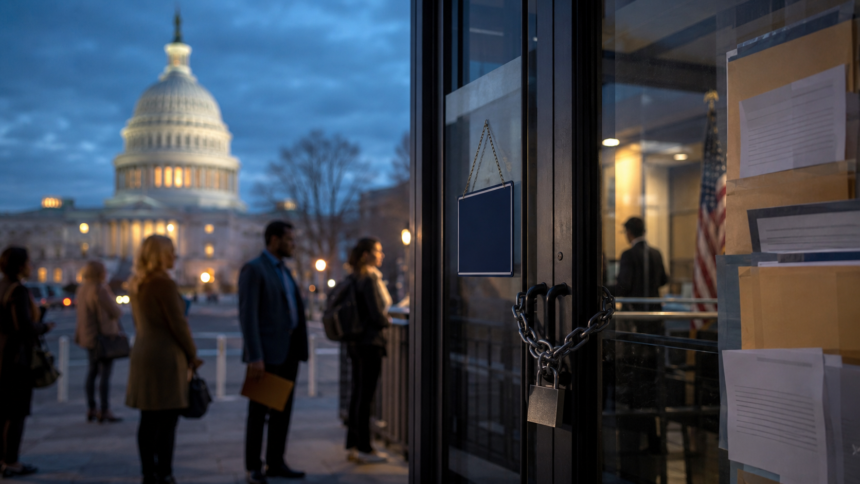
A government shutdown occurs when Congress and the president fail to approve funding for federal agencies on time. When that funding lapses, parts of the government cannot legally continue spending money as they normally do, setting off a chain of changes across the country.
For most people, the term sounds bigger and scarier than what actually happens. A shutdown does not mean every office goes dark or every worker stays home. It means certain operations pause, certain services slow down, and certain federal employees face real uncertainty about their next paycheck. The effects can reach national parks, passport offices, airports, small business lending, and federal research, depending on how long the shutdown lasts and which agencies lose funding.
This guide breaks down what a shutdown actually means, why it happens, what tends to close, what usually keeps running, and how ordinary citizens can prepare if one occurs.
Key Takeaways
- A government shutdown happens when federal agencies lose approved funding because Congress and the president did not agree on a spending bill.
- Shutdowns usually happen due to disagreements over spending levels, policy riders, or funding deadlines in Congress.
- Many public-facing services may close, slow down, or face delays, including parks, permits, and some applications.
- Essential services tied to safety, security, and mandatory benefit programs usually continue, though staffing can be affected.
- Shutdowns matter because they create real disruption for federal workers, contractors, and citizens who rely on government services.
What Is a Government Shutdown?
A government shutdown happens when federal agencies do not receive approved funding from Congress and the president before the start of a new budget period. The U.S. government runs on annual funding bills, often called appropriations bills, that are supposed to be passed each year to keep agencies operating.
When Congress and the president cannot agree on these funding bills by the deadline, many federal agencies lose the legal authority to spend money on regular operations. That is what people mean when they talk about a shutdown.

It is important to understand that the government does not fully stop. Federal law treats some functions as essential, particularly those tied to public safety, national security, and the protection of life and property. These functions usually continue even without new funding. Many other functions, considered nonessential in a strict budget sense, can pause until funding is restored.
Why Does the Government Shut Down?
Government shutdowns are tied directly to how federal funding works. Congress is responsible for passing spending bills that fund federal agencies for the coming year. The president must then sign those bills into law.
When lawmakers disagree on spending levels, attach policy conditions to a bill, or simply run out of time before a deadline, funding can lapse. This disagreement can happen for many reasons, including disputes between political parties, disagreements within the same party, or disputes between Congress and the White House over priorities.
To avoid a lapse, Congress sometimes passes what is called a continuing resolution. A continuing resolution is a temporary funding bill that keeps agencies running at existing funding levels for a short period while lawmakers continue negotiating a longer-term deal. If no continuing resolution and no full-year funding bill are passed in time, agencies must begin shutdown procedures.
What Happens When Agencies Close?
Once funding lapses, federal agencies follow shutdown plans that were prepared in advance. These plans vary by agency, but some patterns are common.
Some federal offices stop serving the public entirely. Others remain open but operate with fewer staff members and limited services. Agencies furlough many employees, which means those employees cannot work and do not receive pay until Congress and the president restore funding. Agencies also require some employees, especially those in essential roles, to keep working, sometimes without immediate pay.
During a shutdown, agencies may stop updating government websites and online portals regularly because they may furlough the staff who maintain them. As a result, applications, permits, and administrative processes can slow down when agencies operate with reduced staff. Public-facing offices, including some regional and local federal offices, may reduce their hours or stop operations until the shutdown ends.
The exact scope of closures depends on which agencies are affected and how each agency has planned for a funding lapse.
Which Government Services Usually Continue?
Some government functions continue during a shutdown because they are considered essential for public safety, national security, or the protection of life and property. It is worth noting that these services usually continue, but staffing levels and possible delays can vary depending on the agency and its specific shutdown plan.
Services that typically continue include:
- Military operations, since national defense is treated as essential
- Border security operations
- Air traffic control, to maintain aviation safety
- TSA airport screening, though wait times may increase if staffing is strained
- Federal law enforcement activities
- Emergency medical care at federal facilities
- Social Security payments, which are funded outside the annual appropriations process
- Medicare and Medicaid payments
- Mail delivery, since the U.S. Postal Service is funded separately from general government appropriations
- Some veterans services, particularly those tied to health care and benefits
Even within these categories, individual experiences can differ. A long shutdown can put more strain on essential staff who are working without pay, which may show up as longer wait times rather than a full stop in service.
Which Services Can Slow Down or Close?
Shutdown rules allow many nonessential government functions to pause or slow down significantly. As a result, citizens often notice the most visible effects in public-facing services.
National parks may close entirely or operate with reduced services because agencies furlough many park staff. Passport processing may slow down if the State Department reduces staffing in affected offices. Agencies may also delay federal permits and applications, including some business and environmental permits.
Small business loans backed by federal agencies may pause if the agency overseeing them loses funding. Food safety inspections may slow down depending on how each shutdown plan prioritizes inspection staff. Federal research projects, including work funded through agencies like the National Institutes of Health or the National Science Foundation, may also stop or slow down.
Some immigration services may slow down depending on whether annual appropriations or application fees support them. However, fee-funded services sometimes continue longer than others. Customer service at many federal agencies may also slow down as call centers and help desks operate with reduced staff.
What Happens to Federal Employees?
Federal employees often feel the direct impact of a shutdown first, although the effect depends on each worker’s role.
Agencies furlough some employees, which means those workers cannot work and do not receive a paycheck during the shutdown. Meanwhile, agencies require others, especially employees in safety or essential operations, to keep working even though they may receive their regular pay only after the shutdown ends.
Federal law generally gives employees back pay after Congress and the president restore funding. As a result, employees usually receive the wages they missed. However, the gap between paychecks can still create real financial stress for families that depend on steady income.
Contract workers face a different and often more uncertain situation. Unlike federal employees, contractors do not always receive back pay. Therefore, a shutdown can create a more lasting financial impact on people who work for companies that provide services to the government.
Government Shutdown Impact on Citizens
Beyond federal workers, a shutdown can ripple out into daily life for many Americans, even those who do not work for the government.
Travel delays may increase if airport staffing becomes strained, particularly with TSA agents and air traffic controllers working without immediate pay. National parks and federally run museums may close or reduce hours, affecting travel plans and tourism in nearby communities. Government paperwork, from permits to certain federal applications, may take longer to process.
Loan approvals tied to federal programs may slow down, which can affect small businesses and individuals waiting on approvals. Some public services may see longer wait times simply because fewer staff are available to handle requests. People who depend on certain federal services for daily needs may face uncertainty about when normal operations will resume.
The overall effect tends to grow the longer a shutdown lasts, since short lapses of a day or two are often barely noticeable to the public, while longer ones create more visible disruption.
Does a Shutdown Affect Social Security, Medicare or Veterans Benefits?
This is one of the most common questions during any shutdown, and the direct answer is reassuring for most beneficiaries.
Social Security, Medicare, Medicaid, and many veterans benefits usually continue during a government shutdown because separate laws fund these programs differently from annual agency budgets. In fact, officials often call them mandatory spending programs because their funding comes from separate law, not the yearly appropriations process that causes shutdowns.
However, this does not mean every part of these programs runs exactly as normal. Customer service lines may have longer wait times. Benefit verification letters may take longer to process. New applications for benefits may face delays if the staff who handle them are furloughed. During a long shutdown, it is reasonable to expect some administrative slowdown even while the core payments continue.
How Long Can a Government Shutdown Last?
There is no fixed length for a government shutdown. It can last a matter of hours, a few days, several weeks, or longer, depending entirely on how quickly Congress and the president reach an agreement.
A shutdown ends when Congress passes a funding bill, whether that is a continuing resolution or a full-year appropriations bill, and the president signs it into law. Until that happens, the funding lapse continues.
Generally speaking, the longer a shutdown lasts, the more visible its effects become. A short lapse might pass with minimal public disruption, while a shutdown stretching into weeks tends to create mounting pressure on federal workers, contractors, and the public services people rely on.
Who Is Responsible for Ending a Shutdown?
Ending a shutdown requires action from both Congress and the president. The House of Representatives and the Senate must each pass funding legislation, and then the president must sign it into law.
Responsibility for resolving a shutdown depends on the specific political dispute at hand, which party controls each chamber of Congress and the White House at the time, and the particular funding or policy issue causing the disagreement. Because control of government can shift between parties, and because shutdowns have happened under both Democratic and Republican administrations, it is not accurate to assign blame to one side as a general rule. Each shutdown has its own specific causes and negotiating dynamics.
Government Shutdown vs Debt Ceiling
People sometimes confuse a government shutdown with a debt ceiling crisis, but the two issues are different, even though both can create economic uncertainty.
A government shutdown is about whether Congress has approved spending for federal agencies to operate. It is a funding and appropriations issue.
The debt ceiling, on the other hand, is about the government’s legal ability to borrow money to pay for spending that Congress has already approved. If Congress does not raise or suspend the debt ceiling in time, the government could struggle to pay obligations it has already committed to. As a result, a debt ceiling crisis can create a separate and generally more severe financial risk than a typical shutdown.
While a shutdown and a debt ceiling standoff can happen independently of each other, both situations stem from disagreements in Washington over fiscal policy, and both can affect public confidence in how the government manages its finances.
Why Government Shutdowns Matter
Government shutdowns matter well beyond the federal workforce. They affect workers who depend on steady paychecks, and they affect the millions of people who rely on public services every day. They create uncertainty for citizens trying to plan travel, apply for benefits, or move forward with paperwork that depends on a federal agency.
Shutdowns can also damage public trust in government, particularly when they happen repeatedly or stretch on for extended periods. Economists have noted that shutdowns can slow certain parts of the economy, since furloughed workers spend less and delayed government contracts can affect private businesses that work with federal agencies.
For agencies themselves, a shutdown interrupts long-term planning and can create backlogs that take time to clear even after funding is restored. For families connected to federal employment, whether directly or through contract work, the financial stress of an unpredictable shutdown timeline can be significant.
How Citizens Can Prepare During a Shutdown
While most people cannot control whether a shutdown happens, there are practical steps that can reduce the impact on personal plans.
- Check official agency updates regularly, since shutdown plans and timelines can change.
- Confirm travel plans in advance, especially flights and visits to national parks or federal museums.
- Apply early for passports, permits, or other documents that may face processing delays.
- Keep copies of important documents in case offices are closed or short-staffed.
- Monitor benefit and payment notices closely if you rely on Social Security, Medicare, or veterans’ benefits.
- Avoid relying on rumors or unverified social media posts, and instead confirm details through official government sources.
- Contact the relevant agency directly if a shutdown delays a service you need, since some agencies provide updated guidance during a shutdown.
Staying informed through verified sources is one of the most effective ways to reduce the stress and confusion that often comes with a shutdown.
How This Fits Into Fresh Global News Government Coverage
This explainer is part of Fresh Global News’s broader coverage of government and policy issues. Readers who want continued updates on funding fights, federal budget negotiations, and related developments can follow our Government and Policy section.
For wider context on how these funding disputes connect to the political landscape, our U.S. Politics coverage offers ongoing reporting on Congress and the White House. Readers interested in how funding battles tie into broader political dynamics may also want to explore our Elections coverage, along with our general Politics section for the latest developments as they unfold.
Conclusion
A government shutdown does not mean every part of the government stops working. Essential services tied to safety, security, and mandatory benefit programs usually continue, even as many other agencies and offices pause their regular operations.
At the same time, shutdowns are far from a minor technical issue. They can affect federal employees and contractors directly, slow down public services that citizens rely on, and create uncertainty that ripples through communities connected to government work. The longer a shutdown lasts, the more these effects tend to be felt.
Shutdowns matter because they show, in a very direct way, how funding disagreements in Washington can reach far beyond the halls of Congress and into the daily lives of ordinary people. Staying informed through official sources remains the most reliable way to understand how any specific shutdown is unfolding and what it means for the services you depend on.
FAQs
Q1. What is a government shutdown?
A government shutdown happens when Congress and the president fail to approve funding for federal agencies on time, causing many agencies to pause nonessential operations until lawmakers restore funding.
Q2. Why does the U.S. government shut down?
Shutdowns usually happen when Congress and the president disagree over spending levels, policy conditions attached to funding bills, or simply cannot finish negotiations before a funding deadline.
Q3. Do federal employees receive pay during a shutdown?
Furloughed employees do not receive pay during the shutdown itself, but federal law generally gives them back pay once Congress and the president restore funding. Meanwhile, essential employees who keep working may also wait for their regular paychecks until the shutdown ends.
Q4. Does Social Security stop during a government shutdown?
No, Social Security payments usually continue because separate laws fund the program outside the annual agency budgets that lapse during a shutdown. Some administrative services tied to Social Security may still face delays.
Q5. Do national parks close during a government shutdown?
National parks may close entirely or operate with reduced services during a shutdown, depending on staffing levels and how the National Park Service plans for the funding lapse.
Q6. How does a government shutdown end?
A shutdown ends when Congress passes a funding bill, either a temporary continuing resolution or a full appropriations bill, and the president signs it into law.