



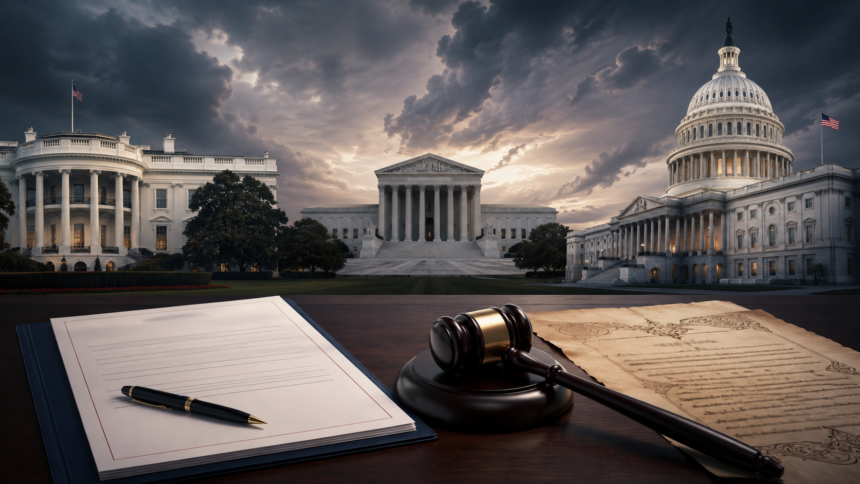
There was a time when “executive power” sounded like a phrase from a law school seminar, not a dinner-table argument. That time has passed.
Today, almost every major fight in American politics eventually comes back to the same question: how much authority does the president actually have? Immigration policy, tariffs, student loan relief, federal agency leadership, emergency declarations, and even who can be fired from an independent commission. All of it now runs through the same constitutional bottleneck.
The president acts. Congress objects, or stays silent. Federal agencies carry out the order, or refuse to. Courts get pulled in to settle the dispute. And the public watches, often unsure whether what just happened was normal governance or something closer to an institutional crisis.
This is an opinion analysis, not a news report. It will not predict how any pending case should be decided, and it will not claim one party is the sole cause of the problem. What it will do is lay out, as clearly as possible, why executive power has become the defining political argument of this era, and what is actually at stake for ordinary people when that argument plays out.
Key Takeaways
- Executive power is the authority held by the president and the executive branch to enforce laws, run federal agencies, and act on national security and foreign policy.
- The current political fight is not about whether the president has power. It is about how far that power should extend.
- Congress writes laws and controls spending, but presidents increasingly rely on executive action when legislation stalls.
- Courts are regularly asked to decide whether a president’s action stayed inside legal limits or crossed them.
- The outcome of this debate touches immigration enforcement, federal spending, agency regulation, and public trust in democratic institutions.
What Is Executive Power?
Executive power Executive power is the constitutional authority that allows the president to enforce the nation’s laws, direct federal agencies, command the armed forces, conduct foreign policy, and respond to emergencies.
Article II of the U.S. Constitution gives the president this authority by vesting “the executive power” in the office. However, the framers did not give the president unlimited power. Instead, the Constitution places clear limits around the presidency: Congress writes the laws the president enforces, the Senate confirms major appointments, and the courts review whether executive actions stay within legal boundaries.
Legal scholars often call this structure the separation of powers. In practice, it means the president does not govern alone. The Constitution requires the executive branch to share authority with Congress and the courts, even when that process feels slow, frustrating, or politically inconvenient.
So when people argue today about “executive power,” they rarely debate whether the president should have any authority at all. Instead, they debate where that authority ends and who should decide when a president crosses the line.
Why Executive Power Has Become a Political Fight
A few forces have combined to push this issue to the center of American politics.
Presidents want to move quickly, especially on issues voters care about right now. Congress, by design, moves slowly. It needs majorities, debate, committee work, and often compromise across party lines.
When Congress cannot or will not act, presidents face a choice: accept gridlock, or use the tools already available to the executive branch, such as orders, agency rules, and enforcement priorities. Most modern presidents have chosen the second option at least some of the time.
That choice almost always ends up in court. Someone affected by the action, often a state government, a company, or an advocacy group, files a lawsuit arguing the president exceeded their authority. A judge, and eventually appellate courts, have to decide.
There is also a more uncomfortable pattern worth naming honestly. Voters tend to support strong presidential action when their own party holds the White House, and call the very same kind of action dangerous overreach when the other party holds it. That inconsistency is not new, and it is not unique to one side of the political spectrum.
President vs Congress: The Fight Over Who Makes Policy
The constitutional division of labor is straightforward on paper. Congress writes laws and controls federal spending through the power of the purse. The president’s job is to enforce the laws Congress has already passed.
The conflict starts when a president uses executive action to shape policy in areas where Congress has not passed new legislation, or has passed something ambiguous enough to leave room for interpretation.
This pattern shows up across very different policy areas. Immigration enforcement priorities have shifted dramatically from one administration to the next, often through executive action rather than new statutes. Tariff policy has become a flashpoint over whether trade emergency laws give the president authority to impose sweeping economic measures on his own. Student loan relief programs have been challenged as exceeding what Congress authorized. Environmental and labor regulations issued by federal agencies are regularly contested as going beyond the text of the laws those agencies are supposed to implement.
None of this is exclusive to one party. Recent Republican and Democratic administrations alike have used executive tools to advance policy goals when legislative paths were blocked. The pattern repeats because the incentive structure repeats: unified control of Congress is rare, legislative compromise is hard, and executive action is available right now.
President vs Courts: Who Sets the Limits?
When someone believes a president has gone beyond legal authority, the usual next step is a lawsuit. Federal courts then have to answer a narrower question than people often assume: not whether the policy is wise, but whether the law actually allows the president to do it.
Courts can block an executive action entirely, narrow how it applies, or allow it to stand. Each outcome carries real consequences, because executive actions often take effect immediately, while court review can take months or years to play out.
This is where the constitutional fight gets sharpest. Elected officials argue they were given a mandate by voters. Courts answer that even an elected mandate operates inside legal boundaries set by the Constitution and by statutes passed by Congress. Both positions can be true at once, and reconciling them is exactly what makes this area of law so contested.
Why the Supreme Court Matters in Executive Power Fights
The Supreme Court sits at the top of this entire structure, which is why its calendar has become unusually central to American political life in recent years.
The Court can decide whether a president’s removal of an agency official was lawful, whether an emergency declaration justified a particular action, whether an executive order on a politically sensitive issue is consistent with existing statutes and constitutional text, and how far Congress can go in restricting presidential authority over the agencies it created.
Recent terms have featured an unusually high concentration of cases touching executive authority, covering tariff powers, the removal of officials at independent agencies, and the scope of long-standing executive orders. Legal scholars across the political spectrum have described this period as one of the more consequential stretches for presidential power in decades.
It is not this article’s place to predict how any pending case will be resolved, and readers should be cautious of anyone who claims certainty about outcomes before a ruling is issued. What can be said clearly is that the Court’s decisions in this area will shape the relationship between the presidency and the other branches for years after the cases themselves are forgotten.
Executive Orders Are Powerful, But Not Unlimited
Executive orders generate enormous attention, and it is worth being precise about what they actually are.
An executive order is a directive from the president to the executive branch, instructing federal agencies how to implement existing law or manage internal operations. They can be consequential. They are not, however, a substitute for legislation.
An executive order must rest on authority the president already has, either from the Constitution directly or from a law Congress has passed. It cannot create entirely new law out of nothing. If a court finds that an order exceeds that authority, it can be blocked or struck down. And because executive orders are not statutes, a new president can often reverse a predecessor’s orders almost immediately after taking office, which is exactly why so much policy made this way feels temporary rather than settled.
Why Congress Looks Weaker in the Executive Power Era
Congress was designed to be the branch closest to the people and the most directly responsible for writing national policy. In recent decades, it has often looked like the weakest of the three branches in practice, even though its constitutional powers have not shrunk at all.
The reasons are mostly structural rather than personal. Congress is frequently divided between the two chambers and the White House. Passing legislation requires building coalitions that are harder to assemble than they once were. Budget fights consume time that might otherwise go toward substantive lawmaking. Polarization makes the kind of cross-party compromise that legislation often requires politically costly for individual members.
When Congress fails to act on a pressing issue, the president usually does not wait. The executive branch fills the space Congress leaves open. That can make government more responsive in the short term. It can also mean that major policy changes happen without the kind of broad democratic buy-in that comes from an actual vote in Congress, and it can leave those changes more legally fragile than a properly passed law would be.
The Public Trust Problem
Survey research on American attitudes toward government consistently finds a tension that does not resolve cleanly. Many Americans say they want decisive leadership capable of solving problems quickly. Many of those same Americans also express discomfort with the idea of concentrated power resting in one office or one branch.
That discomfort tends to intensify whenever executive power is used on a divisive issue, regardless of which party is in the White House at the time. It is not a one-sided phenomenon. Concern about presidential overreach rises and falls depending on who occupies the office, which itself is part of the underlying problem this article is trying to describe.
Public trust in institutions does not recover quickly once it erodes. Each high-profile fight over the limits of executive authority, win or lose, tends to leave behind a little more skepticism about whether the system as a whole is working the way it was designed to.
Why Both Parties Contribute to the Problem
It would be convenient, politically, to blame this entire dynamic on one president or one party. It would also be inaccurate.
Modern Democratic and Republican presidents have both expanded the practical reach of executive power when legislative paths were blocked. Administrations on both sides have used emergency authorities, agency rulemaking, and executive orders to advance policy goals that Congress had not clearly authorized through new legislation.
There is a familiar rhythm to this. Whichever party is out of power tends to describe the sitting president’s use of executive authority as dangerous overreach. Whichever party holds the White House tends to defend the same kind of action as necessary and lawful. Then the parties trade places, and the arguments often trade places with them.
The deeper problem is not really about any single president’s personality or ambition. It is about a political system that consistently rewards unilateral action and rarely punishes it at the ballot box. Every president inherits a slightly more powerful toolkit than the last one, along with the same political pressure to use it.
How Executive Power Affects Ordinary People
It is easy to discuss executive power as an abstract constitutional argument. For millions of people, it is not abstract at all.
Immigration enforcement priorities set through executive action determine who faces deportation and who does not. Decisions about student loan programs affect monthly payments for borrowers across the country. Healthcare rules issued by federal agencies shape what coverage looks like for people relying on public programs. Environmental regulations affect everything from factory emissions to the price of energy. Labor policy set through agency rulemaking influences workplace protections. Tariff decisions can raise or lower prices on everyday goods. National security determinations affect travel, screening, and surveillance. Benefits administration touches Social Security, veterans’ programs, and disability support. Civil rights enforcement priorities determine how aggressively federal agencies pursue discrimination claims.
None of these areas is decided in a courtroom for its own sake. They are decided because the outcome changes something real in someone’s life, often without that person ever casting a vote on the specific decision involved.
The Danger of a President Who Can Do Too Much
Strong, fast presidential action can feel efficient, especially when the alternative is watching Congress fail to pass anything at all. But efficiency is not the only value a democracy is supposed to protect.
A system where one office can act unilaterally on major national issues, with limited practical check from the other branches, is a system that depends entirely on the good judgment of whoever happens to hold that office at the time. That is a fragile way to run a country of more than three hundred million people across decades of changing leadership.
Democracy depends on friction. Oversight, debate, judicial review, and the genuine possibility that another branch can say no are not signs that the system is broken. They are signs that it is working as intended, even when that feels frustratingly slow. A president should be powerful enough to actually govern. A president should not be powerful enough to bypass Congress and the courts every time politics becomes difficult.
The Danger of a Government That Cannot Act
The opposite failure mode deserves equally honest treatment. If Congress is structurally unable to legislate, and courts slow down or block every significant executive response, government can become unable to address real and urgent problems.
National emergencies, public health crises, and fast-moving economic shocks do not wait for a multi-year legislative process. There is a legitimate case for executive flexibility in genuine emergencies, which is part of why the Constitution gives the president real authority in the first place.
The answer to executive overreach is not a powerless presidency that cannot respond to a crisis. The answer is a functioning balance: Congress actually legislating instead of leaving gaps for the executive branch to fill by default, courts applying legal limits consistently rather than selectively, and presidents using their authority within the law rather than testing how far they can push past it before someone stops them.
What a Healthier Balance of Power Would Look Like
None of the three branches is currently performing the role the Constitution assigns to it without friction, and fixing that is not a one-sided task.
Congress should legislate more clearly on the major issues it cares about, rather than leaving ambiguous statutory language for agencies and courts to interpret years later. Presidents should treat executive authority as a tool for implementing law, not a substitute for the legislative process when Congress is simply slow. Courts should apply legal limits on executive power consistently, regardless of which party’s president is involved in a given case. Voters should judge presidents on both the outcomes they deliver and the process they used to get there, rather than excusing process concerns whenever the outcome is one they like. Federal agencies should operate with real transparency about how and why they are exercising delegated authority. Emergency powers, by definition, should be reserved for emergencies, not treated as a routine substitute for ordinary policymaking.
None of this requires constitutional amendments or radical institutional redesign. It mostly requires each branch to take its own assigned job seriously, even when doing so is politically inconvenient.
Why This Fight Will Shape America’s Political Future
Executive power is not a passing controversy tied to one administration. It is one of the central structural questions of American governance going forward.
Future fights over immigration policy, federal spending priorities, war powers, technology regulation, the scope of administrative agencies, and even the mechanics of elections will all run through the same basic question this article has been describing: how much can the executive branch do on its own, and who gets to stop it when it goes too far?
This issue will outlast any single president. It will outlast the current Supreme Court term. It is now a permanent fixture of American constitutional politics, and how it gets resolved, case by case and decade by decade, will shape what kind of democracy the United States actually has.
How This Fits Into Fresh Global News Political Opinion Coverage
This piece sits within Fresh Global News’s broader Political Opinion coverage, alongside reporting on Government and Policy, U.S. Politics, the Supreme Court, and the wider Politics section. Readers following the executive power debate may also want to track how Congress responds to specific agency actions and how upcoming court rulings shape the boundaries discussed here.
Conclusion
America does not need a powerless president. A country this large, facing genuine emergencies and complex global pressures, needs an executive branch capable of acting decisively when action is actually required.
But America also cannot afford a presidency that operates without meaningful checks, because unchecked power does not stay contained to the issues people happen to support. It expands to cover the issues they do not support too, regardless of which party is holding it at the time.
The real test ahead is not whether any single president is right or wrong about any single action. The real test is whether Congress, the courts, and the public can restore a working balance between the speed of executive action and the accountability that democracy actually requires. A presidency that can act, and a system that can still say no. That balance, more than any one ruling or any one order, will determine what the next chapter of American democracy looks like.
Frequently Asked Questions
Q1. What is executive power?
Executive power is the constitutional authority granted to the president and the executive branch to enforce federal laws, manage federal agencies, conduct foreign policy, and respond to national emergencies. It comes from Article II of the U.S. Constitution and operates within a system of checks and balances.
Q2. Why is executive power controversial?
It is controversial because there is ongoing disagreement about how far presidential authority should extend, especially when Congress has not passed clear legislation on an issue. Presidents from both major parties have used executive action to advance policy goals, leading to recurring legal and political disputes.
Q3. Can courts limit executive power?
Yes. Federal courts, including the Supreme Court, can review executive actions when they are challenged in lawsuits. Courts can block, narrow, or uphold an action depending on whether it falls within the legal authority granted by the Constitution or by Congress.
Q4. What role does Congress play in executive power?
Congress writes federal laws and controls government spending through the power of the purse. The president’s role is to enforce those laws. Tension arises when presidents use executive action to make policy in areas where Congress has not passed clear legislation.
Q5. Are executive orders the same as laws?
No. Executive orders are directives from the president to federal agencies on how to implement existing law or manage executive branch operations. They must be grounded in constitutional or statutory authority, can be challenged in court, and can typically be reversed by a future president.
Q6. Why does executive power matter to ordinary citizens?
Executive power shapes immigration enforcement, student loan policy, healthcare rules, environmental regulation, labor protections, tariffs, national security measures, and federal benefits. These decisions affect daily life for millions of people, even though most citizens never vote directly on them.