



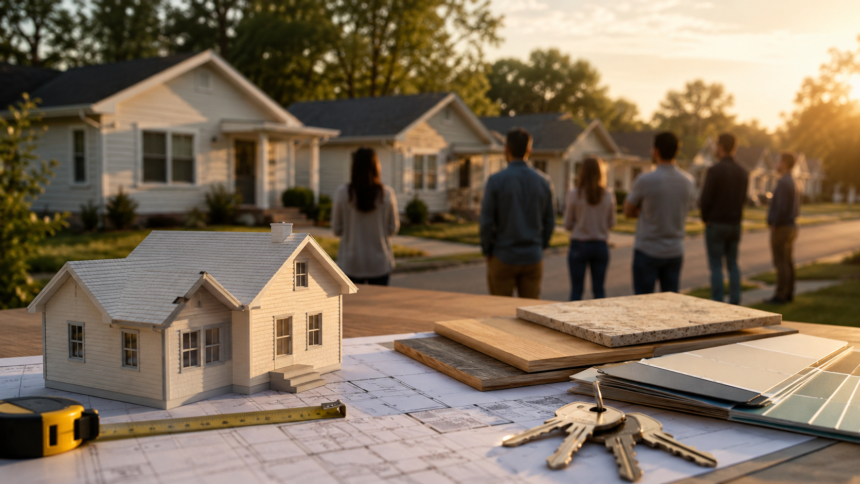
A few years ago, a starter home felt like a realistic goal for many working families. A modest house, a small yard, a manageable monthly payment. That picture has become harder to find in many parts of the world. Buyers who once expected to enter the market with a smaller, lower-priced home are discovering that those homes are scarce, and the ones that remain often sell quickly or at prices that stretch a household budget thin.
Renters are feeling a version of the same pressure. As fewer affordable homes enter the market, more people stay in rentals longer, which can push rents higher in some cities. Rising home prices, higher mortgage rates, increasing construction costs, and a limited supply of new housing have combined to make affordability one of the most discussed issues in real estate today.
It would be convenient to point to a single cause. The reality is more layered. Affordable homes are disappearing because of a mix of supply constraints, financing costs, land limitations, zoning rules, and competition among buyers. None of these forces act alone, and the mix looks different depending on the city, region, and income level involved. This article breaks down the major factors in plain language, without hype and without taking sides on policy debates.
Key Takeaways
- Affordable homes are disappearing because supply has not kept up with demand in many markets.
- Builders often focus on larger or more expensive homes because land, labor, materials, and financing cost more.
- High mortgage rates can make even modest homes feel unaffordable through higher monthly payments.
- Zoning rules, limited land, and slow permitting can restrict new housing supply.
- First-time buyers and renters are often hit hardest when affordable housing options shrink.
What Does Affordable Housing Mean?
Affordable housing usually means housing costs that are manageable compared with a household’s income. There is no single price tag that applies everywhere. A home is generally considered affordable when a household is not forced to spend an unusually large share of its income on rent or a mortgage payment, leaving room for other essentials.
Affordability depends on several things working together: local income levels, home prices, rent levels, mortgage rates, property taxes, insurance costs, and everyday household expenses. Two homes with the same price tag can feel completely different to afford depending on the buyer’s income, the local tax rate, and the cost of insuring the property.

This is also why a home that feels affordable in one city may be completely out of reach in another. A modest house in a smaller town may cost a fraction of a similar home in a major metro area with strong job growth. Affordability is local, and it depends on local conditions as much as national trends.
Why Affordable Homes Are Disappearing
Affordable homes are disappearing because prices, borrowing costs, construction expenses, land shortages, zoning restrictions, and buyer competition have all pushed lower-cost housing out of reach in many areas. No single factor explains the trend on its own.
It helps to think of this as a supply and affordability problem rather than simply a price problem. Even in markets where prices have leveled off, affordability can stay strained if mortgage rates remain high or if there simply are not enough smaller, lower-cost homes being built. Supply, cost, and financing all move together, and when several of them tighten at the same time, the homes that used to be considered affordable start to disappear from the market.
Starter Homes Are Harder to Find
Starter homes have traditionally served as the entry point into homeownership. These are typically smaller, older, and lower-priced properties that gave first-time buyers a way to build equity before moving up to a larger home later.
In many markets, the supply of these smaller, lower-priced homes has shrunk. Some older starter homes have been renovated and resold at higher price points. Others have been expanded with additions that increase both size and price. In some areas, a portion of this housing stock has been converted into rental properties or purchased by investors rather than sold to owner-occupants.
On the new construction side, builders often have less financial incentive to build smaller homes. Land costs, permitting fees, and labor expenses tend to be similar whether a home is small or large, which means a builder’s profit margin is often thinner on a smaller home. This can push new construction toward larger, more expensive houses, even in markets where demand for starter homes remains strong.
Home Prices Have Outpaced Many Incomes
Affordability often comes down to a simple relationship: how home prices compare with what households earn. When home prices rise faster than wages over time, affordability tends to get worse, even if individual buyers are doing everything right financially.
This price-to-income gap can affect buyers who have steady jobs and responsible saving habits. If home prices climb at a faster pace than income growth, the same buyer who could have comfortably afforded a home a few years earlier may find that goal much harder to reach today, even with a similar or improved financial position.
This is not the same in every market. Some regions have seen home prices grow roughly in line with local incomes, while others have experienced a much wider gap. This article does not offer financial guidance on what a household should spend on housing; that depends heavily on personal circumstances and should be discussed with a qualified professional.
Mortgage Rates Make Monthly Payments Higher
A home’s listed price is only part of the affordability equation. Mortgage rates, the interest charged on a home loan, play a major role in determining the actual monthly payment a buyer faces.
When mortgage rates rise, the monthly cost of financing the same home increases, sometimes significantly. A house that looks affordable based on its price alone can become much more expensive on a monthly basis once a higher interest rate is applied to the loan.
This matters because it means affordability can worsen even when home prices themselves are not rising. Higher borrowing costs can reduce how much home a buyer can qualify for, which shrinks the pool of homes that feel within reach. In this way, mortgage rates can act independently of home prices, sometimes offsetting price stability with reduced purchasing power.
Builders Face Higher Construction Costs
Homebuilders manage a long list of expenses before a new home is ever listed for sale. These include land prices, building materials, skilled labor, insurance, construction financing, permitting fees, and the infrastructure needed to support new developments, such as roads, utilities, and water systems.
When these costs rise, building lower-cost homes becomes more difficult. Materials and labor often cost roughly the same per square foot regardless of a home’s price category, which means the dollar amount a builder needs to recover stays relatively fixed even on a smaller, lower-priced project.
Because of this, builders may lean toward constructing higher-priced homes to protect their profit margins. A builder facing the same fixed costs on every project often finds it more financially sustainable to build fewer, larger homes that sell at higher prices rather than many smaller, lower-margin homes. This pattern can reduce the supply of new affordable housing even as overall construction activity continues.
Land Shortages and Zoning Rules Limit Supply
In many cities and suburbs, land located near jobs, schools, transit lines, and other services is limited. As that land becomes scarcer, its price tends to rise, which adds to the overall cost of any home built on it.
Zoning rules can also shape what gets built. Some zoning codes restrict housing density, limiting an area to single-family homes and preventing smaller units, duplexes, or multifamily buildings that could otherwise add more affordable supply. Permitting processes, the local government approvals required before construction can begin, can also take a long time in some areas, which slows down how quickly new housing can reach the market.
Put simply, when the supply of new homes is constrained by land availability, zoning restrictions, or slow permitting, prices in that market tend to stay elevated. Buyers are competing for a limited number of homes, and limited supply combined with steady or growing demand tends to keep prices firm.
Investors and Competition Can Push Prices Higher
In some markets, first-time buyers are not the only ones competing for entry-level homes. Investors, cash buyers, second-home purchasers, and higher-income buyers looking to downsize can also be active in the same price range that starter homes occupy.
A cash offer or an all-cash purchase can sometimes move faster than an offer that depends on mortgage financing, which may put buyers who need a loan at a disadvantage in competitive situations. In areas with strong rental demand, investors purchasing homes to rent out can also reduce the number of homes available for owner-occupants.
It is worth being balanced here. Investor activity varies widely by market and is not the only reason affordable homes are harder to find. In many areas, the bigger constraints come from supply, zoning, and construction costs rather than investor purchases alone. Local conditions determine how much of a role this factor plays.
Renters Are Also Affected
The disappearance of affordable homes does not only affect people trying to buy. When fewer affordable homes are available for purchase, more households end up renting for longer periods than they originally planned.
This extended rental demand can put upward pressure on rents in some markets, particularly where housing supply overall is tight. Higher rents can then make it harder for renters to save toward a down payment, which delays their path to homeownership even further.
This creates a difficult cycle for some households: limited affordable homes push more people into renting, rental demand rises, rents increase, and saving for a home becomes more difficult as a result. The severity of this cycle differs by city and depends heavily on local rental supply and income levels.
Why Affordable Homes Do Not Return Quickly
Housing supply does not respond instantly to demand. Building new homes takes time, often years from the point land is identified to the point a finished home is ready for a buyer.
Several steps can slow this process down: securing land, going through permitting and approval, lining up construction financing, and managing the actual building timeline. Delays at any one of these stages can push back when new supply actually reaches the market.
Because of this, home prices may not fall quickly unless supply increases meaningfully, demand softens, or borrowing costs become easier for buyers. Even then, the response can take time to show up in local price data. It is also important to note that local markets can behave very differently from one another. A national trend toward improving affordability does not guarantee the same outcome in every city or neighborhood.
Which Areas Are Most Affected?
- Affordability pressure is not distributed evenly. While conditions vary by country, region, and even neighborhood, certain types of markets tend to show more strain than others.
- High-demand cities where population growth and job opportunities attract a steady flow of new residents.
- Areas with limited available land, including coastal regions, mountain communities, or cities surrounded by protected land.
- Markets with strong local job growth, where rising incomes in some sectors can push up competition for housing.
- Places experiencing slow construction activity relative to population or household growth.
- Tourist destinations and second-home markets, where vacation buyers compete with local residents for housing.
- Regions facing high insurance costs or climate-related risks, which can add significantly to the ongoing cost of homeownership.
These categories are general patterns rather than a ranking of specific cities. Actual conditions in any given location depend on local data and should be checked against current local market reports.
What Could Help Bring Back Affordable Homes?
Housing economists and industry groups have discussed a range of approaches that could, over time, support more affordable housing supply. None of these are guaranteed fixes, and outcomes depend on how they are applied locally.
- Increasing overall housing supply, including both ownership and rental options.
- Encouraging the construction of smaller, lower-cost starter homes.
- Zoning reform that allows more housing types, such as duplexes or smaller multifamily buildings, in more areas.
- Faster permitting processes that reduce delays between approval and construction.
- More multifamily housing development to add supply in dense or high-demand areas.
- Lower construction costs through improved building methods, materials, or labor efficiency.
- More favorable financing conditions that reduce borrowing costs for builders and buyers alike.
- Public-private housing programs that combine government and private-sector resources.
- Local affordability policies tailored to the specific needs of a city or region.
These ideas are presented as general possibilities discussed in housing policy circles, not as predictions or endorsements of any particular political approach. What works in one market may not translate directly to another.
What Buyers and Renters Should Watch
For anyone trying to understand their own local market, a few indicators tend to offer useful signals over time.
- Local housing inventory means how many homes are listed for sale at a given time.
- Mortgage rate trends directly affect monthly payment costs.
- Median home prices in the specific city or neighborhood of interest.
- Rent trends, which can indicate broader pressure on housing demand.
- New construction activity, including how many new homes are being permitted and built.
- Insurance costs, which have risen sharply in some regions and can affect overall affordability.
- Property tax rates, which vary by location and affect ongoing housing costs.
- Local job growth, since strong hiring can increase housing demand in a specific area.
- Investor activity levels in the local market.
- Housing policy changes at the local or regional level that could affect zoning or permitting.
Tracking these signals over time, rather than reacting to any single data point, tends to give a clearer picture of how a local market is shifting.
How This Fits Into Fresh Global News Business Coverage
Housing affordability connects closely to several other areas of business and economic news. Readers interested in this topic may also want to follow Fresh Global News coverage in Real Estate for ongoing market updates, Economy for broader trends affecting jobs and growth, Personal Finance for general financial planning context, Stock Market for how housing-related companies are performing, and Business for the wider corporate and policy picture shaping the housing sector.
Conclusion
Affordable homes are disappearing because of several pressures that overlap rather than act alone. Limited housing supply, rising construction costs, higher mortgage rates, land and zoning constraints, and competition from a wider pool of buyers have all played a part in different markets, in different combinations, at different times.
None of this means the situation is the same everywhere. Conditions vary widely by city, region, income level, and local market, and what is true in one place may not apply somewhere else. Readers should view broad trends as context rather than a direct prediction for their own situation.
For many households, the housing challenge is not only finding a home, but finding one that fits both their budget and their long-term needs.
Frequently Asked Questions
Q1. Why are affordable homes disappearing?
Affordable homes are disappearing mainly because housing supply has not kept pace with demand, while construction costs, mortgage rates, and land prices have risen at the same time. These pressures combine differently depending on the local market.
Q2. What is an affordable home?
An affordable home is generally one where housing costs are manageable compared with a household’s income, leaving enough room for other living expenses. What counts as affordable depends on local income levels, home prices, and rent in that specific area.
Q3. Why are starter homes harder to find?
Starter homes are harder to find because fewer smaller, lower-priced homes are being built, some older starter homes have been renovated or expanded into pricier properties, and builders often find smaller homes less profitable to construct, given current costs.
Q4. How do mortgage rates affect affordability?
Mortgage rates directly affect the monthly payment on a home loan. When rates rise, the same home becomes more expensive to finance each month, which can reduce how much home a buyer can afford, even if the listed price does not change.
Q5. Do investors make homes less affordable?
Investors can add competition for entry-level homes in some markets, which may make those homes harder for first-time buyers to purchase. However, investor activity is only one factor among several, and its impact varies significantly from one market to another.
Q6. What could make homes more affordable again?
Possible factors that could improve affordability over time include increased housing supply, zoning reform, faster permitting, more multifamily construction, lower building costs, and easier financing conditions. Results depend heavily on local implementation and market conditions.