


Introduction
Artificial intelligence is no longer a futuristic idea; it now writes emails, diagnoses illnesses, drives cars, and shapes what people see online. With this rapid growth comes a pressing question many readers are asking in 2026: What are the real risks of artificial intelligence, and can AI actually harm humans? The answer isn’t simple fear or blind optimism. AI carries genuine risks, from job displacement and privacy erosion to bias, misinformation, and cybersecurity threats, while also offering real benefits when built and used responsibly. This article breaks down the risks of artificial intelligence in clear, practical terms, helping you understand what’s actually at stake, what experts and regulators are doing about it, and how individuals and businesses can reduce harm while still benefiting from AI’s capabilities.
Quick Answer: The risks of artificial intelligence include job displacement, privacy violations, biased decision-making, deepfakes and misinformation, cybersecurity threats, and reduced human oversight in autonomous systems. AI is not inherently dangerous, but poor design, weak regulation, or misuse can lead to real harm to individuals, businesses, and society.
Risks of Artificial Intelligence: Can AI Harm Humans?
Artificial intelligence is no longer a futuristic idea; it now writes emails, diagnoses illnesses, drives cars, and shapes what people see online. With this rapid growth comes a pressing question many readers are asking in 2026: What are the real risks of artificial intelligence, and can AI actually harm humans? The answer isn’t simple fear or blind optimism. AI carries genuine risks, from job displacement and privacy erosion to bias, misinformation, and cybersecurity threats, while also offering real benefits when built and used responsibly. This article breaks down the risks of artificial intelligence in clear, practical terms, helping you understand what’s actually at stake, what experts and regulators are doing about it, and how individuals and businesses can reduce harm while still benefiting from AI’s capabilities.
What Does Artificial Intelligence Mean?
Artificial intelligence refers to computer systems designed to perform tasks that typically require human intelligence, recognizing patterns, making predictions, generating language, or making decisions. Modern AI is largely powered by machine learning, where systems learn patterns from large datasets rather than following fixed, hand-written rules.
Narrow AI vs. General AI
Most AI in use today is “narrow AI”, systems built for specific tasks like image recognition, translation, or recommendation engines. This is different from artificial general intelligence (AGI), a hypothetical system with human-like reasoning across many domains. As of 2026, AGI does not exist; current systems, including advanced generative AI, remain narrow in scope even when they appear broadly capable.
How Generative AI and LLMs Work
Generative AI tools, including large language models (LLMs), are trained on massive amounts of text, images, or other data to predict and generate new content. They do not “think” or “understand” in the human sense; they identify statistical patterns. This distinction matters when evaluating AI risk, because many dangers come from how these pattern-matching systems are deployed, not from independent intent.
Why AI Risks Matter in 2026
Faster Adoption, Bigger Impact
AI tools have moved from research labs into everyday business operations, classrooms, hospitals, and government agencies. As adoption accelerates, the consequences of poorly designed or poorly governed AI systems reach more people, faster.
Public Trust and AI
Surveys and public discourse increasingly reflect concern about AI’s impact on jobs, privacy, and information integrity. Understanding actual risks, rather than relying on sensational headlines, helps readers, businesses, and policymakers make better decisions.
Job Loss and Workplace Disruption
One of the most discussed risks of artificial intelligence is its effect on employment. AI automation can handle repetitive, data-heavy, or rules-based tasks faster and cheaper than human workers, which has led to workforce restructuring in several industries.
Which Jobs Are Most Exposed
Roles involving routine data entry, basic customer service, content transcription, and certain administrative functions face higher automation exposure. Some analysts also point to junior-level knowledge work as increasingly affected by generative AI tools.
New Jobs AI May Create
Historically, major technology shifts have also created new job categories. AI is expected to generate demand for roles in AI oversight, prompt engineering, data governance, AI ethics, and human-AI collaboration. However, the pace and scale of this transition remain uncertain.
Privacy and Data Collection Risks
AI systems often depend on large volumes of personal data to function effectively, raising legitimate privacy concerns.
How AI Systems Collect and Use Data
Many AI-powered products, from recommendation engines to voice assistants, collect behavioral, biometric, or personal data to improve performance. Without strong safeguards, this data can be misused, sold, or exposed in breaches.
Surveillance Concerns
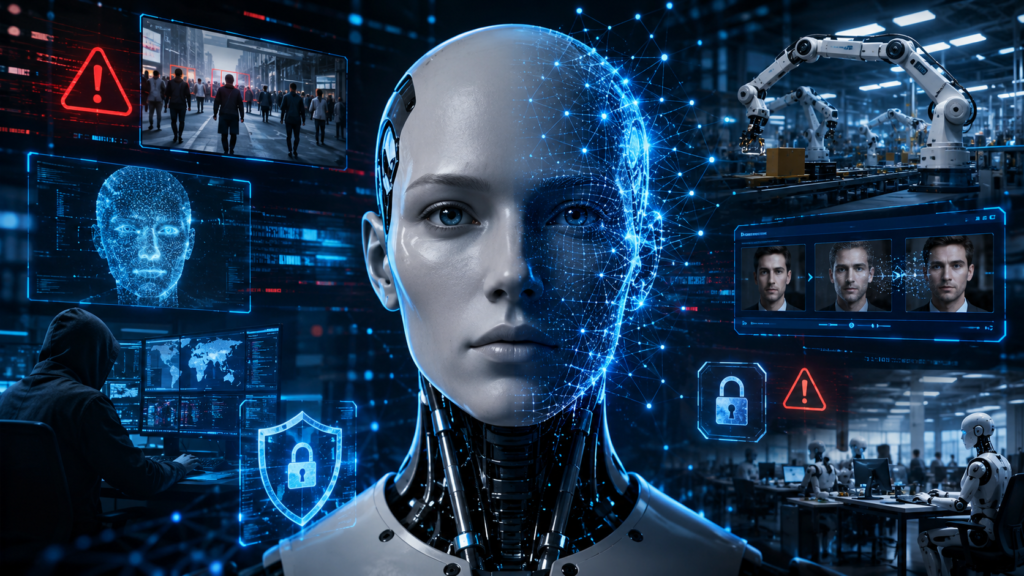
AI-enhanced facial recognition and behavioral tracking tools raise concerns about mass surveillance, particularly when deployed without clear consent, oversight, or legal limits. Digital privacy advocates continue to push for stronger data protection frameworks as AI capabilities expand.
AI Bias and Unfair Decisions
AI systems learn from historical data, which means they can inherit and amplify existing human biases.
Where Bias Comes From
Bias can enter an AI system through unrepresentative training data, flawed labeling, or design choices that fail to account for diverse populations. The result is not intentional discrimination by the AI itself, but a reflection of patterns embedded in its training data.
Real-World Impact of Biased AI
Biased AI has raised concerns in areas such as hiring algorithms, credit scoring, and predictive policing, where unfair outcomes can disproportionately affect certain groups. Addressing bias requires diverse datasets, regular auditing, and human review of high-stakes decisions.
Deepfakes and Misinformation
Generative AI has made it significantly easier to create realistic fake images, audio, and video, commonly known as deepfakes.
How Deepfakes Are Made
Deepfakes use machine learning models trained on real images or voice samples to generate convincing synthetic media. What once required specialized skills can now be attempted with widely available consumer tools.
Why Misinformation Spreads Faster With AI
AI can generate large volumes of text, images, and video quickly, which can be used to produce misleading news, impersonate public figures, or manipulate public opinion. Combined with social media’s rapid distribution, this creates a heightened misinformation risk that platforms, fact-checkers, and regulators are actively working to address.
Cybersecurity Threats From AI
AI is a double-edged sword in cybersecurity, it strengthens both attackers and defenders.
AI-Powered Attacks
Malicious actors can use AI to craft more convincing phishing messages, automate vulnerability scanning, or generate malicious code more efficiently than manual methods allow. This raises the sophistication and scale of potential cyberattacks.
AI as a Defense Tool
At the same time, AI powers advanced threat detection, anomaly monitoring, and automated incident response, helping cybersecurity teams identify and neutralize threats faster than traditional methods.
Autonomous AI and Control Risks
A growing area of concern involves AI systems that operate with increasing autonomy, making decisions or taking actions with limited real-time human oversight.
What “Losing Control” Actually Means
This does not refer to science-fiction scenarios of AI “turning against humans,” but to more practical risks: autonomous systems making errors at scale, acting on flawed logic, or being difficult to predict or audit once deployed in complex environments.
Current Safeguards
Researchers and developers increasingly emphasize “human-in-the-loop” design, where critical decisions require human review, along with testing, monitoring, and kill-switch mechanisms for high-risk autonomous systems.
AI in Healthcare, Finance, Education, and Law Enforcement
Benefits in These Sectors
AI supports faster medical image analysis, fraud detection in finance, personalized learning tools in education, and pattern analysis in law enforcement investigations.
Specific Risks in High-Stakes Fields
In healthcare, AI errors could affect diagnoses or treatment recommendations. Financial systems may use flawed algorithms that unfairly deny credit. In education, over-reliance on AI could weaken critical thinking development. Law enforcement agencies also risk unjust outcomes when using biased or inaccurate AI tools. These high-stakes applications require rigorous testing, transparency, and human oversight before deployment.
Environmental and Energy Concerns
Data Centers and Power Use
Training and running large AI models requires significant computing power, which translates into substantial electricity and water usage at data centers. As AI usage scales globally, its environmental footprint has become a growing area of research and public discussion.
AI Regulation and Safety
Global Regulatory Approaches
Governments and international bodies are developing frameworks to govern AI development and deployment, focusing on transparency, accountability, risk classification, and human oversight. Regulatory approaches vary by region, reflecting different priorities around innovation, safety, and rights protection.
Industry Self-Governance
Many AI developers have introduced internal safety practices, including red-teaming (adversarial testing), model evaluations, and responsible disclosure policies, alongside external regulation.
How Humans Can Use AI Responsibly
For Individuals
- Verify AI-generated information before sharing it
- Review privacy settings on AI-powered apps and tools
- Be cautious about sharing sensitive personal data with AI systems
- Learn to recognize signs of deepfakes and synthetic media
For Businesses and Developers
- Conduct bias and fairness audits on AI systems before deployment
- Maintain human review for high-stakes automated decisions
- Follow applicable data protection and AI regulations
- Invest in cybersecurity measures specific to AI infrastructure
- Be transparent with users about when and how AI is used
Future Outlook: Where AI Risk Is Heading
As AI capabilities continue to advance, risk management is expected to become a bigger focus alongside innovation. Expect continued development of AI safety research, expanding regulatory frameworks, and greater public demand for transparency in how AI systems make decisions. The long-term trajectory of AI risk will likely depend less on the technology itself and more on the governance, oversight, and responsible design choices made by developers, businesses, and policymakers.
Final Takeaway
The risks of artificial intelligence are real but manageable. AI is not inherently good or bad, its impact depends on how it is designed, deployed, and regulated. Understanding specific risk categories, from job disruption to cybersecurity threats, allows individuals and organizations to use AI’s benefits while actively working to reduce its potential harms.
Key Takeaways
- AI risks include job disruption, privacy violations, bias, misinformation, cybersecurity threats, and reduced oversight in autonomous systems.
- Current AI is “narrow,” meaning it performs specific tasks; true artificial general intelligence does not yet exist.
- Bias in AI usually comes from flawed training data, not intentional harm, but it can still cause real-world unfair outcomes.
- Deepfakes and AI-generated misinformation are growing concerns that require media literacy and platform safeguards.
- Regulation and industry self-governance are both expanding to address AI safety, though approaches vary globally.
- Responsible AI use, by individuals, businesses, and developers, can significantly reduce potential harms while preserving AI’s benefits.
Frequently Asked Questions
Q1. Can AI harm humans?
AI can contribute to harm indirectly, through biased decisions, privacy violations, misinformation, or cybersecurity attacks, rather than through independent intent. Most experts agree that current AI systems don’t have desires or self-awareness; risks come from design flaws, misuse, or insufficient oversight.
Q2. Is artificial intelligence dangerous?
Artificial intelligence isn’t inherently dangerous, but it can create real risks if deployed without proper safeguards, testing, or regulation. Like many powerful technologies, its impact depends heavily on how responsibly it is designed and used.
Q3. What are the biggest risks of artificial intelligence today?
The most discussed risks of artificial intelligence include job displacement, data privacy violations, algorithmic bias, deepfakes, misinformation, cybersecurity threats, and reduced human oversight in autonomous systems.
Q4. Will AI cause widespread job loss?
AI is expected to automate certain routine and repetitive tasks, affecting some job categories more than others. At the same time, it may create new roles in AI oversight, development, and human-AI collaboration, though the net long-term impact remains uncertain.
Q5. How does AI threaten privacy?
Many AI systems rely on large datasets, including personal or behavioral data, to function. Without strong protections, this data can be misused, exposed in breaches, or used for surveillance beyond what users originally consented to.
Q6. What causes AI bias?
AI bias typically stems from unrepresentative or flawed training data, not deliberate programming. Because AI systems learn patterns from historical data, they can unintentionally replicate existing societal biases in areas like hiring or lending.
Q7. How does AI contribute to misinformation?
Generative AI can quickly produce realistic text, images, audio, and video, including deepfakes. When combined with fast social media distribution, this makes it easier to spread convincing but false content at scale.
Q8. What is AI safety?
AI safety refers to research and engineering practices aimed at making AI systems reliable, predictable, and aligned with human intentions, including testing, monitoring, and building safeguards against unintended or harmful behavior.
Q9. How is AI being regulated?
Governments and international organizations are developing AI regulation focused on transparency, accountability, and risk-based oversight. Specific frameworks vary by country and region, and continue to evolve as AI technology advances.
Q10. What does the future of AI risk look like?
The future of AI risk will likely depend on how well governance, regulation, and responsible design keep pace with technological advancement. Continued investment in AI safety research and transparent oversight are expected to shape how risks are managed going forward.