



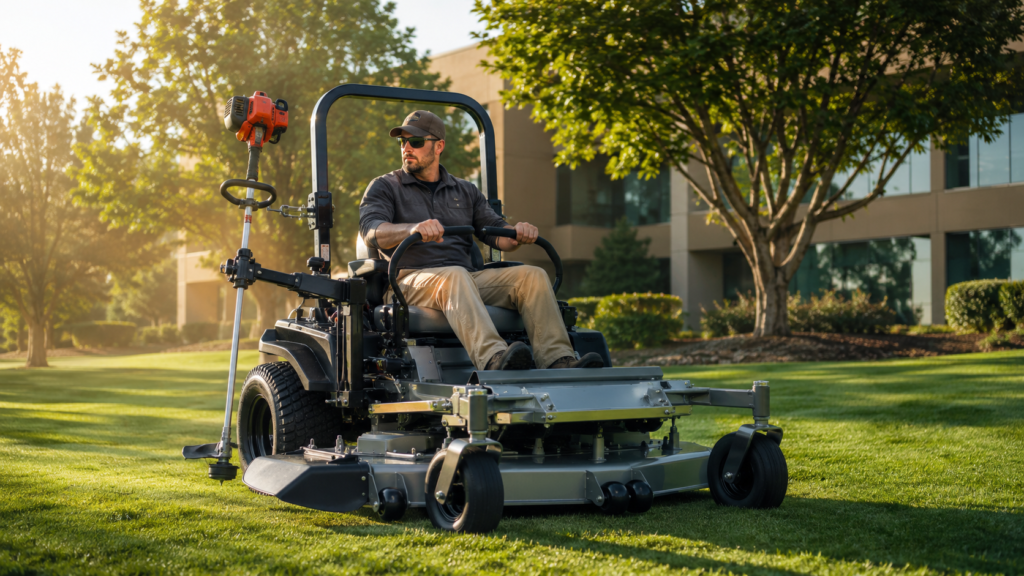
Landscaping companies, property-maintenance teams, and large landowners value zero-turn mowers for their maneuverability, cutting speed, and ability to work efficiently around trees, buildings, flower beds, and other obstacles. However, these users rarely rely on mowing as their only task.
A typical property may also require trimming, edging, debris removal, spraying, spreading, and grass collection. Completing these tasks separately can require additional equipment, repeated stops, and multiple trips across the same area.
This is where zero turn mower attachments can offer practical value.
The right attachment can expand a mower’s capabilities, help operators use equipment more effectively throughout the workday, and streamline repetitive landscaping tasks. Attachments range from conventional baggers and mulching kits to specialized tool-support systems and alternative steering controls.
The business value of an attachment does not come from adding as many accessories as possible. It comes from selecting equipment that solves a specific workflow problem without compromising compatibility, safety, or mower performance.
The 30-Second Answer
Zero turn mower attachments are accessories or equipment systems designed to expand the function of a compatible zero-turn mower. Common options include baggers, mulching kits, striping systems, sprayers, spreaders, tool carriers, utility arms, and alternative control systems.
For a landscaping business, the best attachment is one that reduces unnecessary steps, supports frequently performed services, fits the exact mower model, and can produce enough operational value to justify its purchase and maintenance costs.
Key Takeaways
- Zero turn mower attachments can increase the versatility of an existing mower.
- Common attachments support collection, mulching, spreading, spraying, striping, and tool management.
- Compatibility must be confirmed by mower brand, model, deck size, year, and mounting configuration.
- Commercial buyers should evaluate workflow benefits rather than focusing only on purchase price.
- Specialized systems such as utility arms and foot-steering controls may help operators combine mowing with other property-maintenance tasks.
- Attachments must always be used according to the mower and attachment manufacturers’ safety instructions.
What Are Zero Turn Mower Attachments?
Zero turn mower attachments are products that connect to, mount on, or operate with a zero-turn mower to provide an additional function.
Some attachments modify the mowing process itself. A mulching kit, for example, changes how grass clippings move through the cutting deck. A bagging system collects clippings for removal. A striping kit creates a more defined visual pattern in the turf.
Other attachments expand the mower beyond cutting grass. These may include sprayers, spreaders, debris-management systems, tool racks, utility arms, and control modifications.
Major equipment manufacturers already offer broad attachment ranges for compatible machines. The official Husqvarna zero-turn mower attachments collection includes products designed for functions such as clipping collection and deck management.
The growing attachment market reflects a simple business need: owners want to gain more practical value from equipment they already operate.
Common Types of Zero Turn Mower Attachments
Different attachments solve different landscaping problems. Before purchasing one, operators should identify the task that consumes the most time, labor, or equipment movement.
| Attachment type | Primary purpose | Potential business value |
| Bagger or grass catcher | Collects grass clippings and leaves | Supports cleanup-focused services and reduces manual collection |
| Mulching kit | Processes clippings into smaller particles | Reduces the need to collect and dispose of clippings |
| Striping kit | Creates visible lawn patterns | Supports premium lawn-presentation services |
| Sprayer | Applies liquid lawn treatments | Expands property-care capabilities where legally and operationally appropriate |
| Spreader | Distributes seed, fertilizer, or other materials | Helps combine mowing routes with scheduled lawn applications |
| Tool rack or carrier | Transports handheld equipment | Keeps frequently used tools organized and accessible |
| Utility arm | Supports operation or positioning of secondary tools | May reduce repeated mounting and dismounting |
| Alternative steering system | Changes how the mower is controlled | Can free the operator’s hands for compatible tasks |
| Lighting or visibility equipment | Improves visibility in permitted operating conditions | May support early or late scheduled work |
| Canopy or operator-comfort accessory | Adds shade or weather protection | Can improve comfort during extended operating periods |
Not every mower supports every attachment. The existence of a product category does not mean a specific accessory will fit a particular machine.
Why Attachments Matter to Landscaping Businesses
Residential users may purchase attachments mainly for convenience. Commercial landscaping companies usually need a stronger financial and operational reason.
Better Use of Existing Equipment
A zero-turn mower represents a significant equipment investment. An attachment that enables the mower to support an additional recurring task may improve the machine’s utilization across a working day.
This does not necessarily mean the mower becomes a replacement for every specialized machine. Instead, the mower may become a more useful platform within an organized landscaping workflow.
Fewer Repeated Trips
Landscaping work often involves moving between the mower, trailer, handheld tools, treatment equipment, and disposal area.
An appropriate tool carrier, collection system, sprayer, or utility attachment may reduce some of these transitions. The actual time saved will depend on the property, task, crew size, equipment layout, and operator procedure.
Expanded Service Capabilities
Attachments may allow a company to offer additional services using its existing equipment base. Examples include lawn striping, clipping collection, leaf cleanup, spreading, and certain spraying applications.
Businesses should still account for training, licensing, chemical-handling rules, insurance, and local regulations when adding new services.
More Consistent Workflows
A predictable equipment setup can help crews follow the same process across multiple properties. Standardizing compatible attachments on selected mower models may also simplify training and maintenance.
Operator Accessibility and Comfort
Traditional zero-turn mowers generally require continuous hand input through steering levers. Specialized control systems can change how an operator interacts with the machine.
This is particularly relevant to companies developing equipment for operators with physical limitations or those seeking to reduce repetitive upper-body activity during long mowing sessions.
How to Choose the Right Zero Turn Mower Attachments
The best attachment is not always the most advanced product. It is the attachment that fits the mower, supports the intended task, and provides measurable value under real operating conditions.
1. Confirm Exact Compatibility
Compatibility should be checked using:
- Mower manufacturer
- Exact model name
- Model year
- Deck size
- Frame or mounting configuration
- Existing accessories
- Weight and balance limitations
- Manufacturer-approved operating requirements
A product described generally as a zero-turn mower attachment may fit only selected machines.
Buyers should never assume that two mowers from the same brand use identical mounting points. Confirm the fit with the attachment manufacturer or an authorized dealer before ordering.
2. Identify the Workflow Problem
The purchase should begin with a problem, not a product.
A landscaping company might ask:
- Are crews spending too much time collecting clippings?
- Are operators repeatedly getting off the mower to retrieve tools?
- Is a separate trip required for spreading or spraying?
- Do customers frequently request lawn striping?
- Is operator accessibility limiting who can use the mower?
- Would one attachment eliminate a repeated step on most properties?
Specific questions make it easier to estimate whether the attachment will produce meaningful value.
3. Consider the Full Operating Cost
The purchase price is only one part of the decision.
Businesses should also consider:
- Installation
- Training
- Maintenance
- Replacement parts
- Additional fuel or battery use
- Storage requirements
- Transportation space
- Added loading weight
- Downtime during repairs
- Possible effects on warranties or insurance
A less expensive attachment can become costly if it is difficult to maintain or regularly interferes with other equipment.
4. Evaluate Durability
Commercial landscaping equipment is exposed to vibration, dust, moisture, impacts, heat, and repeated loading.
Important durability considerations include:
- Frame and mounting material
- Weld quality
- Corrosion resistance
- Powder coating or other protective finish
- Fastener quality
- Adjustment mechanisms
- Availability of replacement components
- Ease of inspection and cleaning
Product specifications should be evaluated alongside the conditions in which the attachment will be used.
5. Protect Maneuverability
A primary advantage of a zero-turn mower is its maneuverability. An attachment should not create unacceptable blind spots, interfere with controls, prevent safe clearance, or make the mower difficult to transport.
Operators should test how the attachment affects turning, reversing, loading, unloading, parking, and movement around obstacles.
6. Review Safety Requirements
An attachment cannot make unsafe terrain safe.
The Occupational Safety and Health Administration warns that riding mowers can overturn near slopes, retaining walls, ditches, embankments, and other unprotected edges. OSHA’s riding mower safety guidance should be considered alongside the instructions provided by the mower and attachment manufacturers.
Operators should also use manufacturer-provided rollover protection systems and seat belts when required, keep guards and interlocks functional, and avoid modifying safety systems.
Womack’s Approach to Zero Turn Mower Attachments
Womack Foot Steer is an American outdoor-equipment company developing attachments for selected zero-turn mower models.
Rather than focusing only on clipping collection or deck performance, the company’s products address how an operator controls the mower and manages secondary landscaping tools.
The Womack Utility Arm
According to the company, the Womack Utility Arm is an extendable, frame-mounted system designed to support tools such as string trimmers, blowers, sprayers, and spreaders from the mower seat.
The concept targets a common workflow issue: operators may need to stop, dismount, collect a handheld tool, complete a separate task, and return to the mower.
A tool-support arm may help reduce some of those transitions when the property, tool, mower, and operating conditions are suitable.
The manufacturer lists the Utility Arm as an 11-pound steel attachment with a powder-coated finish. Manufacturers offer compatibility only for selected mower configurations, so buyers should verify their model before making a purchase.
The Womack Foot Steer Attachment
The company also offers a Foot Steer attachment that allows an operator to steer a compatible mower using foot controls.
The intended benefit is to free the operator’s hands for other appropriate controls or supported equipment while maintaining directional control of the mower.
Womack markets the Foot Steer and Utility Arm separately as well as together through its zero-turn mower attachment shop.
The combined concept is straightforward: the operator uses foot steering while a supported secondary tool is positioned through the Utility Arm.
Whether this configuration is appropriate for a particular business will depend on the mower model, terrain, operator training, services performed, and applicable safety requirements.
Accessibility as a Product Strategy
Womack states that its mission includes improving equipment accessibility for veterans, operators with physical limitations, and other users who may benefit from alternatives to traditional hand steering.
The company’s accessibility and hands-free equipment mission places its products within a wider business trend: smaller manufacturers can compete by addressing specific operational needs that are not always covered by standard equipment packages.
This type of focused product development can create a distinct market position. Instead of attempting to build a complete mower, a company can design a compatible system that changes how an existing machine is used.
Conventional Attachments vs. Workflow Attachments
Traditional mower attachments usually improve a single part of lawn maintenance. Workflow-oriented attachments attempt to change the sequence in which work is completed.
| Conventional attachment | Workflow-oriented attachment |
| Primarily changes the mowing result | Changes how the operator completes multiple tasks |
| Examples include baggers and mulch kits | Examples include utility arms and alternative controls |
| Often connected to the cutting deck or rear frame | May connect to the frame, controls, or operator area |
| Value is measured through cut quality or collection | Value is measured through task reduction and equipment utilization |
| Usually performs one defined function | May support several compatible tools or processes |
Neither category is automatically better. A grass-collection company may gain more value from a commercial bagging system than from a tool arm. A crew frequently switching between mowing and trimming may evaluate the options differently.
How Landscaping Companies Can Estimate Return on Investment
Businesses should avoid relying only on broad claims that an attachment will “save time.”
A basic attachment evaluation can use the following formula:
Annual operating value = estimated labor savings + additional service revenue − annual attachment costs
For example, a company can document:
- How many times an operator currently leaves the mower during a typical property visit.
- How many minutes those transitions require.
- How many properties the crew completes each week.
- The company’s loaded labor cost per hour.
- Whether the attachment enables an additional billable service.
- Installation, maintenance, storage, and replacement costs.
- Whether the attachment affects transportation or setup time.
The calculation should use the company’s actual field data rather than generalized estimates.
A short trial on representative properties can provide better information than purchasing several units immediately. Companies can measure job duration, fuel consumption, operator feedback, service quality, and maintenance needs before expanding the equipment across a fleet.
Questions to Ask Before Purchasing
Before selecting any zero turn mower attachments, ask the manufacturer or dealer:
- Is this attachment approved for my exact mower model and year?
- Does it require permanent frame modification?
- Will installation affect the mower warranty?
- What is the attachment’s total operating weight?
- Does the attachment affect rollover protection or seat-belt use?
- Are additional guards or safety systems required?
- Can the mower still be transported on the existing trailer?
- Which replacement parts are normally required?
- How frequently should the attachment be inspected?
- Is professional installation recommended?
- What tools are approved for use with the attachment?
- Is dealer support available in my area?
Clear answers reduce the risk of buying equipment that cannot be used efficiently or safely.
The Future of the Zero-Turn Attachment Market
The attachment market is likely to continue moving beyond basic mowing accessories.
Landscaping businesses are under pressure to complete more work with limited labor, control equipment costs, and provide consistent service. These pressures create demand for products that improve equipment utilization and simplify repetitive workflows.
Future attachment development may increasingly focus on:
- Modular mounting systems
- Interchangeable tool platforms
- Operator-assistance controls
- Electric tool integration
- Improved accessibility
- Equipment tracking
- Safer connection mechanisms
- Compatibility across multiple mower models
- Faster installation and removal
Smaller manufacturers may play an important role in this market because they can focus on narrowly defined operator problems. Established mower manufacturers will also continue developing accessories designed around their own equipment platforms.
Frequently Asked Questions
Q1. What are zero turn mower attachments?
Zero turn mower attachments are accessories or equipment systems that add a function to a compatible zero-turn mower. Examples include baggers, mulching kits, striping kits, sprayers, spreaders, tool carriers, utility arms, and alternative steering controls.
Q2. What are the most useful attachments for a zero-turn mower?
The most useful attachment depends on the work being performed. Baggers are valuable for clipping and leaf collection, mulching kits help manage clippings, striping kits improve presentation, and tool-support attachments may help operators handle multiple landscaping tasks.
Q3. Can any attachment fit any zero-turn mower?
No. Attachment compatibility can depend on the mower’s brand, model, year, deck size, frame, mounting points, and existing equipment. Buyers should confirm exact compatibility before purchasing or installing an attachment.
Q4. Can zero turn mower attachments improve productivity?
They can improve productivity when they eliminate a repeated step, reduce equipment changes, support an additional service, or make an existing process more efficient. The benefit should be measured under actual working conditions.
Q5. What is the Womack Utility Arm?
The Womack Utility Arm is a frame-mounted, extendable attachment designed for selected zero-turn mowers. According to Womack, it can support tools such as trimmers, blowers, sprayers, and spreaders while the operator remains in the mower seat.
Q6. What does the Womack Foot Steer attachment do?
The Womack Foot Steer attachment allows an operator to steer a compatible zero-turn mower using foot controls. This can leave the operator’s hands available for other appropriate controls or supported tasks.
Q7. Does Womack equipment fit every zero-turn mower?
No. Womack currently lists compatibility with selected Exmark, Scag, Hustler, Grasshopper, and Warhawk mower configurations. The mower’s exact model and year should be confirmed through the official product page or a dealer.
Q8. Are zero turn mower attachments safe?
An attachment can be used safely only when it is compatible, correctly installed, properly maintained, and operated according to all manufacturer instructions. Attachments do not remove risks related to slopes, edges, obstacles, rollover, moving blades, or poor operating conditions.
Q9. How should a business calculate attachment ROI?
A business should estimate labor savings and additional service revenue, then subtract purchase, installation, training, maintenance, storage, transportation, and downtime costs. Actual field measurements provide more reliable estimates than general marketing claims.
Final Analysis
Zero turn mower attachments can help landscaping businesses gain more value from an important piece of equipment, but the strongest results come from solving a clearly defined operational problem.
Baggers, mulch kits, striping systems, spreaders, sprayers, tool carriers, and specialized control systems each provide different forms of value. The correct decision depends on the company’s services, mower fleet, property types, crew workflow, safety requirements, and expected return on investment.
Womack Foot Steer represents a specialized approach within this market. Its Utility Arm and foot-steering system focus on tool handling, hands-free control, accessibility, and reducing repeated transitions between mowing and secondary landscaping tasks.
That approach may be relevant to commercial operators seeking more than a conventional deck or collection accessory. However, businesses should confirm exact compatibility, review safety requirements, and test whether the system creates measurable value in their own operations.
The goal is not simply to add equipment to a mower. It is to create a safer, more organized, and more productive landscaping workflow.