



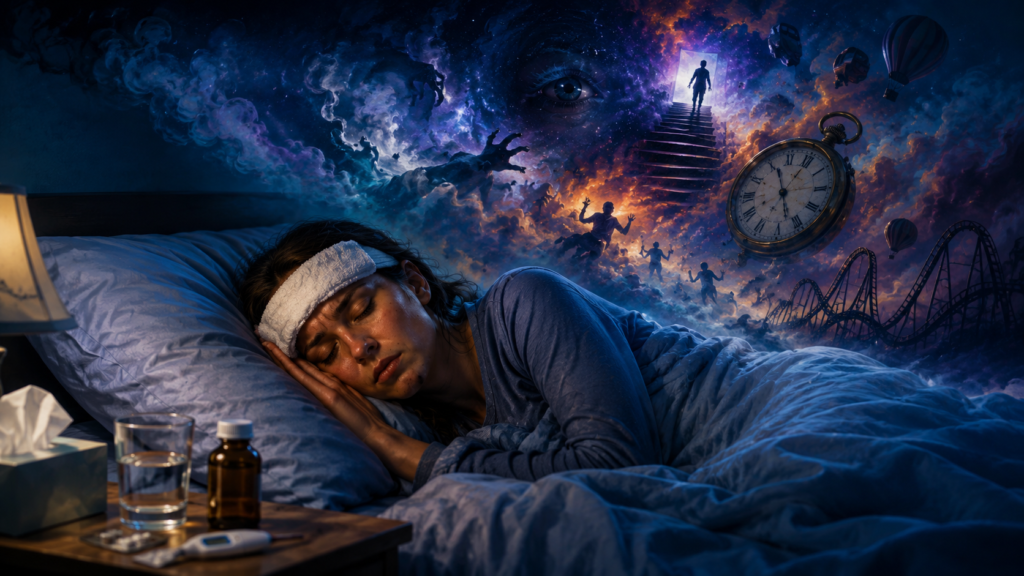
Many people notice that their dreams change when they have a fever. Dreams may become unusually vivid, strange, emotional, or unsettling—sometimes much more intense than dreams experienced while healthy.
Researchers have explored why this happens, but they have not identified one proven cause. Changes in body temperature, disrupted sleep, physical discomfort, and altered sleep patterns may all contribute to the unusual nature of fever dreams.
A peer-reviewed study on fever dreams found that people often described them as more bizarre and negatively toned than ordinary dreams. However, scientists still need more research to fully understand why fever affects dreaming.
What Are Fever Dreams?
A fever dream is a vivid, unusual, or unpleasant dream that occurs while a person has a fever.
The term describes an experience rather than a specific medical condition. People often report dreams that feel more intense, bizarre, emotional, or realistic than their usual dreams.
However, not everyone who develops a fever experiences or remembers a fever dream. Dream recall varies considerably from one person to another. Therefore, having a fever does not guarantee that unusual dreams will occur.
Why Do Fever Dreams Feel So Real?
Researchers have not identified a single proven explanation for fever dreams. However, several factors may contribute to their vivid or unusual nature.
Elevated Body Temperature
One theory suggests that increased body temperature may influence how the brain functions during sleep.
Fever can affect normal physical and cognitive processes. As a result, changes in body temperature may contribute to dream imagery that feels unusual, distorted, or emotionally intense.
Research specifically examining fever dreams remains limited, so scientists have not yet confirmed exactly how temperature changes influence dream content.
Disrupted REM Sleep
People often associate vivid dreams with rapid eye movement (REM) sleep, although dreaming can occur during other stages of sleep as well.
The National Institute of Neurological Disorders and Stroke explains that dreams can occur during any sleep stage but often become most vivid during REM sleep.
Fever and illness can disturb normal sleep patterns. These disruptions may influence how people experience or remember dreams.
Frequent Awakenings
Fever, chills, sweating, coughing, pain, and general discomfort can cause repeated awakenings during the night.
People often remember dreams more clearly when they wake during or shortly after them. Therefore, fragmented sleep may make fever dreams easier to remember, even if fever does not necessarily increase the total number of dreams.
Physical Discomfort and Illness
Physical sensations can also influence dream experiences.
A person who feels overheated, weak, achy, or uncomfortable may experience dream imagery that reflects those sensations. For example, a dream may involve excessive heat, threatening situations, distorted environments, or feelings of being trapped.
Researchers studying fever dreams have found increased references to heat, health problems, and negative emotions compared with ordinary dreams.
However, scientists still consider many explanations for fever dreams theoretical because research in this area remains limited.
What Do Fever Dreams Usually Feel Like?
Fever dreams vary widely, but people often describe several recurring characteristics.
These may include:
- Strange, distorted, or unrealistic settings
- Objects, spaces, or bodies that appear unusually large or warped
- A sense of danger or threat
- Feelings of being trapped or unable to escape
- Illness-related imagery
- Sensations involving heat or physical discomfort
- Strong negative emotions
- Unusually vivid or detailed imagery
- Dreams that feel confusing or difficult to explain after waking
A study published in Frontiers in Psychology found that fever dreams tended to contain more bizarre elements, negative emotions, health-related themes, and references to temperature than ordinary dreams.
Still, individual experiences vary significantly. Some people may notice only minor differences between fever dreams and their regular dreams.
Fever Dreams vs. Nightmares
Fever dreams and nightmares can overlap, but the terms do not mean exactly the same thing.
A nightmare is a disturbing dream that may involve fear, anxiety, danger, or other negative emotions. Nightmares can occur for many reasons, including stress, emotional distress, sleep disruption, medications, illness, or no obvious reason at all.
A fever dream, on the other hand, refers specifically to unusual dreaming that occurs while a person has a fever.
Therefore, a fever dream can also qualify as a nightmare if it causes fear or significant distress. However, not every fever dream is necessarily a nightmare.
The difference mainly comes down to context: the term fever dream connects the dream with fever, while nightmare describes the disturbing emotional nature of a dream.
Do Fever Dreams Have a Meaning?
Scientists have not established a system that assigns a fixed or medically proven meaning to specific fever-dream images.
People may naturally interpret unusual dreams through personal, cultural, spiritual, or symbolic beliefs. However, those interpretations differ from scientific evidence.
A fever dream may reflect a person’s immediate physical or emotional state. For example, someone who feels overheated or uncomfortable may dream about heat, illness, pressure, or threatening situations.
Research on fever dreams has found more health-related themes and temperature sensations than researchers observed in ordinary dreams.
Still, a particular image does not have a scientifically proven universal meaning.
Fever Dreams vs. Hallucinations
Understanding the difference between a fever dream and a hallucination matters.
A fever dream occurs during sleep.
A hallucination occurs while a person is awake and involves seeing, hearing, feeling, or otherwise perceiving something that does not have an external source.
For example, waking from an intense dream and remembering strange imagery differs from seeing or hearing things while fully awake.
Confusion, disorientation, or hallucinations during a fever require more attention than an unusual dream during sleep.
If someone with a fever becomes suddenly confused, difficult to wake, severely disoriented, or experiences unusual perceptions while awake, seek medical guidance promptly. Sudden changes in mental status can signal a more serious medical problem.
For more information, see the MedlinePlus guidance on confusion.
How Can You Reduce Uncomfortable Fever Dreams?
No proven method can specifically prevent fever dreams.
However, supporting sleep and recovery during an illness may reduce general discomfort and sleep disruption.
Helpful steps may include:
- Getting adequate rest
- Drinking enough fluids to avoid dehydration
- Keeping the sleep environment comfortable
- Wearing lightweight clothing when appropriate
- Following medical guidance for managing the underlying illness
- Following appropriate recommendations for fever management
- Avoiding unnecessary sleep disruption when possible
- Contacting a healthcare professional if symptoms become severe or continue to worsen
These measures support general recovery rather than specifically treating fever dreams.
For general fever guidance, see MedlinePlus information about fever.
People with medical conditions that affect fluid intake or fever management should follow advice from their healthcare professional rather than relying only on general recommendations.
When Should You Seek Medical Help?
A strange or vivid dream alone usually does not determine whether a fever requires medical treatment. Instead, pay attention to the fever itself, the person’s age, underlying health conditions, how long symptoms last, and whether other warning signs appear.
Seek prompt medical advice when a fever becomes unusually high, continues for an extended period, worsens, or occurs alongside concerning symptoms.
Seek urgent or emergency medical care when a fever occurs with symptoms such as:
- Significant confusion or disorientation while awake
- Difficulty waking or staying alert
- Severe difficulty breathing
- A seizure
- A severe headache with concerning symptoms
- A stiff neck
- Blue lips, tongue, or nails
- Severe or rapidly worsening illness
- Serious signs of dehydration or inability to drink enough fluids
Hallucinations or major changes in awareness while awake also deserve medical assessment rather than being dismissed as a fever dream.
Infants and young children require special attention because fever recommendations depend heavily on age. Older adults and people with weakened immune systems or serious underlying medical conditions may also need medical care sooner.
The MedlinePlus fever guide provides age-specific and symptom-based guidance on when to contact a healthcare professional or seek emergency care.
What Does the Research Say About Fever Dreams?
Scientific research specifically focused on fever dreams remains limited.
One peer-reviewed study compared recalled fever dreams with ordinary dreams. Researchers found that fever dreams contained more bizarre content, more negative emotions, more health-related themes, and more references to heat.
The researchers also noted important limitations. Participants recalled their dreams retrospectively, and the study could not determine exactly which sleep stages produced the dreams.
Because of these limitations, scientists cannot yet say precisely why fever changes dream experiences.
Future research using sleep laboratories, prospective dream diaries, and direct measurements during febrile illnesses may help researchers understand the connection more clearly.
Conclusion
Fever dreams are unusual, vivid, and sometimes disturbing dreams that occur while a person has a fever.
Scientists do not yet fully understand what causes them. Changes in body temperature, disrupted sleep patterns, physical discomfort, frequent awakenings, and changes in REM sleep may all contribute.
Research suggests that fever dreams can feel more bizarre and negatively toned than ordinary dreams. They may also contain more imagery related to heat, illness, and physical discomfort.
However, fever dreams do not have a scientifically proven symbolic meaning.
Most importantly, distinguish an unusual dream during sleep from confusion, disorientation, or hallucinations while awake. If a person with a fever develops concerning changes in awareness, severe breathing difficulty, seizures, or other serious symptoms, seek appropriate medical care.
For more health explainers and medical news, visit Fresh Global News Health and Diseases & Conditions.
Medical Disclaimer
This article provides general educational and informational content only. It does not replace professional medical advice, diagnosis, or treatment. Anyone with concerning, severe, persistent, or worsening symptoms should contact a qualified healthcare professional.