


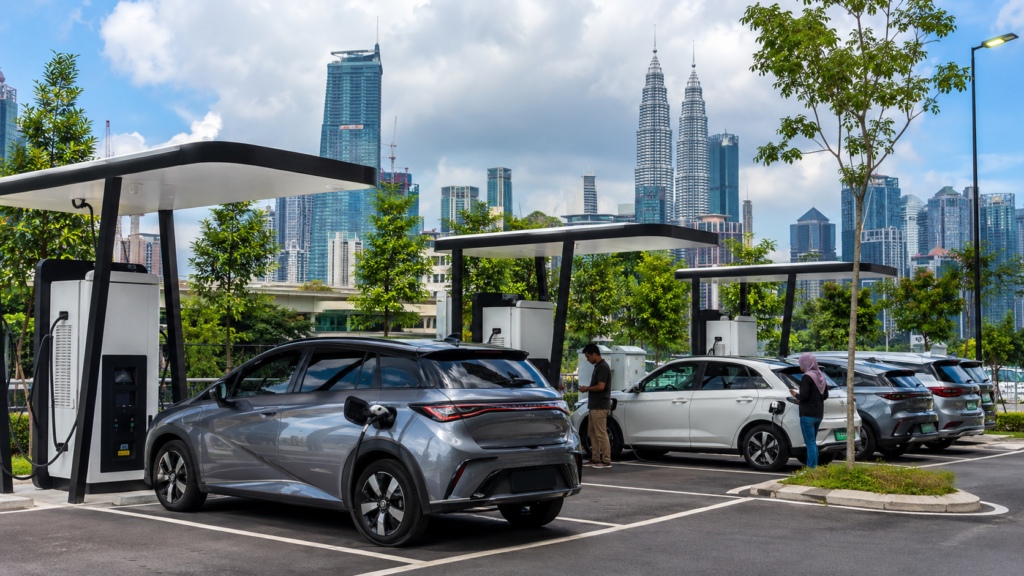
Malaysia is rolling out new EV charging incentives to close a widening gap between electric vehicle demand and the country’s charging network. The government confirmed the plan in parliament in July 2026, tying it to a national target of 30,000 charging points by 2030.
The announcement matters because Malaysia EV sales have grown steadily, yet the number of public chargers has lagged behind. The new incentives are designed for charging point operators, the companies that install and run public chargers, so more stations get built faster.
Quick Answer
Malaysia’s government confirmed it is refining tax incentives and working with national utility Tenaga Nasional Berhad to expand EV charging infrastructure. The country had 6,416 public EV chargers as of May 31, 2026, short of an earlier 10,000 target for 2025. The new goal is 30,000 chargers by 2030, supported by tax breaks for charging point operators and equipment manufacturers.
Key Takeaways
- Malaysia had 6,416 public EV chargers as of May 31, 2026, including 2,143 DC fast chargers and 4,273 AC chargers.
- The government missed its earlier target of 10,000 chargers by the end of 2025.
- A new national target calls for 30,000 charging points by 2030.
- The government is working with Tenaga Nasional Berhad to build more power substations for fast chargers.
- Existing tax incentives for charging point operators are being adjusted to attract more private investment.
- Malaysia trails Singapore in total charger numbers but is ahead of several regional peers on tax-based incentives.
What Malaysia Announced About EV Charging
The update came from Sim Tze Tzin, Deputy Minister of Investment, Trade and Industry, during an oral answer session in the Dewan Rakyat, Malaysia’s lower house of parliament, on July 8, 2026.
Sim told lawmakers the government is aware that charging facilities remain insufficient for the number of EVs now on Malaysian roads. He said officials are adjusting policy settings and incentive structures rather than starting from scratch.
Three elements defined the announcement. First, a new 2030 target of 30,000 charging points. Second, closer coordination with Tenaga Nasional Berhad, the state utility, on power substations. Third, ongoing discussion of targeted incentives for charging point operators to encourage faster rollout.
Sim also noted that EV policy in Malaysia continues to evolve because electric vehicles remain a relatively new product category. The government wants incentives to keep pace with the market rather than lock in rules that quickly become outdated.
Why Malaysia Needs More Charging Stations
Electric vehicle charging infrastructure refers to the physical network of chargers, cables, and supporting electrical equipment that lets EV owners recharge their vehicles away from home. Without enough of it, drivers face longer waits, limited route options, and uncertainty about finding a working charger.
Malaysia’s EV market has expanded quickly in recent years as manufacturers introduced more affordable models. That growth increased pressure on a charging network that was not originally built for mass adoption.
Fast chargers, known as DC chargers, are especially important for longer trips because they restore significant battery range in a short time. Malaysia’s DC fast charger count grew by more than 70 percent year over year in 2025, according to the International Energy Agency, yet demand has continued to outpace supply in several states.
How Many EV Chargers Does Malaysia Have?
As of May 31, 2026, Malaysia had 6,416 public EV chargers nationwide. That total includes 2,143 DC fast chargers and 4,273 slower AC chargers, based on figures cited by the Deputy Minister in parliament.
The government had previously set a target of 10,000 chargers by the end of 2025. That target was not met, prompting the policy review announced in July 2026.
Malaysia’s EV Charging Targets for 2025 and 2030
| Metric | Figure |
| Current charging stations (as of May 31, 2026) | 6,416 |
| Previous government target | 10,000 by end of 2025 |
| New government target | 30,000 by 2030 |
| Progress toward new target | About 21 percent |
The gap between the old target and actual deployment explains why officials are revising incentives rather than simply repeating the same approach.
How Charging Incentives Work
Charging point operators, often shortened to CPOs, are private companies that install, own, and manage EV chargers in public locations such as malls, highways, and office buildings. Malaysia had roughly 30 such operators active in the market as of late 2024.
Two financial tools sit at the center of Malaysia’s approach: the investment tax allowance and the income tax exemption.
An investment tax allowance lets a qualifying company deduct a percentage of its capital spending from its taxable income, reducing the tax bill in the years after it invests. An income tax exemption removes tax liability on a portion or all of a company’s statutory income for a set period.
Malaysia’s EV Charging Tax Incentives
Under Malaysia’s Green Investment Tax Allowance program, CPOs that meet eligibility criteria can receive a 100 percent investment tax allowance for five years. That allowance can offset up to 100 percent of statutory income in each assessment year, according to the Ministry of Investment, Trade and Industry.
Separately, companies that manufacture EV charging equipment qualify for a full income tax exemption on statutory income from the 2023 assessment year through 2032, provided they meet manufacturing and local employment requirements set by the Malaysian Investment Development Authority.
Individual EV owners also benefit. Malaysians can claim RM2,500 in annual personal income tax relief through 2027 for installing, renting, or subscribing to home charging equipment.
| Incentive | Who Qualifies | Purpose | Expected Impact |
| Green Investment Tax Allowance | Charging point operators meeting criteria | Offset capital spending on charger installation | Faster buildout of public charging stations |
| Income tax exemption for equipment makers | Licensed EV charging equipment manufacturers | Reduce tax burden through 2032 | More domestic charger production |
| Personal income tax relief (RM2,500) | Individual EV owners | Lower cost of home charger installation | Increased home charging adoption |
| New targeted CPO incentives (under discussion) | Charging point operators expanding networks | Encourage investment in underserved areas | Wider geographic coverage of chargers |
Benefits for Charging Point Operators
Operators gain a clearer path to profitability when tax allowances offset a large share of upfront installation costs. That matters because charger hardware, site preparation, and grid connection work all carry significant capital expense before an operator earns any revenue.
The government’s ongoing work with Tenaga Nasional Berhad on power substations also reduces a major barrier for operators. Without adequate substation capacity, a site simply cannot support fast chargers, regardless of available tax breaks.
Benefits for EV Manufacturers
Automakers benefit indirectly. A denser, more reliable charging network reduces range anxiety among potential buyers, which supports vehicle sales. Manufacturers of charging equipment itself benefit directly through the income tax exemption running through 2032.
Benefits for Consumers
EV owners gain from shorter wait times, more charging locations, and continued personal tax relief for home installations. A stronger public network also makes EVs a realistic option for drivers without access to home charging, including many apartment residents.
Malaysia’s EV Infrastructure Challenges
Several structural issues remain beyond incentives alone. Approval timelines for new charging bays have historically been slow, though PLANMalaysia’s EV Charging Bay Guidelines have shortened that process. Grid capacity in older buildings and dense urban areas continues to limit where fast chargers can be installed.
Power Grid and Substations
Fast chargers draw substantially more electricity than standard AC chargers, and many existing substations were not designed for that load. Tenaga Nasional Berhad’s involvement is intended to ensure new substations are built alongside charger rollout rather than after demand already exceeds capacity.
What the Policy Means for EV Infrastructure Investors
The combination of tax allowances, income tax exemptions, and a firm 2030 target creates a more predictable environment for investors. Charging network operators, equipment manufacturers, and green energy companies interested in sustainable transportation infrastructure may benefit if the incentives reduce installation and operating costs from continued policy support.
How Malaysia Compares With Singapore, Thailand and Indonesia
Singapore had deployed about 30,500 EV charging points as of March 2026, according to its Ministry of Transport, and is targeting 60,000 by 2030. That would split roughly 40,000 in public car parks and 20,000 in private premises.
Thailand had surpassed 3,700 charging stations by mid-2025 and has separately set expansion targets for its DC fast-charging network as part of broader industry plans, alongside stricter equipment certification rules that took effect in April 2026.
Indonesia had fewer than 5,000 public charging stations as of December 2025. The International Energy Agency reported an Indonesian government target of 32,000 public charging points by 2030, while some industry estimates project even higher figures depending on how quickly EV adoption accelerates.
| Country | Approximate Current Chargers | 2030 Target |
| Malaysia | 6,416 (May 2026) | 30,000 |
| Singapore | 30,500 (March 2026) | 60,000 |
| Thailand | 3,700+ (mid-2025) | Expanding DC network under EV 3.5 policy |
| Indonesia | Under 5,000 (Dec 2025) | 32,000 |
Singapore leads the region in absolute numbers and has the most mature regulatory framework, anchored by its Electric Vehicles Charging Act. Malaysia’s tax-based incentive model is broadly similar in intent to approaches used across Southeast Asia, though each country structures its support differently.
How Stronger Charging Infrastructure Supports EV Adoption
Charging availability directly influences purchase decisions. Buyers are more likely to choose an EV when they can reasonably expect to find a working charger near home, work, or along common travel routes. Malaysia’s push to triple its charger network by 2030 is intended to remove that hesitation for a wider segment of drivers, including those in apartments and multi-unit housing who cannot install home chargers.
Challenges Malaysia Still Faces
Even with expanded incentives, Malaysia must still resolve grid capacity constraints, streamline remaining approval bottlenecks, and ensure charger distribution reaches rural and semi-urban areas rather than concentrating in major cities. Coordination between federal agencies, state governments, and Tenaga Nasional Berhad will determine how quickly the 2030 target becomes achievable.
What Happens Next
The Ministry of Investment, Trade and Industry has indicated that detailed terms for the new charging point operator incentives are still being finalized. Further announcements are expected as the government works with Tenaga Nasional Berhad on substation planning and refines eligibility criteria for operators seeking tax relief.
Frequently Asked Questions
Q1. What is Malaysia’s new EV incentive?
Malaysia is refining tax incentives for charging point operators, including investment tax allowances, alongside a new national target of 30,000 public chargers by 2030.
Q2. Why does Malaysia need more EV charging stations?
Demand for public charging has outpaced supply as EV sales rise, and the country missed its earlier target of 10,000 chargers by the end of 2025.
Q3. How many charging stations does Malaysia have?
Malaysia had 6,416 public EV chargers as of May 31, 2026, including 2,143 DC fast chargers and 4,273 AC chargers.
Q4. What is Malaysia’s EV target?
The government’s current target is 30,000 public charging points nationwide by 2030.
Q5. How do charging incentives work?
Charging point operators can receive a 100 percent investment tax allowance for five years, offsetting up to 100 percent of statutory income, while individual owners get personal tax relief for home charger installation.
Q6. Will this help EV adoption?
Analysts expect a denser charging network to reduce range anxiety and support continued EV sales growth, though results depend on how quickly new stations are actually built.
Q7. How does Malaysia compare with neighboring countries?
Malaysia trails Singapore in total chargers and target scale but is ahead of Indonesia’s current deployment, with Thailand pursuing a parallel expansion focused on fast charging.
Final Verdict
Malaysia’s revised EV charging incentives reflect a government adjusting course after missing an earlier deployment target. The new 30,000-charger goal for 2030, paired with tax allowances for operators and continued grid investment through Tenaga Nasional Berhad, gives the market a clearer direction. Whether Malaysia closes the gap with regional leaders like Singapore will depend on how quickly the finalized incentives translate into chargers on the ground.