



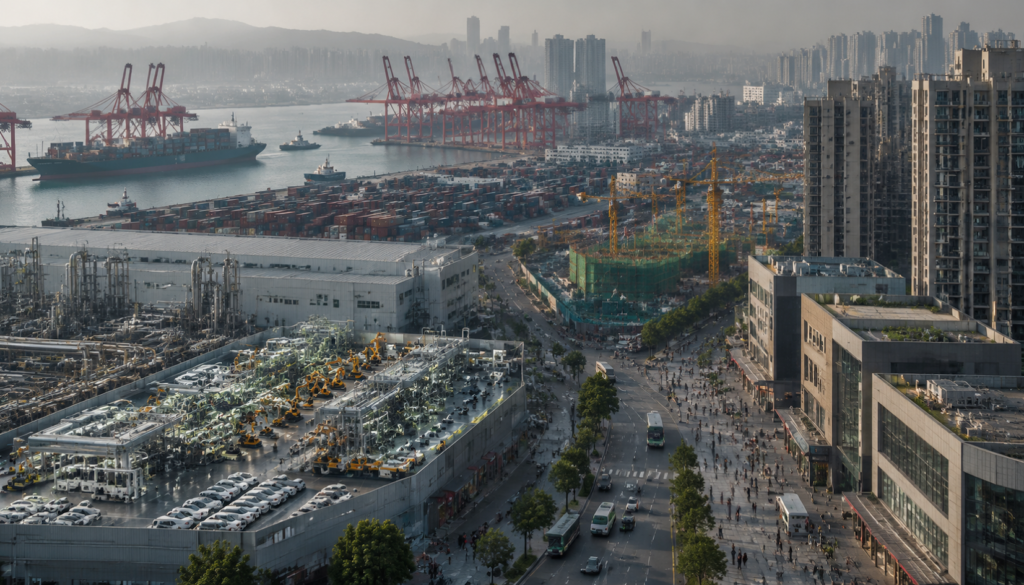
China’s economy grew 4.3% year-over-year in the second quarter of 2026, down from 5.0% in the first quarter, the National Bureau of Statistics (NBS) reported on July 15. The Chinese economy slowdown occurred despite a 27% jump in exports, as weak consumer spending, falling home prices, and shrinking investment offset gains from semiconductors and electric vehicles.
Key Facts
- China’s GDP grew 4.3% year-over-year in Q2 2026, below the 4.5% consensus forecast and under Beijing’s 4.5%–5% annual target, according to the National Bureau of Statistics.
- First-half 2026 GDP growth stood at 4.7% year-over-year, with output reaching roughly 69.6 trillion yuan (about $10.25 trillion), per NBS data released July 15.
- June exports surged 27% year-over-year to a record $412.4 billion, the fastest pace since October 2021, the General Administration of Customs reported.
- Retail sales rose just 1.0% year-over-year in June, rebounding from a 0.6% decline in May that was China’s first monthly retail drop since December 2022.
- Nationwide fixed-asset investment fell 5.7% year-over-year in the first half of 2026, dragged down by an estimated 18% plunge in real estate investment, according to NBS figures.
Why Is China’s Economy Slowing?
China’s economy is slowing because a persistent gap between strong export manufacturing and weak domestic demand is widening. Factories tied to semiconductors, artificial intelligence hardware, and electric vehicles are booming, but households are spending cautiously, and the property sector keeps shrinking. Economists describe this as a “two-track” or “K-shaped” economy, where advanced manufacturing outperforms while everyday consumption and construction activity lag.
The property downturn is the biggest drag. Real estate and related investments have declined for roughly five consecutive years, and new-home prices in 70 major cities fell 3.3% year-over-year in June, marking the 36th straight month of annual declines, according to NBS data reported by Trading Economics. Falling home values have eroded household wealth, since residential property has historically made up the majority of urban family assets, which in turn discourages spending on everything from cars to appliances.
Volatile global energy prices tied to the war in Iran added a further complication. Higher oil and energy costs earlier in the year raised import bills and helped pull China out of a long stretch of mild deflation, though the connection to the broader growth slowdown is one contributing factor among several rather than the primary cause.
How Fast Did China’s Economy Grow in Q2 2026?
China’s economy expanded 4.3% year-over-year in the April-to-June quarter, down from 5.0% in the first quarter and the weakest quarterly pace since late 2022, according to the NBS. On a quarter-over-quarter basis, growth eased to 0.9% from 1.3% in the first quarter, per Trading Economics data drawn from official statistics.
| Indicator | Result | Previous Period | Meaning |
| Q2 2026 GDP (YoY) | 4.3% | 5.0% (Q1 2026) | Growth slowed and missed the official target range |
| First-half 2026 GDP (YoY) | 4.7% | — | Still within reach of the annual target, but decelerating |
| Retail sales (June, YoY) | 1.0% | -0.6% (May) | Consumer demand remains weak despite a rebound |
| Fixed-asset investment (H1, YoY) | -5.7% | -1.6% (Jan–Apr) | Investment weakness deepened, led by real estate |
| Exports (June, YoY) | 27% | 19.4% (May) | External demand accelerated sharply |
| Official 2026 growth target | 4.5%–5% | 5.0% (2025 actual) | Lowest target range since the early 1990s |
Why Strong Exports Were Not Enough
China’s exports were not enough to offset the slowdown because export-driven manufacturing employs a smaller share of the workforce than construction, retail, and services, which are more directly tied to household spending. June exports rose 27% year-over-year to a record $412.4 billion, and integrated-circuit exports jumped 96.1% year-over-year in the first half of 2026 to $177.3 billion, according to customs data cited by Tom’s Hardware. Automobile exports, led by electric vehicles, climbed 69.6% year-over-year in June.
China’s trade surplus reached $575.98 billion for the first half of 2026, though that was slightly below the $586 billion recorded a year earlier, per Trading Economics. Julian Evans-Pritchard, head of China economics at Capital Economics, noted that much of the surge in trade values reflects rising semiconductor prices tied to the global AI boom rather than a broad-based pickup in demand. Because these high-tech gains are concentrated in a narrow set of industries, they cannot fully substitute for a recovery in the far larger consumer economy.
Weak Consumer Spending Is Holding Back Growth
Consumer spending remains the weakest link in China’s economy, with retail sales rising just 1.0% year-over-year in June after an outright decline in May. First-half retail sales growth totaled 1.3% year-over-year, and sales excluding autos rose a stronger 2.8%, according to NBS figures tracked by Trading Economics. Automobile sales fell sharply even as auto exports boomed, while home appliances, furniture, and building materials all posted year-over-year declines in June.
Job security concerns are a major factor behind cautious spending. China’s urban unemployment rate held steady at 5% in June, but a separate long-term unemployment survey referenced by CNBC put broader joblessness at 10.2%, with more than half of that group aged 16 to 24. The youth unemployment rate, using a revised methodology, fell to 15.6% in May, its lowest level in nearly a year, though it remains elevated by historical standards.
How the Property Slump Is Affecting China
China’s property crisis continues to weigh on household wealth, local government finances, and construction activity. New-home prices across 70 cities fell 3.3% year-over-year in June, while secondary-market prices in 100 major cities dropped 0.42% month-over-month, according to data from the China Index Academy reported by Asia Times. Real estate development investment fell roughly 16% to 18% in year-to-date terms through the first half of 2026, extending a decline that began in 2021.
Because housing represents the largest share of household assets for most urban Chinese families, falling prices have pushed many households to save more and spend less, a pattern economists call the “negative wealth effect.” Local governments, which historically relied on land sales for revenue, have also faced fiscal strain as property transactions have slowed.
Why Fixed-Asset Investment Is Falling
China’s fixed-asset investment fell 5.7% year-over-year in the first half of 2026, and even excluding real estate, investment was still down 2.7%, according to NBS data reported by Xinhua. Infrastructure investment declined 2.4%, and manufacturing investment slipped 1.2%, though investment in high-tech industries rose 4.6% and spending on intellectual property products climbed 9.4%. This split shows that capital is flowing toward strategic sectors such as artificial intelligence, integrated circuits, and aerospace manufacturing, while traditional investment channels keep shrinking.
Are AI, Chips, and EVs Supporting China’s Economy?
Yes, but only partially. Semiconductor, AI-hardware, and electric-vehicle exports have been the standout performers of 2026, with integrated-circuit export value up 96.1% year-over-year in the first half of the year. Investment in high-tech manufacturing, including aircraft, spacecraft, and computer-related equipment, also grew faster than overall investment, according to NBS figures.
However, these industries employ a relatively small share of China’s workforce compared with construction, retail, and traditional manufacturing. Analysts at Macquarie noted that chips, computer parts, and power equipment accounted for roughly half of China’s export growth in the first half of the year, meaning the broader economy remains heavily exposed if global AI demand were to slow. High-tech exports can lift headline GDP and industrial output, but they cannot single-handedly restore household confidence or revive the property market.
Is China’s Economy in a Recession?
No. China’s economy grew 4.3% year-over-year and 0.9% quarter-over-quarter in the second quarter of 2026, meaning output expanded rather than contracted. A recession is commonly defined as two consecutive quarters of negative growth, and China has not recorded a quarterly GDP contraction. The slowdown reflects decelerating growth, not an outright economic decline, though it is the weakest pace of expansion since late 2022.
Could China Announce More Economic Stimulus?
China has not confirmed new large-scale stimulus, but investors are watching an expected Politburo meeting in late July for signals on policy direction. Premier Li Qiang has called for “a comprehensive and objective understanding” of the economic situation and urged stronger counter-cyclical policy adjustments, according to Trading Economics. A Reuters poll of economists found that most expect the People’s Bank of China to hold its policy rate steady through 2026, with a possible 20-basis-point cut to the reserve requirement ratio only in the fourth quarter.
Earlier in 2026, banks including Goldman Sachs and Nomura pushed back their forecasts for monetary easing after the Politburo signaled confidence in growth and limited urgency for aggressive action, Bloomberg reported. Economist Woei Chen Ho of UOB said a large-scale stimulus package appears unlikely, though selective, targeted measures to support consumption and investment remain possible. Any additional stimulus, and its scale, remains an estimate rather than a confirmed policy at this stage.
Will China Meet Its 2026 Growth Target?
China’s official target for 2026 is 4.5% to 5% GDP growth, the lowest range Beijing has set since it began publishing annual targets in the early 1990s. First-half growth of 4.7% keeps China within reach of that range, but the second-quarter figure of 4.3% fell below the target floor, an unusual outcome for Chinese data. A Reuters poll of economists forecasts full-year 2026 growth of 4.6%, which would land within the official target range but represent a continued slowdown from 5.0% in 2025. The International Monetary Fund similarly projects 2026 growth of around 4.6%, a slight upgrade from its April forecast, though it has flagged structural issues such as weak demand and an aging population as ongoing risks.
How Could China’s Slowdown Affect the Global Economy?
A slower China matters well beyond its borders because the country remains the world’s largest consumer of industrial commodities and a central node in global manufacturing supply chains. Softer property construction and fixed-asset investment could reduce Chinese demand for steel, cement, copper, and other raw materials, with knock-on effects for commodity-exporting economies in Latin America, Africa, and Australia. At the same time, surging Chinese exports of EVs, semiconductors, and electronics are reshaping trade flows, with shipments to the European Union and other markets rising as manufacturers diversify away from the United States.
China’s widening trade surplus, which reached $575.98 billion in the first half of 2026, has also fueled friction with trading partners in the US and EU concerned about excess industrial capacity. Weaker Chinese domestic demand could dampen oil consumption growth, though this must be weighed against the separate upward pressure on prices from the war in Iran. For global investors, the direction of Beijing’s policy response, rather than the GDP figure itself, is likely to be the more consequential signal for markets in the second half of 2026.
What Is Confirmed?
Confirmed, NBS-reported figures include: Q2 2026 GDP growth of 4.3% year-over-year; first-half 2026 GDP growth of 4.7%; June retail sales growth of 1.0%; first-half fixed-asset investment down 5.7%; and June exports up 27% year-over-year, per the General Administration of Customs. China’s official 2026 growth target of 4.5%–5% and June’s steady 5% urban unemployment rate are also officially confirmed.
What Remains Uncertain?
It remains uncertain whether Beijing will introduce additional stimulus, and if so, how large and targeted it will be; this depends on the outcome of the expected late-July Politburo meeting. It is also uncertain how long elevated AI-related chip demand will continue to support exports, whether the property market will stabilize in 2026 or 2027 as some analysts project, and how the Iran conflict’s effect on energy prices will evolve. Broader unemployment estimates outside official urban figures, such as the 10.2% long-term joblessness estimate cited by CNBC, have not been independently verified by NBS.
What Should Readers Watch Next?
- Monthly retail sales and industrial production data from the NBS
- New-home price trends across 70 cities and property investment figures
- Fixed-asset investment and manufacturing investment trends
- Monthly export and import growth from the General Administration of Customs
- Consumer price inflation and producer price trends
- Youth and broader unemployment data
- Any policy announcements from the People’s Bank of China
- Outcomes of the Communist Party’s late-July Politburo meeting
Frequently Asked Questions
Q1. Why is China’s economy slowing?
China’s economy is slowing mainly because weak consumer spending, falling property investment, and cautious business investment are outweighing gains from strong exports. The property downturn has reduced household wealth and confidence, while job security concerns keep many families saving rather than spending, according to NBS and customs data.
Q2. What was China’s GDP growth in Q2 2026?
China’s GDP grew 4.3% year-over-year in the second quarter of 2026, down from 5.0% in the first quarter, the National Bureau of Statistics reported on July 15. The figure missed the roughly 4.5% consensus forecast and fell below Beijing’s official 4.5%–5% annual growth target.
Q3. Is China’s economy in a recession?
No. China’s GDP expanded 4.3% year-over-year and 0.9% quarter-over-quarter in the second quarter, meaning output grew rather than contracted. A recession typically requires two consecutive quarters of negative growth, which has not occurred.
Q4. Why are China’s exports strong while domestic demand is weak?
Exports are strong because global demand for Chinese semiconductors, AI-related hardware, and electric vehicles has surged, with June exports up 27% year-over-year. Domestic demand remains weak because falling home prices, job uncertainty, and cautious household spending have not improved at the same pace, creating a two-track economy.
Q5. Could China introduce more economic stimulus?
China has not confirmed new large-scale stimulus, but analysts are watching the Communist Party’s expected late-July Politburo meeting for policy signals. Most economists surveyed by Reuters expect targeted, incremental measures rather than aggressive rate cuts, with a possible reserve-requirement-ratio cut later in the year.
Q6. How will China’s slowdown affect the global economy?
A slower China could reduce Qdemand for industrial commodities such as steel and copper, affecting exporting economies, while its surging tech and EV exports continue to reshape global trade flows. The policy response from Beijing, rather than the GDP figure alone, is likely to matter most for global markets and manufacturers in the coming months.
Conclusion
The Chinese economy slowdown in the second quarter of 2026 reflects a widening gap between a booming, technology-driven export sector and a domestic economy still weighed down by the property crisis and cautious consumers. While 4.3% growth is far from a collapse, it is a rare miss against Beijing’s own target range and underscores how difficult it has become to rebalance the world’s second-largest economy toward consumption. Whether policymakers respond with targeted stimulus at the late-July Politburo meeting, and whether exports can keep outperforming, will shape how the rest of 2026 unfolds. Follow FreshGlobalNews.com for continuing coverage of China’s economic data and its impact on global markets.