


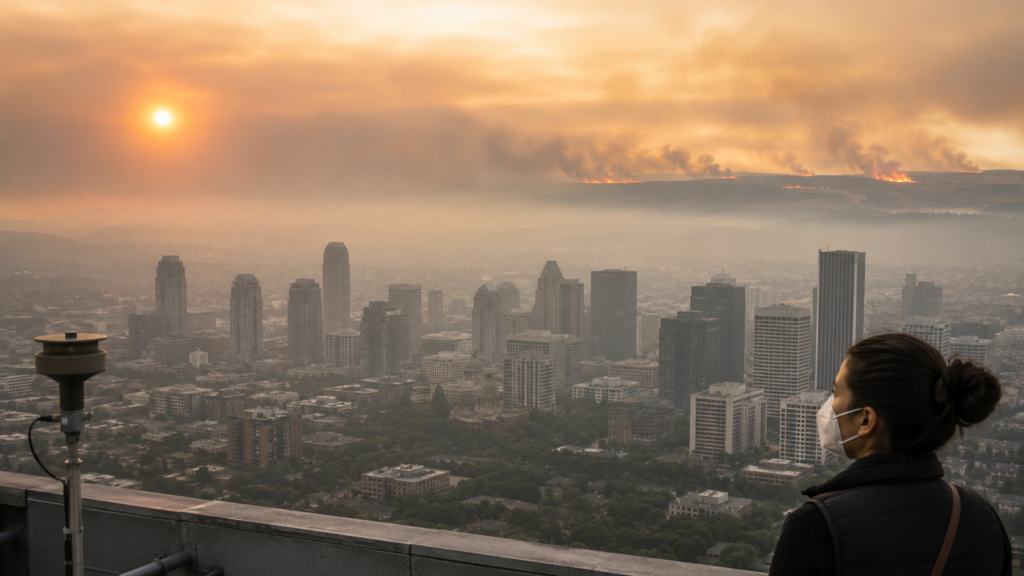
Wildfire smoke from Canada and northern Minnesota is reducing air quality across the U.S. Midwest, Great Lakes, and Northeast. Some locations have recorded unhealthy or worse conditions, prompting officials to urge residents to limit outdoor activity, monitor local alerts, and reduce their exposure to smoke. Conditions vary significantly by location and can change quickly with wind and weather patterns.
Quick Update
Smoke from wildfires in Ontario and other central Canadian provinces continued affecting parts of the Midwest, Great Lakes, and Northeast on July 17, 2026. Canada reported 859 active fires on July 16, including 113 classified as out of control. Residents should check local Air Quality Index readings because conditions can differ sharply between nearby communities and change throughout the day.
Canada Wildfire Smoke Spreads Across U.S. Regions
Heavy smoke from wildfires in Canada has moved south and southeast into the United States, producing hazy skies, reduced visibility, and unhealthy air in several regions.
The most significant effects have been reported across portions of Minnesota, Wisconsin, Michigan, Illinois, Ohio, Pennsylvania, New York, and New England. Smoke has also reached other parts of the Midwest and East Coast, although conditions are not equally severe everywhere.
The National Weather Service reported that Canadian wildfire smoke was spreading across much of the Great Lakes, with surface-level smoke capable of reducing visibility and creating air-quality problems. In northeastern Wisconsin, visibility was expected to fall below one mile at times, according to a National Weather Service briefing issued July 16. National Weather Service
Air quality alerts were active across parts of more than 20 states on July 16, according to current reporting. The affected area remained dynamic as wind shifted the smoke between communities. Reuters
Residents should not assume that a statewide alert means every city or neighborhood has the same air quality. Smoke concentrations can vary by elevation, wind direction, local weather, and time of day.
Latest Canada Wildfire Update
Canada was battling 859 active wildfires as of July 16, 2026, according to figures reported by Reuters. Of those fires, 113 were classified as out of control. Approximately 2.384 million hectares had burned during the 2026 season by that date.
Most of the major fire activity was concentrated in remote areas of Manitoba, Saskatchewan, and Ontario. The number of active fires and the total area burned were higher than at the same point in 2025. Reuters
Ontario requested federal assistance on July 16 to support evacuations from remote northern communities. The request included possible assistance from the Canadian Armed Forces. Approximately 1,600 people had been evacuated from First Nations communities at the time of the request.
Canadian officials remained in contact with provincial and municipal authorities as they evaluated the need for additional emergency assistance.
Wildfire figures can change several times in one day as agencies identify new fires, update existing incidents, or revise their classifications. The Canadian Interagency Forest Fire Centre provides the latest national fire statistics and an active-fire map.
Why Is the Smoke Reaching the United States?
Smoke can travel hundreds or thousands of miles from its source when winds carry it into the upper atmosphere. Weather systems can then transport it across provincial, state, and international borders.
In this event, winds carried smoke from fires in central Canada, particularly northern Ontario, toward the southern part of the province and into the U.S. Midwest and Northeast. Fires in northern Minnesota have also contributed to smoke in parts of the region.
Some smoke remains high in the atmosphere and causes only hazy skies or an orange appearance around the sun. The greater health concern begins when smoke descends toward the surface and increases concentrations of fine particulate matter.
Rain, changing wind direction, and stronger atmospheric mixing may improve conditions. A wind shift can also move smoke into a community that previously had relatively clean air. Forecasts should therefore be treated as forecasts rather than guarantees.
What Is Wildfire Smoke?
Wildfire smoke is a mixture of gases, water vapor, and extremely small particles produced when trees, vegetation, buildings, and other materials burn.
The most important pollutant for public health during many smoke events is PM2.5. These particles have a diameter of 2.5 micrometers or smaller. Their small size allows them to travel deep into the lungs and, in some cases, enter the bloodstream.
Smoke can irritate the eyes, nose, throat, and lungs. Exposure may cause coughing, wheezing, headaches, chest discomfort, shortness of breath, or unusual fatigue.
The Centers for Disease Control and Prevention advises everyone to reduce smoke exposure. Children, pregnant people, older adults, and people with asthma, chronic obstructive pulmonary disease, heart disease, diabetes, or chronic kidney disease may face greater risks. CDC
What Does the Air Quality Index Mean?
The U.S. Air Quality Index converts measurements of major air pollutants into a scale that helps people understand current health risks.
According to AirNow, the official categories are:
| AQI level | Category | General meaning |
| 0 to 50 | Good | Air pollution presents little or no risk |
| 51 to 100 | Moderate | Usually acceptable, with possible concerns for unusually sensitive people |
| 101 to 150 | Unhealthy for sensitive groups | Higher-risk groups should reduce prolonged outdoor activity |
| 151 to 200 | Unhealthy | Some effects are possible for everyone |
| 201 to 300 | Very unhealthy | Health alert conditions affect the entire population |
| 301 and above | Hazardous | Emergency conditions with greater risk for everyone |
Air quality should not be described as hazardous unless the official AQI reaches 301 or higher. An AQI above 100 is initially unhealthy for sensitive groups, with broader risks developing as the number rises. AirNow
The AQI can change quickly during a wildfire smoke event. Readers should check AirNow’s Fire and Smoke Map or their state and local health department before going outside.
Canada uses the Air Quality Health Index, or AQHI. It ranges from 1 to 10+, with higher numbers representing greater health risks. An AQHI of 10+ indicates a very high health risk, and everyone should take precautions. Environment and Climate Change Canada
Who Faces the Greatest Wildfire Smoke Health Risks?
Anyone can experience symptoms when smoke levels become high enough. However, several groups may be affected sooner or more severely:
- Children and teenagers
- Adults aged 65 and older
- Pregnant people
- People with asthma or other lung conditions
- People with cardiovascular disease
- People with diabetes or chronic kidney disease
- Outdoor workers
- People without access to filtered indoor air
- People performing strenuous outdoor exercise
People with asthma should follow their asthma action plan and keep prescribed quick-relief medication available. Anyone experiencing severe difficulty breathing, chest pain, confusion, or worsening symptoms should seek urgent medical assistance.
Does an N95 Mask Help With Wildfire Smoke?
A properly fitted, NIOSH-approved N95 respirator can reduce exposure to the fine particles in wildfire smoke. It must fit closely around the nose and mouth to work effectively.
Loose-fitting surgical masks, cloth face coverings, and bandanas do not provide the same protection against PM2.5.
An N95 does not remove all gases found in smoke. Staying in a cleaner indoor environment remains preferable to spending extended periods outdoors, even while wearing a respirator. The CDC recommends an approved N95 when a person must go outside during a significant smoke event. CDC
Should People Exercise Outside?
People should check their local AQI before exercising outdoors. When air quality is unhealthy, postponing, shortening, or moving exercise indoors can reduce exposure.
Physical activity increases breathing rate and the amount of polluted air entering the lungs. During intense exercise, a person may inhale 10 to 20 times more air than at rest. CDC
Sensitive individuals should begin reducing prolonged or heavy outdoor exertion when the AQI reaches 101. At higher levels, everyone should consider limiting strenuous activity and following local health guidance.
How to Improve Indoor Air Quality
Closing windows is helpful, but smoke can still enter a building through small openings, ventilation systems, and frequently opened doors.
The Environmental Protection Agency recommends taking practical steps to create cleaner indoor air:
- Keep windows and doors closed when outdoor air is unhealthy.
- Run an HVAC system with an appropriate filter when available.
- Set air conditioning systems to recirculate indoor air.
- Use a portable air cleaner sized for the room.
- Avoid smoking, frying food, burning candles, or using fireplaces.
- Spend time in a designated clean-air room.
- Visit a public cooling or clean-air center if the home becomes too hot.
Portable air cleaners and upgraded HVAC filters can reduce indoor PM2.5 during wildfire smoke events. EPA
People should not seal themselves inside a dangerously hot home. Extreme heat creates a separate health risk, particularly for older adults and people with medical conditions.
How Long Could the Smoke Last?
The exact duration depends on fire activity, wind direction, rainfall, temperature, and atmospheric conditions.
Smoke may improve in one location within hours while worsening elsewhere. Even after surface air becomes cleaner, another wind shift can bring smoke back. Fires in remote parts of Canada may continue producing smoke until they are controlled or receive substantial rain.
National Weather Service forecasts indicated that smoke would continue affecting parts of the Great Lakes and Northeast around July 17. Residents should monitor hourly observations because a regional forecast may not reflect conditions in every neighborhood.
Frequently Asked Questions
Q1. Where is Canadian wildfire smoke affecting the U.S.?
The main effects have been reported across parts of the Midwest, Great Lakes, Ohio Valley, New York, and New England. Conditions vary by city and can change throughout the day.
Q2. Why has air quality worsened?
Winds have transported smoke from Canadian and Minnesota wildfires into populated areas. When smoke reaches ground level, PM2.5 concentrations rise and reduce air quality.
Q3. How dangerous is the current air quality?
The risk depends on the local AQI. Conditions above 100 are unhealthy for at least some people. AQI readings from 151 to 200 are unhealthy for everyone, while readings above 300 are hazardous.
Q4. What is an air quality alert?
An air quality alert is an official notice that pollution levels are unhealthy or expected to become unhealthy. The alert usually includes the affected area, pollutant, time period, and recommended precautions.
Q5. How can people protect themselves?
Check local conditions, reduce outdoor exertion, keep indoor air filtered, wear a properly fitted N95 when necessary, and follow health guidance issued by local authorities.
Canada wildfire smoke will remain a changing regional hazard while major fires continue burning. Checking the latest local AQI, rather than relying only on visible haze or a regional headline, is the most reliable way to decide what precautions are necessary.