


A Venezuela earthquake has become one of the deadliest natural disasters in the country’s modern history, and the recovery effort is still unfolding. Two powerful quakes struck the country’s northern coast on June 24, and officials continue to update casualty figures, damage assessments, and aid deliveries on a near-daily basis.
The disaster has raised urgent questions about building safety, emergency preparedness, and how much help Venezuela is receiving from the outside world. Below is what has been confirmed so far, along with context on why the country is vulnerable to earthquakes in the first place.
Key Points
- Two earthquakes, initially reported at magnitudes of roughly 7.2 and 7.5, struck off Venezuela’s northern coast on June 24, arriving about 39 seconds apart.
- The hardest-hit areas include Caracas and La Guaira state, with damage also reported near the industrial hub of Morón.
- Thousands of buildings have been reported damaged or destroyed, though precise totals differ across official and independent sources.
- Venezuelan authorities have confirmed thousands of deaths and injuries, with the toll continuing to rise as search efforts wind down.
- A mix of Venezuelan personnel, international rescue teams, and humanitarian organizations has been involved in the response, alongside a U.S. aid mobilization.
- Venezuela sits near an active tectonic boundary, which is why earthquakes, while less publicized than those in Pacific “Ring of Fire” nations, are not unusual for the country.
Was there an earthquake in Venezuela today?
If you’re searching for “earthquake Venezuela today,” it’s worth checking a live source rather than relying on older news coverage, since aftershocks and follow-up tremors remain possible in the affected region.
The major earthquake event that has dominated headlines struck on June 24. For the most current confirmed activity, readers should check the U.S. Geological Survey’s earthquake tracker, Venezuela’s civil protection agency, or established wire services such as Reuters and the Associated Press. This article will not speculate about any activity beyond what official sources have verified.
What happened in the Venezuela earthquake?
According to the U.S. Geological Survey, a magnitude 7.2 quake struck the northern coast on the evening of June 24, followed roughly 39 seconds later by a stronger magnitude 7.5 event. Seismologists have described the pairing as an earthquake “doublet,” a relatively uncommon occurrence in which two closely related quakes strike in rapid succession.
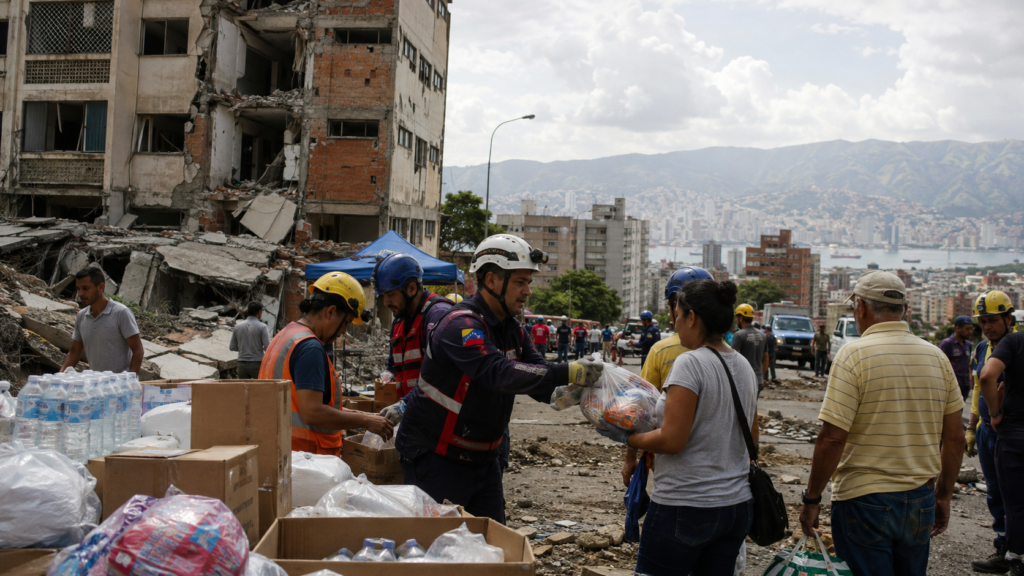
The shaking triggered building collapses across multiple cities, prompting Venezuela’s government to declare a state of emergency and close Simón Bolívar International Airport near Caracas due to damage. Search-and-rescue operations began almost immediately, involving Venezuelan firefighters, civil defense units, military personnel and volunteers, later joined by international teams.
More than a week after the disaster, officials say most search-and-rescue operations have wound down, and recovery work has shifted toward shelter, medical care and rebuilding. Aid groups have warned that overcrowded shelters and limited access to clean water could fuel a secondary health crisis among displaced residents.
Where did the earthquake hit?
The quakes were centered off Venezuela’s northern coast, with an epicenter reported near the city of Morón, a coastal industrial hub, and roughly 100 miles west of Caracas. Despite the distance, the shaking was strong enough to cause serious damage in the capital.
The regions most affected include Caracas and La Guaira state, particularly coastal communities such as Catia La Mar. Officials have said damage assessments are still ongoing in some outlying areas, and the full geographic scope of destruction may not be confirmed for some time.
How much damage has been reported?
Damage estimates have varied depending on the source and the date reported, which is common in the early weeks after a major disaster. Venezuelan officials have cited figures in the range of several hundred to several thousand damaged or collapsed structures, while some independent estimates have put the number of affected buildings much higher.
The earthquake also damaged public infrastructure, including at least one major airport. Hospitals in Caracas have reported shortages of medicine and medical supplies as they run low on donated stockpiles from the initial response phase. Some preliminary estimates suggest reconstruction costs could reach tens of billions of dollars, but officials and independent analysts have not confirmed these figures, so readers should treat them as early projections rather than final totals.
The disaster has also left tens of thousands of people without stable housing. Many displaced residents are now staying in temporary shelters inside gymnasiums, sports complexes, and community centers across the affected region.
Are earthquakes common in Venezuela?
Yes. While Venezuela does not draw the same level of global attention as earthquake-prone nations along the Pacific “Ring of Fire,” the country sits in a seismically active zone and has a documented history of significant earthquakes.
The most widely referenced past event is the 1967 Caracas earthquake, which caused deadly building collapses in the capital and remains a benchmark for discussions of earthquake preparedness in Venezuela. Seismologists have noted that the June 24 earthquakes were among the strongest to affect the country in more than a century.
Why Venezuela faces earthquake risk
Venezuela’s earthquake risk comes down to geography. The country sits near the boundary where the Caribbean tectonic plate and the South American tectonic plate meet and grind against one another. Over time, that friction builds up stress in the earth’s crust, which is released in the form of earthquakes.
This tectonic boundary runs along much of Venezuela’s northern coast, close to major population centers including Caracas. That combination of active fault lines and dense urban development is a major reason earthquakes in this region can cause outsized damage compared with quakes of similar strength in less populated areas.
What is the aid response?
Venezuela earthquake aid has come from a combination of domestic and international sources. Venezuelan authorities have mobilized tens of thousands of military and security personnel, alongside volunteers, to support search-and-rescue and relief operations. Neighboring countries and international rescue teams also deployed personnel in the days following the disaster, though many of those teams have since withdrawn as the emergency phase has wound down.
On the U.S. side, the State Department has said it deployed a regional Disaster Assistance Response Team along with urban search-and-rescue units to assist with assessment and recovery work. The U.S. Treasury Department also issued a general license authorizing earthquake-related humanitarian transactions with Venezuela, an important step given existing U.S. sanctions on the country. Officials have named Catholic Relief Services, Samaritan’s Purse, and World Vision as partner organizations in the response.
International rescue and relief organizations, including United Nations–coordinated agencies, have also warned that people still need more support than responders have delivered so far, especially clean water, sanitation, and medical care in shelters.
Why the U.S. response is being compared with Haiti
Some observers have drawn comparisons between Venezuela’s disaster response and the aftermath of Haiti’s catastrophic 2010 earthquake, which killed more than 200,000 people and caused an estimated $7.8 billion in damage. In that case, the U.S. eventually allocated roughly $2.3 billion toward Haiti’s reconstruction and development over the following decade, according to U.S. government audits, though disbursement of that funding stretched over many years.
Venezuela’s situation differs in important ways. The country has a long, complicated diplomatic relationship with Washington, including years of U.S. sanctions, and its government has undergone significant political change in recent months. Analysts say these political and economic factors, combined with logistical challenges, help explain why the scale and pace of the U.S. response to Venezuela may look different from what followed the Haiti earthquake. Officials have not yet finalized long-term reconstruction funding, so the two responses remain difficult to compare. Readers should treat any specific dollar comparisons cautiously until official figures become available.
What role does Venezuela’s oil revenue play?
Venezuela holds some of the world’s largest oil reserves, and oil revenue has long shaped the country’s economic and political debate. In the context of earthquake recovery, analysts and humanitarian groups have questioned how the government will track and distribute reconstruction funds, including any money linked to state oil revenue.
At this stage, officials have not provided a confirmed, independently verified accounting of how much oil revenue, if any, they have directly allocated to earthquake recovery. This is an area to watch as rebuilding efforts move from emergency response into longer-term reconstruction.
What happens next?
Venezuela’s path forward will likely depend on several factors: the completion of full damage assessments, the scale and consistency of international aid, the pace of infrastructure repairs, and the government’s capacity to manage a disaster of this size on top of an already strained economy.
Public trust will also shape the recovery process, especially as people continue to question oil revenue transparency and criticize the country’s past disaster preparedness.
Frequently Asked Questions
Q1. Was there an earthquake in Venezuela today?
The major, confirmed earthquake event took place on June 24. For any newer activity, check live sources such as USGS or established news wires rather than relying on past coverage.
Q2. Where did the Venezuela earthquake hit?
The quakes were centered off the northern coast near Morón, with the most severe damage reported in Caracas and La Guaira state.
Q3. Are earthquakes common in Venezuela?
Yes. Venezuela sits near an active tectonic boundary and has a documented earthquake history, including the 1967 Caracas earthquake.
Q4. Why does Venezuela have earthquakes?
The Caribbean and South American tectonic plates meet near Venezuela. Over time, stress builds along this boundary and triggers earthquakes when it releases.
Q5. How strong was the Venezuela earthquake?
Officials have reported magnitudes of roughly 7.2 and 7.5 for the two quakes, according to the U.S. Geological Survey. These figures may be refined as further analysis is completed.
Q6. What damage has been reported?
Reports describe thousands of damaged or collapsed buildings, disrupted infrastructure including a major airport, and widespread displacement. However, sources report different totals, and officials are still assessing the full scale of the damage.
Q7. What aid is Venezuela receiving?
Aid has come from Venezuelan government resources, regional partners, international rescue teams, and a U.S. response that includes disaster assistance teams and a humanitarian sanctions exemption.
Q8. How does Venezuela’s earthquake response compare with Haiti?
Observers have compared the two disasters given their scale, but political, economic and logistical differences make the responses hard to compare directly. Long-term funding comparisons remain unclear at this stage.
Conclusion
The Venezuela earthquake is more than a natural disaster story. It has become a test of the country’s emergency response systems, the resilience of its building infrastructure, the transparency of its aid and reconstruction process, and its long-term capacity to rebuild. As search-and-rescue operations give way to recovery and reconstruction, the coming months will show whether Venezuela’s government and its international partners can turn emergency aid into lasting, accountable rebuilding.