



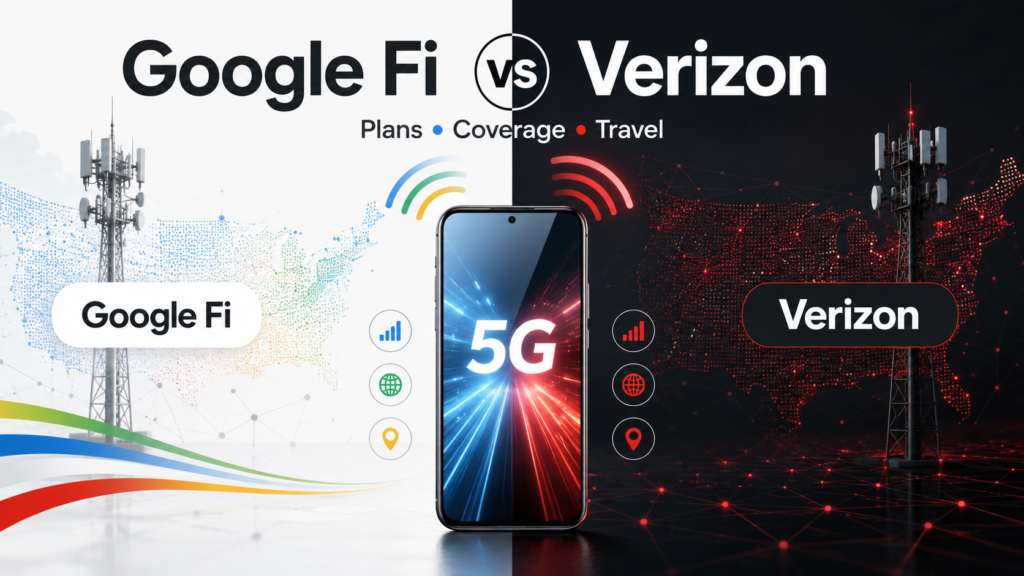
Google Fi and Verizon both offer nationwide mobile service in the United States, but they are designed for different types of customers. Google Fi is generally the better choice for international travelers, moderate-data users, and families looking for straightforward multi-line pricing. Verizon is usually better for heavy-data users, customers who get stronger Verizon coverage at home, and people who prefer physical stores, extensive phone deals and a traditional carrier experience.
The best choice ultimately depends on coverage at the places where you live, work and travel. Check both carriers’ official coverage maps before switching.
Google Fi vs Verizon: Quick Answer
Google Fi is better for:
- International travel
- Lower standard single-line prices
- Families seeking multi-line discounts
- Customers needing more hotspot data
- Google Pixel and Google-service users
Verizon is better for:
- Heavy monthly data use
- Customers who need unlimited premium data
- Areas where Verizon has stronger local coverage
- Phone financing, trade-in deals and physical stores
- People who want optional entertainment and service bundles
Overall verdict: Google Fi offers better value and international flexibility for many customers, while Verizon is stronger for heavy data consumption and users who prioritize its network coverage.
Google Fi vs Verizon Comparison
| Feature | Google Fi Wireless | Verizon | Winner |
| Mobile network | Uses T-Mobile’s nationwide 5G network | Operates its own 5G and 4G LTE network | Depends on location |
| Lowest regular unlimited price for one line | $35 per month | $45 per line with Auto Pay on Simplicity | Google Fi |
| Promotional price | Offers vary | Advertised at $30 for an eligible switching line | Verizon promotion |
| High-speed data | 30GB, 50GB or 100GB, depending on plan | Simplicity has no premium-data threshold | Verizon |
| High-speed hotspot | Up to 25GB or 50GB on selected plans | 10GB on Simplicity | Google Fi |
| Canada and Mexico | Included on Standard and Premium | Included on Simplicity | Tie |
| Wider international coverage | Included on Fi Premium in 200+ destinations | Included on Unlimited Ultimate in 210+ destinations; add-ons available for other plans | Google Fi for value |
| Family pricing | Significant multi-line discounts | Flat Simplicity pricing; myPlan options also available | Google Fi |
| Physical stores | Limited carrier-store presence | Extensive Verizon retail presence | Verizon |
| Included services | Google One, YouTube Premium trial and select smartwatch service on Premium | Optional entertainment, travel and family bundles | Depends on preference |
Prices exclude applicable taxes and government fees unless otherwise stated. Promotions and plan terms can change.
What Is Google Fi Wireless?
Google Fi Wireless is Google’s mobile phone service. It does not operate a completely separate nationwide tower network. Instead, Google Fi’s 5G service runs on T-Mobile’s nationwide network.
Google says Fi customers receive top-priority data on its current unlimited plans. The service also includes built-in Google Account security, spam-call protection, a Google VPN, and connectivity for selected smartwatches.
Google Fi currently offers four main plan types:
- Flexible
- Unlimited Essentials
- Unlimited Standard
- Unlimited Premium
The Flexible plan charges customers according to the amount of mobile data they use. The three unlimited plans offer different high-speed data, hotspot and international allowances.
What Is Verizon?
Verizon is one of the largest facilities-based mobile network operators in the United States. Unlike Google Fi, Verizon owns and operates its national mobile network.
Verizon introduced its Simplicity Plan as its flagship unlimited offering in June 2026. The plan includes unlimited talk, text and premium data, access to Verizon 5G Ultra Wideband, 10GB of high-speed hotspot data, Canada and Mexico roaming, satellite texting and family safety features. Verizon’s older myPlan choices remain available.
This change is important because older Google Fi vs Verizon comparisons may only discuss Verizon Unlimited Welcome, Unlimited Plus and Unlimited Ultimate without mentioning Simplicity.
Google Fi vs. Verizon: Plans and Pricing
Google Fi Plan Prices
For a single line, Google Fi’s current standard plan prices are as follows:
| Google Fi plan | One-line price | High-speed data | Main benefits |
| Flexible | $20 plus $10 per GB | 15GB before slower speeds | Pay only for data used |
| Unlimited Essentials | $35 | 30GB | Affordable unlimited US service |
| Unlimited Standard | $50 | 50GB | 25GB hotspot and Canada/Mexico coverage |
| Unlimited Premium | $65 | 100GB | 50GB hotspot and international data |
After a customer reaches the applicable high-speed threshold, Google Fi reduces data speeds to 256Kbps for the remainder of the billing cycle. Customers can choose to resume high-speed data for an additional $10 per GB.
Google Fi says taxes and government surcharges normally add approximately 10% to 20%, depending on the customer’s service address. The service does not charge an annual contract, activation fee or cancellation fee.
Verizon prices
Verizon’s Simplicity Plan has a standard price of $45 per line with Auto Pay. Verizon is currently advertising a price of $30 per month for an eligible switching line after Auto Pay and a $15 monthly switch discount. Taxes and fees are additional.
Simplicity includes:
- Unlimited premium smartphone data
- Verizon 5G Ultra Wideband access
- 10GB of high-speed mobile hotspot data
- Canada and Mexico roaming
- Satellite text messaging
- Call Filter
- Verizon Family features
Verizon’s myPlan options are also still available. Standard one-line rates are currently listed at $65 for Unlimited Welcome, $80 for Unlimited Plus and $95 for Unlimited Ultimate. Discounts and optional perks can change the final monthly cost.
Which carrier is cheaper?
At regular prices, Google Fi Unlimited Essentials costs less than Verizon Simplicity for one line. Google Fi also publishes substantial multi-line discounts.
However, Verizon’s temporary switching promotion can make Simplicity cheaper than Google Fi for eligible new customers. Consumers should compare the price after the promotional period rather than choosing only on the introductory rate.
Price winner: Google Fi at regular rates; Verizon may win temporarily for eligible switchers.
Google Fi vs Verizon Coverage
Coverage is the most important part of any carrier comparison. A cheaper plan has little value when it does not provide a dependable signal where the customer needs it.
Google Fi uses T-Mobile’s nationwide 5G network. Verizon operates its own 5G and 4G LTE network. Both carriers provide online maps where customers can enter an address or ZIP code, although coverage maps show estimated outdoor coverage rather than guaranteeing indoor performance.
An independent Opensignal report published in July 2026 gave Verizon its national Coverage Experience award, with a score of 9.7 out of 10. T-Mobile, whose network powers Google Fi, won most of the report’s other performance awards, including several measurements related to speed and 5G experience.
This means there is no universal coverage winner:
- Verizon can be the better choice where its broader coverage reaches more roads, rural areas or buildings.
- Google Fi can perform very well in places with strong T-Mobile 5G coverage.
- A carrier’s national result may not match performance at a particular house, workplace or neighborhood.
Check the two coverage maps and, where possible, test the service before transferring every family line.
Coverage winner: Verizon for overall national coverage measurements; Google Fi may be faster in strong T-Mobile 5G areas.
Data Speeds and Premium Data
Google Fi includes top-priority data, but each plan has a defined high-speed allowance:
- 30GB on Unlimited Essentials
- 50GB on Unlimited Standard
- 100GB on Unlimited Premium
Once the allowance is used, the connection slows to 256Kbps unless the customer purchases additional high-speed data.
Verizon’s Simplicity Plan includes unlimited premium data without a premium-data threshold. That makes Verizon more suitable for customers who regularly use large amounts of cellular data for video streaming, downloads, gaming or remote work.
Customers who normally use less than 30GB or 50GB each month may not notice Google Fi’s limits. Someone using more than 100GB regularly is more likely to benefit from Verizon.
Heavy-data winner: Verizon.
Mobile Hotspot Comparison
Google Fi Unlimited Standard includes 25GB of high-speed hotspot data. Unlimited Premium includes 50GB. Hotspot usage counts toward the customer’s total monthly high-speed allowance.
Verizon Simplicity includes 10GB of high-speed mobile hotspot data each month. Customers needing larger hotspot allowances may need another Verizon plan or an additional option.
Google Fi is therefore more attractive for travelers, remote workers and students who regularly connect a laptop or tablet through their phone.
Hotspot winner: Google Fi Unlimited Standard or Premium.
Google Fi vs Verizon for International Travel
International service is one of Google Fi’s strongest advantages.
Google Fi Unlimited Premium includes high-speed data in more than 200 countries and territories without requiring a daily travel pass. International texting is included, while cellular calls generally cost 20 cents per minute. Customers must activate and primarily use Fi in the United States; international data can be suspended when most usage occurs abroad for a consecutive 90-day period.
Google Fi Flexible also works in more than 200 destinations, but customers pay the same $10-per-GB data rate used in the United States. Unlimited Standard includes Canada and Mexico but not wider overseas data. Unlimited Essentials does not support international cellular use outside the United States.
Verizon Simplicity includes Canada and Mexico. For wider travel, Verizon offers TravelPass at $12 per day in more than 210 countries and destinations, or a $100 International Monthly Plan for longer trips.
Verizon Unlimited Ultimate includes international data, talk and text in more than 210 countries, but its standard one-line price is higher than Google Fi Unlimited Premium.
International winner: Google Fi Unlimited Premium for most frequent travelers.
Which Is Better for Families?
Google Fi becomes significantly less expensive as more lines are added.
Current four-line totals are:
- Unlimited Essentials: $90 per month
- Unlimited Standard: $100 per month
- Unlimited Premium: $160 per month
That equals approximately $23, $25 or $40 per line before taxes and government fees. Every member of a Google Fi group must use the same plan.
Verizon’s Simplicity strategy uses a consistent flat price per line rather than traditional multi-line tiers. Eligible customers may receive switching discounts, while Verizon’s remaining myPlan choices continue to offer lower per-line rates when several lines are added.
Google Fi is usually easier to understand for families primarily concerned with the monthly service price. Verizon may provide greater value when a family also uses its device promotions, entertainment bundles or home internet discounts.
Family-plan winner: Google Fi for straightforward service pricing; Verizon when bundled benefits provide meaningful savings.
Perks and Additional Features
Google Fi includes several Google-focused benefits:
- VPN by Google
- Advanced spam-call blocking
- Google Account security
- Free connectivity for selected smartwatches
- 100GB of Google One storage with Unlimited Premium
- Six months of YouTube Premium with Unlimited Premium
- Data-only connectivity for compatible tablets and laptops on Premium
Verizon offers a larger selection of optional bundles covering streaming services, cloud storage, travel, family features and other digital subscriptions. It also provides extensive device financing, trade-in promotions and physical retail support.
Verizon Loyalty customers can earn 3% back in Verizon Dollars on plan payments and avoid certain activation and upgrade fees after opting into the program.
Perks winner: Google Fi for included Google services; Verizon for optional bundles and retail support.
Google Fi Pros and Cons
Pros
- Lower regular entry price
- Strong international options
- Generous hotspot data on Standard and Premium
- Clear multi-line discounts
- Top-priority access on T-Mobile’s network
- Included Google security tools
- Selected smartwatch connectivity at no extra charge
Cons
- Data slows after the plan’s high-speed limit
- Fewer physical carrier stores
- Coverage depends on T-Mobile’s network
- Unlimited Essentials has limited travel features
- Group members must use the same plan
Verizon Pros and Cons
Pros
- Unlimited premium data on Simplicity
- Strong national coverage performance
- Extensive physical stores
- Large phone selection and trade-in offers
- Canada and Mexico included
- Optional entertainment and service bundles
- Satellite texting on compatible devices
Cons
- Regular price can be higher than Google Fi
- Simplicity includes only 10GB of hotspot data
- Broader international service may require a costly plan or add-on
- Promotions can make pricing difficult to compare
- Taxes, fees and optional perks can increase the bill
Who Should Choose Google Fi?
Choose Google Fi when:
- You frequently travel outside the United States.
- Your local T-Mobile coverage is strong.
- You normally stay below the plan’s high-speed data limit.
- You need 25GB or 50GB of hotspot data.
- You want lower multi-line prices.
- You use Pixel phones, Google One or other Google services.
- You prefer managing your service online.
Google Fi Unlimited Standard is likely the best balance for users who need domestic service, Canada and Mexico coverage and a useful hotspot allowance.
Unlimited Premium is better for frequent international travelers and people who need up to 100GB of high-speed data.
Who Should Choose Verizon?
Choose Verizon when:
- Verizon has better coverage at your home or workplace.
- You regularly use more than 100GB of mobile data.
- You want unlimited premium data.
- You prefer visiting a physical store for support.
- You value device financing and trade-in promotions.
- You use Verizon home internet or optional Verizon bundles.
- You need a traditional full-service carrier experience.
The Simplicity Plan is particularly competitive for eligible customers receiving its switching discount.
Final Verdict: Is Google Fi or Verizon Better?
Google Fi is the better overall value for frequent travelers, moderate-data users and families seeking clear multi-line pricing. Its Unlimited Standard and Unlimited Premium plans also provide significantly more hotspot data than Verizon Simplicity.
Verizon is the better choice for heavy-data users and people who receive stronger Verizon coverage where they live. Its unlimited premium data, physical stores, device promotions and bundle options make it more suitable for users who want a complete traditional-carrier package.
There is no single winner for every customer. Before switching, compare the full price after promotions, check coverage at your exact addresses and review your previous three months of data usage.
Frequently Asked Questions
Q1. Is Google Fi cheaper than Verizon?
Google Fi is generally cheaper at regular one-line and multi-line prices. However, Verizon’s current switching promotion can make Simplicity cheaper for eligible new customers during the promotional period.
Q2. Does Google Fi use Verizon towers?
No. Google Fi’s nationwide 5G service runs on T-Mobile’s network, not Verizon’s network.
Q3. Is Google Fi coverage as good as Verizon?
It depends on the location. Verizon led the Coverage Experience category in Opensignal’s July 2026 US report, while T-Mobile led many other performance and 5G categories. Customers should check both maps for their specific addresses.
Q4. Does Google Fi have truly unlimited high-speed data?
No. Google Fi reduces speeds to 256Kbps after 30GB, 50GB or 100GB, depending on the selected unlimited plan. Customers can pay $10 per GB to restore high-speed service before the next billing cycle.
Q5. Does Verizon slow unlimited data?
Verizon’s Simplicity Plan includes unlimited premium smartphone data without a premium-data threshold. Network speeds can still vary because of signal strength, device compatibility and other technical conditions.
Q6. Which is better for international travel?
Google Fi Unlimited Premium is better for many international travelers because data is included in more than 200 destinations without a daily fee. Verizon offers broader travel coverage through Unlimited Ultimate, TravelPass and its International Monthly Plan.
Q7. Which carrier has better hotspot data?
Google Fi has better hotspot allowances on its higher plans. Unlimited Standard includes 25GB and Unlimited Premium includes 50GB, compared with 10GB on Verizon Simplicity.
Q8. Can iPhone users switch to Google Fi?
Yes. Google Fi supports compatible iPhones, although users should check device compatibility before switching. Google notes that some iPhone MMS settings may need to be configured for messaging with Android phones.
Q9. Which carrier is better for four lines?
Google Fi usually offers lower straightforward service pricing for four lines. Verizon may become more competitive when switching promotions, phone discounts, home internet savings, or other bundles are included.
Q10. Can I keep my existing phone number?
Both Google Fi and Verizon generally allow customers to transfer an eligible existing number. Do not cancel the old service before the transfer has been completed.