


The U.S. Supreme Court’s decision in Watson v. Republican National Committee clarified an important question about mail voting: can states count ballots that voters send by Election Day but election officials receive several days later?
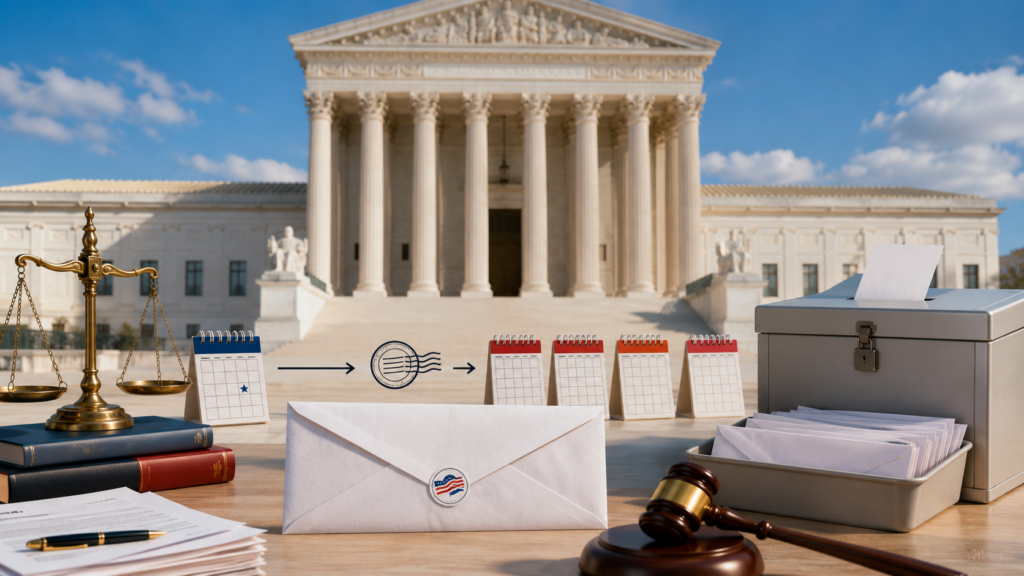
In its June 29, 2026 decision, the Court ruled that federal Election Day laws do not require every mail ballot to arrive by Election Day. States may count ballots postmarked on or before Election Day when their own laws provide a valid receipt grace period.
The case involved Mississippi’s rule allowing certain absentee ballots to be counted when they are postmarked by Election Day and received within five business days afterward.
Editorial note: This article provides general legal information and does not constitute legal advice.
Quick Answer
The Supreme Court mail-in ballot ruling allows states to count eligible mail ballots received after Election Day when voters sent them by Election Day and state law provides a receipt deadline. The ruling does not allow people to cast ballots after Election Day, nor does it create one national deadline for every state.
Case at a Glance
| Case detail | Information |
| Case | Watson v. Republican National Committee |
| Docket | 24-1260 |
| Argued | March 23, 2026 |
| Decided | June 29, 2026 |
| Vote | 5-4 |
| Majority author | Justice Amy Coney Barrett |
| Result | Fifth Circuit ruling reversed |
| Main issue | Ballots received after Election Day |
The Supreme Court docket confirms that the case came from the U.S. Court of Appeals for the Fifth Circuit and was reversed and remanded.
What Was Watson v. Republican National Committee About?
Mississippi permits certain voters, including some seniors and college students living away from home, to vote using absentee ballots.
Under Mississippi law, those ballots may be counted when they are:
- Postmarked on or before Election Day
- Received by election officials within five business days after Election Day
The Republican National Committee, Mississippi Republican Party and several individual plaintiffs challenged that rule. They argued that federal statutes establishing a national Election Day also require election officials to receive ballots by that day.
Mississippi defended the law by arguing that federal statutes determine when voters must cast their ballots, while state law may determine when properly cast ballots must arrive.
What Did the Supreme Court Decide?
The Supreme Court sided with Mississippi.
The majority held that federal Election Day statutes regulate when voters must make their choice. They do not establish a nationwide deadline requiring election officials to physically receive every ballot by Election Day.
As a result, Mississippi may continue counting qualifying absentee ballots that are postmarked by Election Day and received within its five-business-day grace period.
Did the Court Allow Voting After Election Day?
No.
The ruling distinguishes between two different events:
- Casting a ballot
- Election officials receiving that ballot
A voter must still cast or mail the ballot by the applicable Election Day deadline. The decision only concerns ballots already cast on time that arrive later because they are travelling through the mail or another permitted carrier.
The Court explained that the electorate makes its choice when voting is completed, not when election officials receive the envelope.
Why Did the Court Reject the Election Day Challenge?
The majority focused on the ordinary meaning of the word “election.”
Justice Amy Coney Barrett wrote that an election has historically referred to voters choosing candidates. Federal law therefore fixes the date by which that choice must be made.
The Court found no language in the relevant statutes creating a national ballot-receipt deadline.
It also relied on the Uniformed and Overseas Citizens Absentee Voting Act. That federal law repeatedly refers to ballot-receipt deadlines established under state law, supporting the conclusion that states retain authority over when properly cast ballots must arrive.
What Was the Lower Court’s Decision?
A federal district court initially upheld Mississippi’s rule.
The Fifth Circuit later reversed that decision, concluding that federal law required ballots to be received by Election Day. The appeals court therefore found Mississippi’s five-day receipt period preempted by federal law.
The Supreme Court reversed the Fifth Circuit and returned the case for further proceedings consistent with its opinion.
How Did the Justices Vote?
The result was 5-4.
Justice Amy Coney Barrett wrote the majority opinion. She was joined by:
- Chief Justice John Roberts
- Justice Sonia Sotomayor
- Justice Elena Kagan
- Justice Ketanji Brown Jackson
Justice Samuel Alito wrote a dissent joined by Justices Clarence Thomas and Neil Gorsuch. Justice Brett Kavanaugh joined most, but not all, of the dissent.
The unusual lineup brought together the Chief Justice, Justice Barrett and the Court’s three liberal justices.
Does the Ruling Apply Only to Mississippi?
The decision directly concerned Mississippi’s five-business-day rule, but its interpretation of federal Election Day laws is nationally important.
The Supreme Court noted that roughly 30 states count at least some absentee ballots mailed by Election Day but received afterward. Their exact rules differ depending on the voter, election type, postmark and receipt deadline.
The ruling indicates that federal Election Day statutes do not automatically invalidate those state grace periods.
However, it does not require every state to adopt such a period. States may continue setting different receipt deadlines unless another federal law applies.
Does This Mean All Late Ballots Must Be Counted?
No.
A ballot may still be rejected when:
- It was mailed or cast after the legal deadline
- It arrives after the state’s receipt deadline
- It lacks a required postmark
- The voter is not eligible for absentee voting under applicable rules
- It fails signature, identification or other lawful requirements
- Another state-specific problem makes it invalid
The ruling protects state-authorized receipt periods; it does not eliminate normal ballot-verification rules.
What Does the Decision Mean for the 2026 Elections?
The decision gives states greater certainty that they may continue using lawful post-Election-Day receipt periods.
For voters, the practical lesson remains simple: mailing a ballot close to Election Day can still create risk. Even where a grace period exists, the ballot must comply with postmark and arrival requirements.
Voters should check their state election office’s current rules rather than assume Mississippi’s five-day period applies everywhere.
Did the Court Decide a Constitutional Question?
No.
The Court described the dispute as a narrow statutory case. It decided what federal Election Day statutes mean and whether they conflict with Mississippi law.
The justices did not decide the full constitutional scope of Congress’s power to regulate federal elections. They also did not rule on the overall legality of mail voting, early voting or vote counting after Election Day.
What the Decision Did Not Change
The ruling did not:
- Permit ballots to be cast after Election Day
- Create one national mail-ballot deadline
- Require states to offer universal mail voting
- Approve every ballot arriving after Election Day
- Remove signature or identity checks
- Prevent legislatures from changing state deadlines
- Decide whether every mail-voting practice is constitutional
It answered one question: whether federal Election Day statutes themselves prohibit Mississippi from counting timely mailed ballots received during its five-day grace period.
Why Does the Supreme Court Mail-In Ballot Ruling Matter?
The decision matters because mail delivery does not always occur immediately, particularly for military voters, overseas citizens, rural residents, seniors and voters sending ballots near Election Day.
Supporters of receipt grace periods argue that a voter should not lose a properly cast vote because of postal delays outside the voter’s control.
Opponents argue that receiving ballots after Election Day can delay results and reduce public confidence.
The Supreme Court did not choose between those policy positions. It said policy arguments should be directed to legislatures because the federal statutes do not establish the receipt deadline sought by the challengers.
Frequently Asked Questions
Q1. What was the Supreme Court mail-in ballot ruling?
The Supreme Court ruled that federal Election Day statutes do not prevent Mississippi from counting absentee ballots postmarked by Election Day and received within five business days afterward.
Q2. Can ballots arrive after Election Day?
Yes, when state law permits it and the ballot was cast or postmarked by the required deadline. The exact receipt period differs between states.
Q3. Can voters mail ballots after Election Day?
No. The ruling concerns ballots cast by Election Day but received later. It does not authorize voting after Election Day.
Q4. What was the case called?
The case was Watson v. Republican National Committee, docket number 24-1260.
Q5. Was the ruling 5-4?
Yes. Justice Amy Coney Barrett wrote the majority opinion, joined by Chief Justice Roberts and Justices Sotomayor, Kagan and Jackson.
Q6. Does every state have a five-day grace period?
No. Five business days is Mississippi’s rule. Other states have different deadlines, and some require ballots to arrive by Election Day.
Q7. Did the Court legalize mail voting?
Mail voting was already legal under state and federal rules. The case addressed only whether federal Election Day statutes prohibit certain post-Election-Day ballot receipt deadlines.
The Bottom Line
The Supreme Court mail-in ballot ruling confirmed that Election Day is the deadline for voters to make their electoral choice, but not necessarily the deadline for officials to receive every ballot.
Mississippi may count qualifying absentee ballots postmarked by Election Day and received within five business days afterward. Other states may also maintain lawful receipt grace periods.
The ruling does not permit voting after Election Day or guarantee that every late-arriving ballot will count. Voters must still follow their state’s postmark, eligibility, identification and final receipt requirements.