



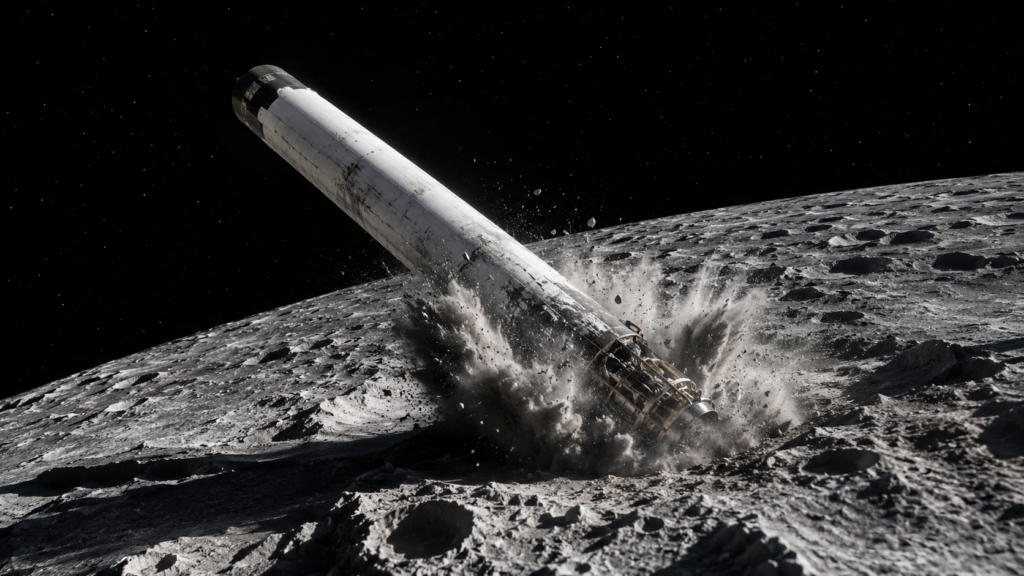
Early on the morning of August 5, 2026, a discarded piece of a SpaceX rocket that had been drifting through space for more than a year finally met its end, smashing into the far side of the Moon at roughly 5,400 miles per hour. If you’ve been searching “SpaceX Moon crash” or “why did SpaceX rocket hit the Moon,” you’re not alone. TThe story has drawn attention across space-watching circles and mainstream news outlets, and for good reason: it offers one of the clearest confirmed examples of a man-made object striking the lunar surface.
In this article, we’ll break down exactly what happened, why it happened, what scientists are learning from it, and what it means for the growing problem of space debris. No jargon overload, just the facts, explained clearly.
What Happened: The SpaceX Rocket Moon Impact, Explained
The object involved was the upper stage of a Falcon 9 rocket, launched by SpaceX back on January 15, 2025. That mission carried two commercial lunar landers, Firefly Aerospace’s Blue Ghost and ispace’s Resilience, toward the Moon. Once its job delivering the landers was done, the spent upper stage was left drifting in space rather than being deliberately deorbited.
For more than a year, that leftover rocket stage circled through space on a slow, unpowered trajectory. Independent astronomers who track objects like this using publicly available orbital data eventually determined it was on a collision course with the Moon, and NASA confirmed the prediction.
Early Wednesday morning, the rocket segment struck the lunar surface near the Einstein Crater, on the Moon’s far side, the side that always faces away from Earth. Because of that positioning, no one on Earth could watch it happen with the naked eye, and confirmation depended on telescope data and the time it takes signals to travel back from the Moon.
How Fast and How Big Was the SpaceX Rocket Debris?
According to tracking data reported by multiple outlets, the rocket piece:
- Weighed around 8,800 pounds
- Measured roughly 45 feet long and 12 feet wide, about the size of a school bus
- Struck the Moon at approximately 5,400 miles per hour (8,700 km/h)
- Hit with a force estimated at nearly 3 tons of TNT
The impact released an enormous amount of kinetic energy in an instant. The object carried no explosives or hazardous fuel; it consisted only of the empty structural shell of the rocket’s second stage.
Why Did the SpaceX Rocket Hit the Moon?
This wasn’t a mission failure or a malfunction. It also wasn’t intentional, unlike NASA’s deliberate lunar impact experiments in the past. Instead, it’s a byproduct of how upper stages are handled after they complete their primary mission.
Here’s the short version: once a rocket’s upper stage releases its payload, in this case, the two lunar landers, it often has no further use. If it isn’t actively deorbited back toward Earth or sent on a trajectory that avoids other celestial bodies, it can end up drifting for months or years, subject to the gentle pull of the Moon’s and Earth’s gravity. Eventually, orbits like this can intersect with the Moon.
SpaceX has acknowledged that this crash landing was unintentional. Importantly, experts have emphasized that this kind of event poses no danger to Earth; it happened roughly 240,000 miles away, on a part of the Moon we can’t even see from home.
Is This the First Time a SpaceX Rocket Has Hit the Moon?
No, and that’s part of why this story feels familiar to some readers. Back in 2022, astronomers tracked a different piece of space debris, originally linked to a Falcon 9 launched in 2015, that was expected to strike the Moon that March. Later analysis suggested that particular object was actually the leftover booster from a Chinese Chang’e 5-T1 mission rather than a SpaceX component, a reminder of how difficult it can be to positively identify drifting space junk years after launch.
The 2026 impact, by contrast, has been more directly and confidently traced back to SpaceX’s own January 2025 Falcon 9 mission.
Where Did the SpaceX Rocket Hit the Moon?
The impact site is located near the Einstein Crater, on the Moon’s far side. This region isn’t visible from Earth at any point, which is part of why real-time visual confirmation wasn’t possible. Instead, scientists relied on:
- Orbital trajectory tracking from independent astronomers
- Confirmation from space-tracking agencies and NASA
- Telescope observations of the resulting impact plume
The European Southern Observatory’s Very Large Telescope, located at the Paranal Observatory in Chile, was one of the key instruments used to detect the aftermath. According to reporting, the telescope picked up spectral signatures of sodium and lithium gas in the impact plume, which lingered for several minutes after the collision, a useful signature that helped confirm the impact had actually occurred.
What Crater Did the SpaceX Moon Crash Create?
One of the most searched questions right now is how big the resulting crater will actually be. Based on the size, weight, and speed of the object, scientists estimate the new crater could measure:
- Up to 100 feet wide
- As much as 16 feet deep
Confirming the exact crater dimensions will take longer, though. Unlike the plume detection, actually locating and photographing the new crater requires high-resolution orbital imagery, likely from lunar-orbiting spacecraft, and that kind of confirmation can take weeks or even months to complete.
What Scientists Can Learn From the SpaceX Moon Impact
It might sound alarming to hear “rocket crashes into Moon,” but for planetary scientists, this is a rare and valuable research opportunity rather than a catastrophe. Carl Schmidt, a planetary scientist at Boston University’s Center for Space Physics, noted that events like this don’t happen often, and they offer a chance to better understand the Moon’s thin, wispy atmosphere.
Here’s why researchers care:
- Crater formation data: High-speed impacts like this are rare to observe in real time, giving scientists a controlled way to study how craters form on airless worlds.
- Lunar exosphere insights: The gas plume kicked up by the impact, including that sodium and lithium signature, helps researchers understand what’s below the Moon’s surface and how material behaves when it’s suddenly vaporized.
- Space debris awareness: Every documented impact adds to a growing dataset that helps agencies track and manage the increasing amount of human-made debris in deep space.
What the SpaceX Moon Crash Means for Space Debris
This incident is also reigniting a broader conversation that has been building since at least 2022: what should happen to rocket stages after they complete their missions? As launch activity increases, driven heavily by SpaceX along with other private companies and government space programs, operators are leaving more hardware in orbits that can eventually intersect with the Moon or other celestial bodies.
Right now, there’s no single international authority responsible for tracking or cleaning up this kind of deep-space debris. Space agencies and private companies largely operate under a patchwork of best practices rather than binding requirements, especially for anything beyond low Earth orbit. As lunar missions become more common, including NASA’s Artemis program and a growing number of commercial lunar landers, experts expect this issue to become more pressing, not less.
Frequently Asked Questions
Q1: Did the SpaceX rocket crash pose any danger to Earth or people?
No. The impact happened on the Moon’s far side, roughly 240,000 miles from Earth, and involved an empty rocket stage with no fuel or explosive payload. Experts have confirmed there was no risk to Earth.
Q2: What SpaceX rocket hit the Moon?
It was the upper (second) stage of a Falcon 9 rocket, launched on January 15, 2025, on a mission that delivered two commercial lunar landers, Firefly Aerospace’s Blue Ghost and ispace’s Resilience.
Q3: Can I see images of the SpaceX rocket crash or the resulting crater?
Because the impact occurred on the Moon’s far side and was not visible from Earth, there are no direct photos of the collision itself. Confirmation came from telescope spectral data, and images of the actual crater will depend on future high-resolution orbital imagery, which can take weeks or months to obtain.
Q4: Was this crash intentional?
No. SpaceX has said the impact was unintentional. It resulted from the upper stage being left in a drifting orbit after completing its mission, rather than being deliberately deorbited.
Q5: How does this compare to the 2022 SpaceX Moon crash reports?
In 2022, astronomers tracked a piece of debris toward a lunar impact that was initially attributed to a 2015 SpaceX Falcon 9 launch, though later analysis suggested it was actually a Chinese rocket stage. The 2026 event is a separate, more directly confirmed impact involving a 2025 Falcon 9 mission.
What Happens Next?
The SpaceX rocket crash into the Moon isn’t a disaster story, it’s a snapshot of how the modern space industry actually works, debris and all. A routine mission from early 2025 ended, more than a year later, with an unplanned but scientifically useful lunar impact near the Einstein Crater. No one was in danger, researchers are already gathering valuable data, and the event is fueling a bigger conversation about how the space industry manages the hardware it leaves behind.
As more images and crater measurements become available in the coming weeks, expect updated details on the exact scope of the impact. For now, this event stands as a striking reminder of just how much human-made material is quietly drifting through space above our heads, and occasionally, coming back down to leave a mark.
Have questions about this story or want to stay updated as new details emerge? Check back for updates as scientists release imagery and confirm final crater measurements.