



Walk into almost any technology conversation in 2026- a boardroom, a software conference, a LinkedIn feed- and one phrase keeps coming up: AI agents. Not chatbots. Not “generative AI.” Agents.
The shift in language reflects a real shift in capability. For the past few years, most people’s experience of artificial intelligence was a text box: type a question, get an answer. That model is still useful, but it is no longer the center of the story. A growing share of AI systems now do something different. They take a goal, break it into steps, decide which digital tools to use, carry out those steps, and report back, often with far less moment-to-moment human input than a chatbot requires.
That capability is why “AI agents” has become one of the most searched, most funded, and most debated terms in technology this year. Research firm Gartner has predicted that 40% of enterprise applications will be integrated with task-specific AI agents by the end of 2026, up from less than 5% in 2025, a forecast that captures just how quickly software vendors are racing to add agentic features. At the same time, security researchers, regulators, and standards bodies are racing just as fast to figure out how to govern systems that can act, not just answer.
This explainer breaks down what AI agents actually are, how they differ from the chatbots and generative AI tools most people already know, why 2026 has become the year they moved from demos to deployed business systems, and what risks come with giving software the ability to act on your behalf.
What Are AI Agents?
AI models, typically large language models, power AI agents. These software systems can pursue a goal across multiple steps by planning actions, using digital tools or APIs, and adjusting their approach based on results, usually with less continuous human direction than a standard chatbot requires. Unlike a chatbot, which mainly responds to one prompt at a time, an AI agent can decide what to do next on its own, within limits set by its designers, and many still require human approval before completing sensitive or high-stakes actions.

What Makes an AI Agent Different From a Chatbot?
The simplest way to understand the difference is this: a chatbot responds, an agent acts.
A traditional chatbot, even a sophisticated one, mostly does one thing well: it takes your input and generates a relevant reply. It does not independently decide to check your calendar, send an email, or query a database unless a developer has wired in a very specific feature for that single purpose. Each exchange is largely self-contained.
An AI agent is designed to do more of the surrounding work. Given a goal, “find the three best-reviewed vendors for X and draft a comparison,” an agent can:
- Break the goal into smaller steps
- Decide which tools, files, or systems it needs to consult
- Call APIs or software functions to retrieve or change information
- Evaluate whether the first attempt worked
- Try a different approach if it didn’t
- Continue across multiple steps without a person typing a new prompt after every single action
That combination- planning, tool use, and at least some self-directed follow-through- is what separates “agentic” systems from earlier generations of AI software. It’s also why the line between categories can get blurry, since many products mix several of these capabilities together.
Comparison Table: Chatbot vs. Generative AI Tool vs. AI Assistant vs. AI Agent vs. Autonomous AI Agent
| Type | Primary Behavior | Plans Multiple Steps? | Uses External Tools/APIs? | Acts Without a New Prompt Each Time? | Typical Human Oversight |
| Chatbot | Responds to a single message | No | Rarely | No | High, every reply is reviewed in real time |
| Generative AI tool | Produces text, images, code, or audio from a prompt | No | Sometimes (e.g., plug-ins) | No | High, output is reviewed before use |
| AI assistant | Helps complete a task within an app, often with suggestions | Limited | Often, within one app | No, usually needs user confirmation | Moderate, user approves each step |
| AI agent | Pursues a defined goal across multiple steps | Yes | Yes, frequently | Often, within set permissions | Moderate, approval required at key checkpoints |
| Autonomous AI agent | Pursues a broader goal with minimal step-by-step confirmation | Yes, extensively | Yes, across multiple systems | Largely yes, within guardrails | Lower during execution, but oversight is still typically built into design, monitoring, and review |
It’s worth noting that no current mainstream system is “fully autonomous” in the sense of operating with zero human design, limits, or review. Even the most independent agents run inside permissions, budgets, monitoring, and, for consequential actions, approval steps that a person or organization has set up in advance.
How Do AI Agents Work?
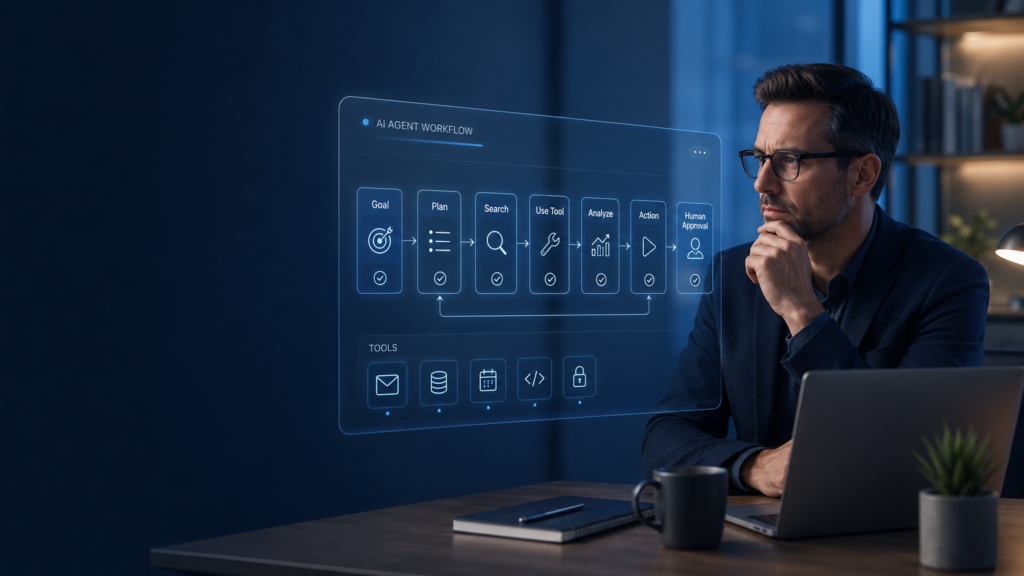
Stripped of marketing language, most AI agents share a similar underlying loop:
- User goal. A person or system specifies what needs to happen: “reconcile this month’s invoices” or “research competitor pricing and summarize it.”
- Reasoning and planning. The underlying AI model, usually a large language model, interprets the goal and proposes a sequence of steps to get there.
- Model. This is the “brain” of the agent: a generative AI model that interprets language, weighs options, and generates instructions for what to do next.
- Tools and API access. The agent connects to external systems, a search engine, a database, a code execution environment, and a company’s internal software to actually retrieve information or make changes.
- Memory and context. Many agents retain information about the current task, prior steps, or relevant documents so they don’t lose track of progress across a multi-step job.
- Execution. The agent carries out the planned action: running a query, drafting a document, updating a record, or sending a message.
- Feedback loop. The agent checks the result against the goal. If something failed or looks wrong, it can revise its plan and try again.
- Human approval. At defined checkpoints, particularly for actions involving money, sensitive data, legal commitments, or irreversible changes, the agent pauses for a person to review or authorize the next step.
That last point matters more than it might seem. The structures NIST’s Center for AI Standards and Innovation (CAISI) is currently developing for agentic systems explicitly focus on governance and oversight mechanisms, human supervision, escalation protocols, access controls, and accountability structures to manage agent behavior in production environments. Oversight isn’t an afterthought bolted onto agents; in well-designed systems, it’s part of the architecture from the start.
Why Are AI Agents Everywhere in 2026?
A few converging trends explain why “agentic AI” went from a research term to a business buzzword in such a short window.
Generative AI has matured enough to be trusted with more. Early large language models were impressive at conversation but inconsistent at multi-step reasoning. As underlying models improved, they became more reliable at planning sequences of actions, which is a prerequisite for any agent that needs to do more than one thing in a row.
Software vendors built the missing plumbing. Agents need standardized ways to talk to outside tools and to each other. Protocols such as Anthropic’s Model Context Protocol (MCP) and Google’s Agent2Agent (A2A) emerged to give agents a common way to call tools and coordinate, something like a shared connective layer for the “agentic” software stack.
Enterprise demand for automation didn’t go away, it evolved. Businesses have wanted to automate repetitive work for decades. What changed is the type of work that can now be automated. Rule-based automation could only handle predictable, narrowly defined tasks. Agents can handle messier, language-heavy tasks, drafting, researching, triaging, that previously required a person.
Cloud and AI infrastructure kept scaling. Running agents that call models repeatedly, store context, and execute many tool calls per task requires meaningfully more compute than a single chatbot reply. The continued buildout of cloud and AI infrastructure from major providers made that economically viable at scale.
Software companies started shipping agent features by default. Enterprise software vendors, from productivity suites to customer relationship management platforms to developer tools, have been adding agent capabilities directly into existing products rather than treating them as a separate category. That’s part of why Gartner’s 40%-of-enterprise-applications forecast centers on agents being embedded inside the tools companies already use, not standalone “agent” products.
Businesses started asking for workflows, not just answers. A chatbot that can explain a process is useful. A system that can actually execute the process, and flag the parts that need a human’s signature solves a different, often more valuable, problem.
Common Examples of AI Agents
These examples vary widely in maturity, reliability, and how much human review they require. None should be assumed to operate without oversight.
- Customer support agent: handles routine inquiries, looks up order or account information, and escalates complex or sensitive cases to a human representative.
- Research assistant agent: gathers information from multiple sources, organizes findings, and drafts a summary for a person to verify.
- Coding agent: writes, tests, and revises code based on a specification, typically with a developer reviewing and approving changes before deployment.
- Sales workflow agent: qualifies leads, drafts outreach messages, and updates records in a customer relationship management system, usually with a salesperson approving outbound communication.
- Finance reporting agent: pulls data from multiple internal systems and assembles draft reports, which finance staff then check before anything is finalized or filed.
- HR onboarding agent: guides new employees through paperwork, scheduling, and account setup tasks, generally within strict, pre-approved permission boundaries.
- Cybersecurity monitoring agent: scans logs and network activity for anomalies and can flag or contain suspicious activity, often with a security analyst reviewing significant actions.
- Travel planning agent: compares options, builds itineraries, and can initiate bookings, frequently pausing for explicit user confirmation before any payment is made.
- Personal productivity agent: manages calendars, drafts emails, or organizes tasks, typically asking for confirmation before sending anything on a person’s behalf.
In every case above, the underlying pattern is the same: more independence than a chatbot, but not full independence from human judgment, especially where mistakes would be costly.
AI Agents vs. Automation: What Is the Difference?
It’s tempting to call agents “automation, but smarter.” That’s directionally right, but the distinction is more specific.
Traditional automation follows predefined rules. If a system is told “if X happens, do Y,” it will do exactly that, every time, regardless of context. It cannot interpret an ambiguous instruction or improvise when the situation doesn’t match the rule it was given.
AI agents can interpret goals, not just rules. If a user tells an agent, “Draft a response to this customer complaint,” the agent can read the actual complaint, assess its tone and substance, and generate an appropriate reply. A rules engine cannot do that unless developers have already anticipated every possible complaint type in advance.
Agents adapt within limits; automation does not adapt at all. If an agent’s first attempt at a task fails, it can often try a different approach. Rule-based automation breaks or halts when it encounters a case the rules didn’t cover.
The tradeoff is that automation is highly predictable, while agents introduce more flexibility, and more uncertainty about exactly what they’ll do in an unfamiliar situation. That uncertainty is precisely why oversight design matters so much for agents in a way it never had to for simple rule-based systems.
Why Companies Are Investing in AI Agents
Surveyed business priorities around agentic AI tend to cluster around a consistent set of motivations:
- Productivity: completing multi-step tasks faster than a person working manually through each step
- Cost control: reducing the manual labor needed for repetitive, language-heavy work
- Customer service: handling a higher volume of routine inquiries without proportional headcount growth
- Faster research: compressing the time needed to gather and synthesize information from many sources
- Software development: accelerating routine coding, testing, and documentation tasks
- Internal operations: streamlining processes like onboarding, scheduling, and reporting
- Sales and marketing workflows: automating lead qualification, outreach drafting, and campaign tracking
- Data analysis: pulling and structuring data from multiple systems before a person interprets it
- Employee support: answering internal questions and routing requests to the right team or system
Gartner’s research frames this shift carefully: the firm’s analysis describes agentic AI moving enterprise applications beyond enhancing individual productivity and beginning to reshape collaboration and workflow efficiency, rather than simply replacing tasks one for one.
What Are the Risks of AI Agents?
Giving software more independence to act introduces a different risk profile than giving it more ability to talk. Researchers, security agencies, and standards bodies point to several recurring categories of concern:
- Hallucinations: AI models can generate confident but incorrect information, and an agent that acts on a hallucinated fact can cause real-world consequences, not just a wrong answer on a screen.
- Wrong or unintended actions: an agent that misinterprets a goal might take a technically “successful” action that wasn’t actually what the user wanted.
- Data privacy: agents that access multiple systems may be exposed to sensitive personal or company data beyond what’s strictly necessary for the task.
- Cybersecurity risk: because agents often connect to external tools and APIs, they can create new attack surfaces. Researchers cited in NIST-related security research found that red-team exercises against AI agents have produced a high success rate for novel attack strategies, underscoring that agent security is still an active, unresolved area.
- Unauthorized system access: if permissions aren’t tightly scoped, an agent could access or modify systems beyond its intended task.
- Bias: agents inherit the biases present in their underlying models and training data, and acting on biased judgments can compound the impact compared with simply generating biased text.
- Compliance failures: agents operating in regulated industries (finance, healthcare, employment) can trigger legal or regulatory violations if their actions aren’t properly bounded and audited.
- Overreliance: organizations that lean on agents without adequate review processes risk missing errors that a human would otherwise catch.
- Unclear accountability: when an agent takes an action with unintended consequences, determining who is responsible- the developer, the deploying company, or the end user- is not always straightforward.
- Job disruption: as covered in more detail below, agents are likely to change which tasks humans perform, and that transition carries real costs for some workers.
Academic researchers studying agentic risk frame the underlying concern plainly: increased autonomy introduces significant risks, such as unintended goal pursuit and unauthorized privilege escalation. As a result, risk-management guidance for agents increasingly tells developers and organizations to carefully scope autonomy instead of maximizing it by default.
Why Human Oversight Still Matters
None of the above is a reason to treat AI agents as inherently dangerous, but it is a reason to resist treating them as fully independent decision-makers, especially in high-stakes settings.
Human approval remains important for:
- Money movement: payments, transfers, refunds, or purchases
- Legal decisions: contracts, compliance determinations, regulatory filings
- Hiring: candidate screening, interview scheduling decisions, and especially final hiring choices
- Healthcare: diagnosis-adjacent tasks, treatment recommendations, and anything touching patient records
- Cybersecurity: actions that could lock out legitimate users or affect production systems
- Customer data: access to or sharing of personal information
- Safety-critical tasks: anything where an error could cause physical, financial, or reputational harm that’s hard to reverse
This is also the direction emerging governance frameworks are heading. The NIST AI Risk Management Framework’s emerging agentic profile work is explicitly built around autonomy tiering, tool-use risk, runtime monitoring, and delegation accountability; in plain terms, the idea that the amount of independence an agent gets should scale with how well-understood and low-risk its task is, not be maximized across the board. Put simply: more agency should come with more, not less, structured human checkpoints in the parts of the system that matter most.
How AI Agents Could Change Jobs
The honest answer here is that the picture is mixed, evolving, and not fully settled.
Some tasks may be automated. Repetitive, well-defined, language-heavy tasks, drafting routine emails, summarizing documents, basic data entry, first-pass customer inquiries, are the most likely candidates for agent assistance or automation.
Some roles may change rather than disappear. Many jobs are bundles of tasks, not single tasks. A role that involves drafting, reviewing, and approving documents might shift toward more reviewing and approving, and less drafting from scratch.
Demand may rise for new kinds of roles, including:
- AI supervisors who monitor and correct agent output
- Workflow designers who define how agents fit into business processes
- Data specialists who ensure agents have access to clean, well-structured information
- Cybersecurity roles focused specifically on agent and AI system security
- AI governance staff responsible for compliance, auditing, and risk oversight
Workers may need to learn how to manage AI tools rather than simply use them, a different and arguably more demanding skill than typing a good prompt. Industry forecasts (treated here as projections, not settled fact) suggest a meaningful share of knowledge workers will eventually need some literacy in directing, evaluating, or governing AI agents as part of their day-to-day responsibilities.
No credible source currently claims agents will fully replace human judgment across these roles outright. The more consistent theme across labor research is task-level shift rather than wholesale role elimination, though the scale and pace of that shift remains genuinely uncertain and varies significantly by industry and occupation.
AI Agents and Regulation
Because AI agents can take actions, not just generate text, on behalf of users, they raise distinct regulatory questions that go beyond what was needed for earlier generative AI tools. Governments and standards bodies have been moving to address this gap throughout 2026.
In the United States, NIST’s Center for AI Standards and Innovation (CAISI) launched an AI Agent Standards Initiative and issued a Request for Information on securing AI agent systems in early 2026, with anticipated areas of focus including security controls and risk management, identification of agent-specific vulnerabilities, governance and oversight controls, secure development lifecycle practices, and monitoring, logging, and incident response. Separately, NIST’s National Cybersecurity Center of Excellence has been developing guidance specifically on agent identity and authorization, essentially, how systems verify what an agent is allowed to do and on whose authority.
Academic and civil-society researchers, including teams at UC Berkeley’s Center for Long-Term Cybersecurity, have published risk-management profiles that extend the NIST AI Risk Management Framework specifically to agentic systems, organized around the same core functions: govern, map, measure, and manage, applied to risks like unintended goal pursuit, unauthorized privilege escalation, and resistance to shutdown or containment mechanisms.
Beyond the U.S., other jurisdictions are extending existing AI regulatory frameworks to address systems capable of autonomous action, particularly for “high-risk” applications such as credit decisions, healthcare, and employment.
Recurring regulatory themes across these efforts include:
- Transparency: making it clear when an AI agent, rather than a human, is taking an action
- Accountability: establishing who is responsible when an agent’s action causes harm
- Privacy: limiting what personal data agents can access and how it’s used
- Safety testing: evaluating agents before they’re deployed in production environments
- Cybersecurity: securing the expanded attack surface that tool-using agents create
- Consumer protection: ensuring agents don’t mislead or disadvantage the people they’re meant to serve
- High-risk AI systems: applying stricter scrutiny to agents operating in sensitive domains like finance, healthcare, and legal services
It’s worth being direct about where things stand: as of mid-2026, most of this guidance, including the NIST AI Risk Management Framework itself, remains voluntary in the U.S. rather than legally mandatory, even as it increasingly shapes what regulators, auditors, and enterprise customers expect.
How to Use AI Agents Safely
Whether you’re a business deploying agents or an individual experimenting with one, the same general principles apply:
- Start with low-risk tasks. Use agents first for tasks where a mistake is easy to catch and cheap to fix.
- Limit permissions. Give an agent access only to the systems and data it actually needs for its specific task, nothing more.
- Review outputs. Treat agent output as a draft or recommendation until you’ve verified it, especially early in deployment.
- Avoid sensitive data where possible. Don’t expose agents to personal, financial, or confidential information unless it’s strictly necessary and properly secured.
- Require approvals for consequential actions. Build in a human checkpoint before anything involving money, legal commitments, or irreversible changes.
- Monitor logs. Keep a record of what an agent did and why, so teams can trace problems and correct them.
- Test with small workflows first. Prove that an agent works reliably on a narrow task before expanding its scope.
- Keep humans in the loop. Especially during early deployment, design the system so a person can intervene, pause, or override the agent at any point.
What Comes Next for AI Agents?
A few trends look likely to continue through the rest of 2026 and beyond, with the usual caveat that forecasts in a fast-moving field carry real uncertainty:
- More workplace integration: agent features increasingly embedded directly into existing enterprise software rather than sold as standalone products
- More specialized agents: narrower, task-specific agents built for particular industries or functions, rather than one general-purpose agent trying to do everything
- Agent marketplaces: ecosystems where businesses can select, combine, or build on pre-built agents for specific tasks
- Better memory and tool use: continued technical progress in how agents retain context and reliably operate multiple tools together
- Stronger AI governance: wider adoption of frameworks like NIST’s agentic profile and growing corporate investment in AI oversight functions
- More regulation: continued movement, in the U.S. and elsewhere, from voluntary guidance toward more formal requirements for agent security and accountability
- More cybersecurity concern: as agents connect to more systems, securing those connections becomes a larger and more persistent challenge
- More demand for AI-literate workers: a growing need for people who can configure, supervise, and troubleshoot agentic systems, not just use them
Key Takeaways
- AI agents are AI systems that can plan multi-step tasks, use external tools, and act with less continuous human input than a chatbot, but not without human-designed limits.
- The core difference from a chatbot is action: chatbots respond, agents pursue goals across multiple steps.
- Gartner forecasts that 40% of enterprise applications will include task-specific AI agents by the end of 2026, up sharply from under 5% in 2025.
- Agents matured because of better underlying AI models, new tool-connection standards, and growing enterprise demand for automated workflows rather than just generated answers.
- Real-world examples, customer support, coding, research, finance, HR, and cybersecurity agents, vary widely in capability and generally still require human review.
- Risks include hallucinations, security vulnerabilities, privacy exposure, bias, and unclear accountability when something goes wrong.
- Human oversight remains essential for high-stakes actions involving money, legal matters, healthcare, hiring, and sensitive data.
- Regulators and standards bodies, including NIST’s CAISI, are actively developing agent-specific security and governance frameworks throughout 2026, most still voluntary rather than mandatory.
- The likely path forward involves more specialized agents, stronger governance tools, and growing demand for workers who can supervise and manage AI systems rather than simply use them.
Frequently Asked Questions
Q1. What are AI agents?
AI technology powers AI agents. These software systems can plan a sequence of steps, use external tools or APIs, and carry out multi-step tasks to reach a specific goal, usually with less continuous human input than a chatbot requires.
Q2. How are AI agents different from chatbots?
Chatbots mainly respond to individual prompts. AI agents can plan ahead, decide what actions to take, use outside tools or systems, and continue working across multiple steps toward a goal.
Q3. What is agentic AI?
Agentic AI is the broader term for AI systems that have some degree of agency, meaning they can plan, decide, and act toward a goal instead of simply generating a response to a single input.
Q4. Are AI agents safe?
Organizations can use AI agents safely when they limit permissions, require human approval for sensitive actions, monitor performance, and test systems carefully. However, AI agents still carry real risks, including hallucinations, security vulnerabilities, and unclear accountability, especially when organizations deploy them without adequate oversight.
Q5. Can AI agents replace workers?
AI agents are more likely to change which tasks workers perform than to eliminate entire jobs outright, though the scale of that shift varies by role and industry and remains an active area of research and debate.
Q6. Why are companies using AI agents?
Companies use AI agents to improve productivity, reduce costs, speed up research and reporting, and automate multi-step workflows that previously required significant manual effort.
Q7. What are examples of AI agents?
Common examples include customer support agents, coding agents, research assistant agents, sales workflow agents, finance reporting agents, HR onboarding agents, and cybersecurity monitoring agents, most still requiring some level of human review.
Final Thoughts
AI agents matter because they represent a genuine shift in what artificial intelligence is being asked to do: not just answer questions, but complete tasks. That shift is why 2026 has seen agentic features move from research demos into enterprise software at a pace serious enough for analysts like Gartner to track in concrete forecasts.
But the same capability that makes agents useful, the ability to plan and act with reduced human input, is exactly what creates new categories of risk, from security vulnerabilities to unclear accountability when something goes wrong. That’s not a reason for alarm, but it is the reason that oversight, security design, and thoughtful governance are showing up as central themes in every serious conversation about agents right now, from NIST’s standards work to enterprise risk teams. The technology is still evolving, and so is the guidance for using it responsibly.