



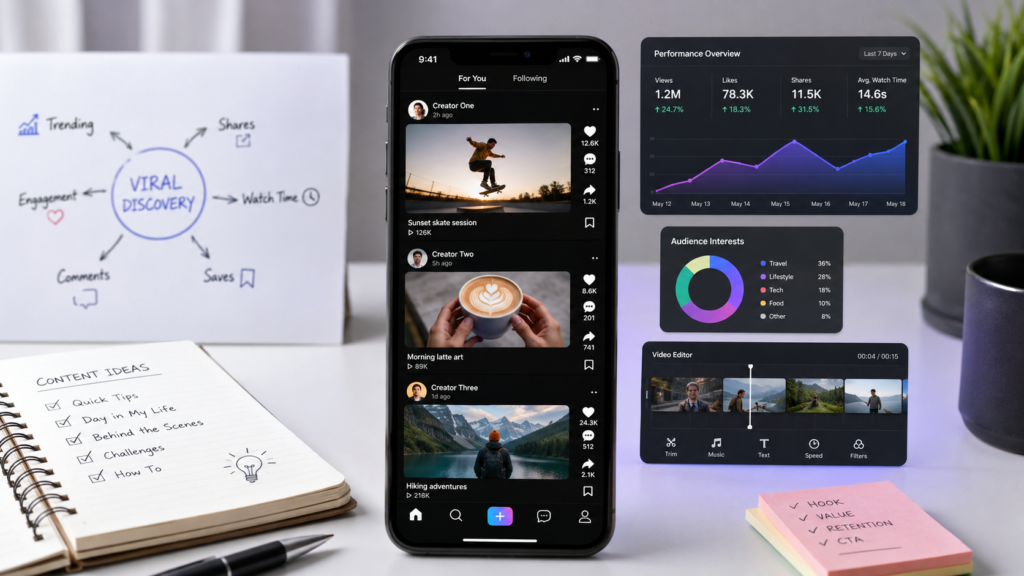
Short-form videos have quietly become one of the most dominant formats across the internet. On TikTok, Instagram Reels, YouTube Shorts, Facebook Reels, and Snapchat Spotlight, brief vertical clips now compete directly with traditional media, news websites, and longer video content for the same limited pool of human attention.
The reasons are interconnected. Mobile devices changed how people consume content. Platform algorithms were redesigned to reward fast engagement. Creators learned that shorter videos generate faster discovery. And brands discovered that a 30-second clip can introduce a product to someone who would never click a banner ad.
This article explains why short-form videos have become so powerful, how platforms promote them, why creators and brands rely on them, and what the long-term effects are for users, content quality, and the broader media landscape.
Why Are Short-Form Videos Taking Over Social Media?
Short-form videos are popular because they are fast to watch, easy to share, and built for mobile screens. Recommendation algorithms on platforms like TikTok, Instagram, and YouTube are designed to surface videos that hold viewer attention, and short clips often do that more effectively than longer content. For creators, short videos are faster to produce and easier to test. For brands, they offer a low-cost way to reach new audiences organically or through paid promotion.
What Are Short-Form Videos?
Short-form videos are typically defined as video content under 60 seconds, though many platforms have expanded that definition to include videos of two to three minutes. The format is almost always vertical, designed to fill a smartphone screen without requiring the viewer to rotate their device.

These videos use fast editing, on-screen captions, trending audio, and strong visual hooks in the opening seconds to capture attention quickly. Many are built to loop, meaning the video replays automatically, which increases the time a viewer spends watching without requiring any extra clicks.
The storytelling in short-form video is compressed. Creators communicate a single idea, emotion, joke, or lesson in as little time as possible. Unlike a YouTube documentary or a long blog post, the goal is immediacy.
Why Short-Form Videos Fit Mobile Behavior
Most social media is now consumed on mobile devices. People scroll during commutes, breaks, waiting rooms, and downtime at home. Vertical short-form video fits this behavior precisely.
A vertical video fills the phone screen edge to edge. The viewer does not need to rotate their device, tap to expand, or adjust their position. The content starts immediately.
Short videos also match the low-commitment nature of mobile scrolling. A viewer who opens a social media app between tasks is more likely to watch a 30-second clip than to commit to a five-minute video. If the short video is not engaging within the first few seconds, the viewer simply scrolls to the next one.
This ease of consumption creates high volume viewing. Users may watch dozens of short videos in a single session, spending significant time on the platform without intentionally choosing to do so. That behavior is exactly what social media platforms are designed to encourage.
How Social Media Algorithms Promote Short Videos
Social media platforms use recommendation systems to decide which content appears in a viewer’s feed. While the exact details of any platform’s algorithm are not publicly disclosed, researchers and creators have identified several behavioral signals that appear to influence distribution.
Watch time matters significantly. If viewers consistently watch a video to the end, or rewatch it multiple times, the algorithm reads that as a signal that the content is engaging. Short videos are more likely to be watched fully than long ones, which gives them a structural advantage in many recommendation systems.
Completion rate is closely related. A video that most viewers finish scores differently than one where most people stop after a few seconds. Short-form videos, by design, are easier to finish.
Engagement signals, including likes, comments, shares, and saves, also influence how widely a video is distributed. Content that generates fast interaction after posting may reach a broader audience than content that accumulates engagement slowly.
Rewatches appear to carry particular weight on some platforms. A video that loops multiple times before a viewer scrolls away sends a strong signal that the content held attention.
These algorithmic dynamics create a feedback loop. Creators who understand them produce short, fast, hook-driven videos that the algorithm rewards with greater reach. That reach encourages other creators to adopt the same format.
TikTok, Instagram Reels, and YouTube Shorts: Why Platforms Are Competing
Several major platforms now have their own short-form video product. Each serves a different primary audience and serves different creator and brand goals.
| Platform | Main Format | Why Users Watch | Why Creators Use It | Why Brands Care |
| TikTok | TikTok videos (up to 10 min, short clips dominant) | Discovery, entertainment, trends, humor, learning | High organic reach for new accounts, fast audience growth | Large Gen Z and millennial audience, viral potential, creator partnerships |
| Instagram Reels | Reels (up to 90 seconds) | Lifestyle, fashion, food, personal brands | Cross-promotion with Instagram posts and Stories, existing follower base | Visual products, influencer marketing, shopping integrations |
| YouTube Shorts | Shorts (up to 60 seconds) | Quick content from favorite creators, trending topics | Access to YouTube’s large search-based audience, monetization | Long-established ad platform, brand safety tools, broad demographic reach |
| Facebook Reels | Reels (up to 60 seconds) | Family, community groups, news, local content | Reach older demographics, cross-post from Instagram | Access to broad age range, Facebook’s advertising ecosystem |
| Snapchat Spotlight | Spotlight videos (under 60 seconds) | Casual entertainment, friends, Gen Z trends | Potential bonus payouts from Snapchat’s creator fund | Younger demographic, privacy-first image, less competitive than TikTok |
Competition between these platforms has accelerated the development of short-form features. When TikTok grew rapidly, Instagram launched Reels and YouTube expanded Shorts. That competition has benefited creators by giving them multiple platforms where short content can find audiences.
Why Creators Love Short-Form Video
Short-form video has lowered the barrier to entry for content creation in a significant way. A creator does not need professional camera equipment, an editing suite, or a large following to publish a video that reaches millions of people.
A smartphone, decent lighting, and a clear idea are often sufficient to start. Many of the most-watched short videos are filmed in ordinary environments with minimal production value. Authenticity frequently outperforms polish in the short-form format.
Creators also benefit from the fast testing that short videos allow. Producing a 10-minute YouTube video requires significant time investment before a creator knows how the audience will respond. A 30-second clip can be produced and published in a fraction of the time, giving the creator rapid feedback on what resonates.
Discovery is faster too. Short-form recommendation feeds can expose a new creator’s video to a large audience without requiring any pre-existing follower base. This is different from long-form platforms, where audience growth has traditionally been slower and more dependent on search.
Creators can also participate in trends, sounds, and formats that are already circulating. Using a trending audio clip or joining a popular format increases the likelihood that a video will be seen by people already engaging with that trend.
Monetization on short-form platforms has expanded. TikTok, YouTube, and Snapchat have each introduced creator payment programs, though the structure, eligibility requirements, and payout rates vary significantly and change over time. Brand partnerships and sponsored content represent a more consistent income source for many creators with established audiences.
Why Brands Are Investing in Short-Form Videos
For brands, short-form video offers something that traditional advertising formats struggle to deliver: organic discovery at scale.
A 30-second product demonstration on Instagram Reels can reach people who have never heard of the brand and who did not search for it. If the content is useful, entertaining, or visually appealing, users may share it, save it, or visit the brand’s profile. This kind of passive discovery is difficult to achieve through search ads or email campaigns.
Brands use short-form video across several use cases. Product demonstrations show how something works in a real context. Behind-the-scenes content builds trust and personality. Customer testimonials act as social proof. Educational clips answer common questions before a customer even asks them.
Creator partnerships have become one of the most effective strategies. Brands work with influencers and micro-creators to produce authentic content that reaches specific communities. An audience that trusts a creator is more likely to be receptive to a product recommendation from them than to a traditional ad.
Short-form video also integrates directly with social commerce features on platforms like Instagram and TikTok, where users can tap a product shown in a video and proceed to purchase without leaving the app.
Why Short-Form Video Is Becoming a Search Tool
A growing number of people, particularly younger users, are using TikTok, Instagram, and YouTube as search engines rather than going to Google first.
When someone wants to find a good restaurant, review a skincare product, learn a quick cooking technique, or plan a trip, they may search for it on a short-form video platform and watch creator-made content rather than reading articles.
This shift is significant for brands and publishers. Being discoverable on video platforms now requires the same attention that search engine optimization once demanded. Creators who produce consistent, specific, informative short videos on a topic can become the go-to source for that subject within their community.
Google has acknowledged this trend and integrated video content into its own search results more aggressively. YouTube Shorts appear in Google search, and short clips from multiple platforms are increasingly surfaced in response to informational queries.
What Makes a Short-Form Video Work?
Not every short video performs equally. Creators and marketers who study the format consistently identify several elements that separate effective short videos from ones that go unnoticed.
The first three seconds are decisive. Viewers who are not engaged immediately will scroll away. A strong visual, a surprising statement, or a direct question in the opening seconds keeps people watching.
The hook is closely related to the opening. A hook is the reason a viewer has to stay. It creates a small tension or question that gets resolved by watching the rest of the video.
Captions are now standard. Many users watch short videos without sound, particularly in public spaces. Captions make the content accessible and increase watch time among silent viewers.
Audio choice matters even for viewers who do watch with sound. Using trending audio on platforms that favor it can increase a video’s exposure. Original audio can distinguish a creator’s voice.
Pacing is critical. Short videos that drag in the middle lose viewers before the ending. Every second needs to serve the content.
A shareable idea gives viewers a reason to send the video to someone else. This is often a useful tip, a relatable experience, humor, or an emotional moment.
Short-Form Videos vs Long-Form Videos
Short and long-form video serve different purposes and work best in combination rather than as substitutes.
| Short-Form Video | Long-Form Video | |
| Typical length | Under 60–90 seconds | 5 minutes to several hours |
| Best use case | Discovery, entertainment, quick information | Deep learning, tutorials, storytelling, community building |
| Strengths | Fast to produce, high discoverability, mobile-friendly | Builds deeper trust, supports complex topics, stronger monetization |
| Weaknesses | Limited depth, harder to build loyal audience, algorithm-dependent | Slow to produce, harder for new creators to get discovered, requires longer viewer commitment |
Short videos often act as a top-of-funnel tool. A viewer watches a 45-second clip about a topic, becomes curious, and then seeks out a longer video, article, podcast, or product. Many creators deliberately use short-form content to drive traffic to longer content on YouTube, newsletters, courses, or their own websites.
Long-form video remains important for topics that require nuance, extended demonstration, or ongoing community engagement. Short-form video has not replaced it; the two formats increasingly work together.
The Downsides of Short-Form Video
Short-form video brings genuine benefits, but also introduces challenges that affect users, creators, and the broader information environment.
Attention fatigue is a real concern. Consuming many rapid-fire videos in a single session can leave users feeling drained without feeling informed. The format encourages passive consumption at high volume.
Misinformation spreads quickly in short-form video. A false claim can reach millions of viewers in hours. Short clips do not naturally accommodate nuance, fact-checking, or context. Platforms have introduced content moderation policies and labels, but enforcement is uneven and fast-moving false content often reaches a large audience before it is addressed.
Creator burnout is widespread. The expectation of consistent, frequent posting creates pressure that many creators describe as exhausting. Posting daily or multiple times per week to maintain algorithmic visibility is unsustainable for many creators long-term.
Copycat trends reduce content diversity. When a format or audio clip goes viral, many creators produce similar content within hours. This can create a sameness across feeds and make it harder for genuinely original content to stand out.
Shallow engagement is another risk. Likes and views do not always translate into meaningful connection between a creator and their audience. Building a loyal community through short-form content alone is difficult.
Platform dependency is a structural risk for creators who build their entire audience in one place. Algorithm changes, policy updates, or shifts in platform popularity can significantly affect a creator’s reach overnight.
How Short-Form Video Changes the Creator Economy
Short-form video has fundamentally altered what it means to be a content creator. Entry barriers are lower than they have ever been. Anyone with a smartphone and an idea can publish content that reaches a global audience.
This accessibility has brought millions of new creators into the space, which has also intensified competition. Standing out on any platform requires more consistency, faster iteration, and stronger content than it did three or four years ago.
Niche creators have found unexpected success. Creators who focus on specific topics, obscure history, repair tutorials, regional food, niche hobbies, can build passionate communities even with modest follower counts. Brands increasingly seek out these micro-creators because their audiences tend to be more engaged and more targeted.
Platform monetization rules shape creator income in ways that creators cannot fully control. Payment structures change, eligibility requirements shift, and what was lucrative on one platform may not be on another. Many experienced creators maintain a presence across multiple platforms and build owned channels, newsletters, websites, or subscription communities, to reduce their dependency on any single platform.
What This Means for Everyday Users
For the average user, the dominance of short-form video means a more personalized, fast-paced content experience. Recommendation feeds learn viewing habits quickly and surface content that matches individual interests. This can feel useful and entertaining, but it also means the algorithm strongly shapes what information and perspectives a user encounters.
Product discovery through short-form video is increasing. Users find new brands, books, restaurants, and services through creator recommendations on video platforms, often in contexts where they were not actively looking for those things.
The ease of consuming short video also makes information verification more important. Content that looks credible and is presented confidently can be wrong. Users benefit from checking unfamiliar claims through additional sources before sharing or acting on them.
Platform tools, following specific creators, blocking topics, saving content, and using reporting features, give users more control over their feeds than casual viewers often realize. Using these tools actively produces a better and more accurate experience than passively accepting default recommendations.
What Comes Next for Short-Form Videos?
Several trends are likely to shape how short-form video develops over the next few years.
Platform competition will continue. New features, creator funds, and monetization tools will roll out as TikTok, Instagram, YouTube, and others compete for creators and viewers.
Shopping integrations will expand. Social commerce, where users purchase directly through video content, is growing, and most major platforms are investing in tighter integration between video and purchase experiences.
Creator tools will become more sophisticated. AI-assisted editing, automatic captioning, translation, and content suggestions are already available on some platforms and will become more common.
Social search will grow in importance. Platforms are investing in making their content more searchable, and brands and creators who optimize for social search will have an advantage.
Vertical video advertising will increase. As more attention shifts to short-form formats, advertisers are shifting budgets toward vertical video ads that fit naturally within short-form feeds.
Regulation around teen safety and harmful content is increasing in multiple countries. Platform policies around content recommendations for younger users are likely to become more restrictive, which will affect how short-form video is distributed and moderated.
Key Takeaways
- Short-form videos are typically under 60–90 seconds, vertical, and designed for mobile viewing.
- They fit naturally into mobile browsing habits because they require low time commitment and fill the screen.
- Recommendation algorithms reward high completion rates, watch time, and engagement, which gives short videos a structural advantage.
- TikTok, Instagram Reels, YouTube Shorts, Facebook Reels, and Snapchat Spotlight are the major competing platforms.
- Creators benefit from low production barriers, fast discovery, and the ability to test content quickly.
- Brands use short-form video for product discovery, awareness, creator partnerships, and social commerce.
- Short-form video is increasingly used as a search tool for recommendations and how-to content.
- The format brings real challenges: attention fatigue, misinformation, creator burnout, and platform dependency.
- Short-form video works best as a complement to long-form content, not a replacement.
- Shopping integrations, creator tools, and platform competition will continue to shape the format’s development.
Frequently Asked Questions
Q1. What are short-form videos?
Short-form videos are typically brief video clips under 60 to 90 seconds, formatted vertically for mobile screens. They are designed for quick viewing and are used across platforms like TikTok, Instagram Reels, YouTube Shorts, Facebook Reels, and Snapchat Spotlight.
Q2. Why are short-form videos so popular?
They are easy to watch, require little time commitment, and are optimized for mobile viewing. Recommendation algorithms on major platforms favor content with high completion rates and engagement, which short videos are better positioned to achieve.
Q3. Which platforms use short-form videos?
The main platforms are TikTok, Instagram (Reels), YouTube (Shorts), Facebook (Reels), and Snapchat (Spotlight). Each platform has its own audience demographics, creator tools, and algorithmic approach.
Q4. Are short-form videos replacing long-form videos?
No. Short-form videos often act as discovery content that leads viewers to longer videos, websites, podcasts, or purchases. Long-form video remains important for topics requiring depth, nuance, and community building.
Q5. How do creators make money from short-form videos?
Creators can earn through platform creator funds, brand partnerships, sponsored content, affiliate marketing, and social commerce features. Platform payment programs vary significantly in structure, eligibility, and payout rates.
Q6. Why do brands use short-form videos?
Brands use them for product discovery, brand awareness, creator partnerships, and social commerce. Short-form video allows brands to reach new audiences who are not actively searching for them and to appear in organic recommendation feeds.
Q7. What are the downsides of short-form videos?
The main downsides include attention fatigue from high-volume consumption, the rapid spread of misinformation, creator burnout from posting pressure, shallow engagement, and platform dependency risk for creators who rely on a single platform for their audience.
Final Thoughts
Short-form video is taking over social media because it matches how people use phones, how platforms recommend content, and how creators and brands compete for attention in an increasingly crowded digital environment.
The format succeeds because it removes friction. Watching a 30-second clip requires almost no effort. Sharing it requires a single tap. Producing one requires only a smartphone. That simplicity, at every stage of the experience, makes short-form video uniquely suited to the current media landscape.
But the format is not without cost. Misinformation moves faster than corrections in short-form feeds. Creator burnout is real. Attention fatigue is growing. And the algorithmic infrastructure that makes short videos so effective also concentrates enormous power in the hands of a small number of platforms.
Understanding why short-form video works, and where it falls short, helps users consume it more thoughtfully, helps creators build more sustainable careers, and helps brands invest in content strategies that generate genuine value rather than just chasing metrics.
The format is here to stay. How it evolves will depend on platform decisions, creator innovation, regulatory pressure, and user behavior. All of those forces are already in motion.