


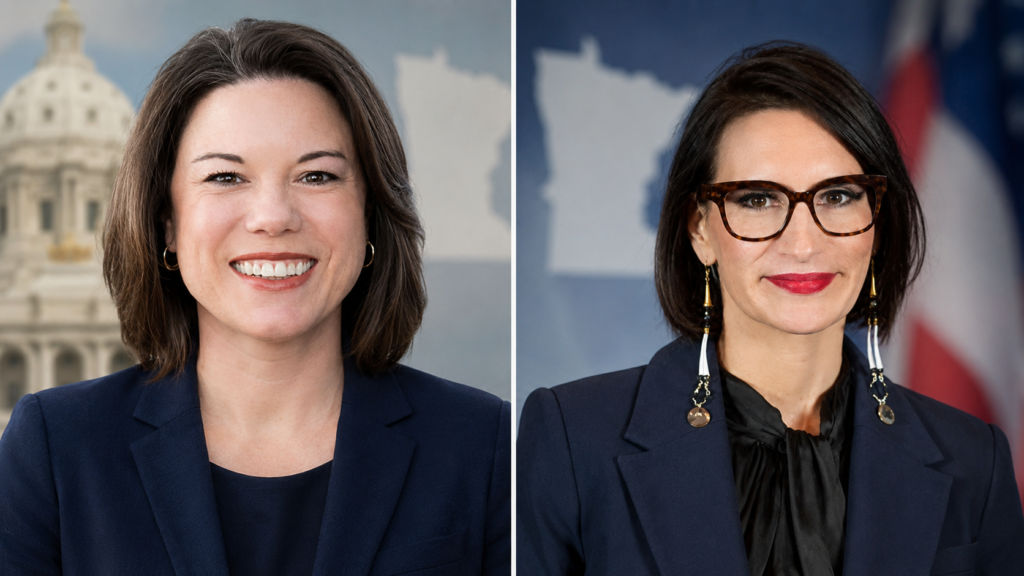
U.S. Rep. Angie Craig and Lt. Gov. Peggy Flanagan, the two leading Democrats seeking Minnesota’s open U.S. Senate seat, face off in the state’s Democratic primary on Tuesday, August 11, 2026. The winner will advance to the November 3 general election for the seat being vacated by retiring Sen. Tina Smith, in a contest both parties consider one of the more closely watched Senate races of the midterm cycle.
Polls across Minnesota are open from 7 a.m. to 8 p.m. Central Time on primary day. As of this writing, voting was underway, and no results had been reported. This article will be updated with verified results once they become available from Minnesota election officials.
Angie Craig vs Peggy Flanagan: What to Know
The Angie Craig vs Peggy Flanagan matchup is the marquee contest in Minnesota’s 2026 Democratic Senate primary. Craig, a four-term congresswoman from the state’s Second Congressional District, is running as a candidate who has shown she can win in a competitive, closely divided district. Flanagan, Minnesota’s sitting lieutenant governor since 2019, is running as the more progressive choice and enters the primary with the formal endorsement of the state’s Democratic-Farmer-Labor Party, commonly known as the DFL.
A third Democrat, former state Senate Minority Leader Melisa López Franzen, also qualified for the ballot. However, public polling throughout the campaign has centered on the contest between Craig and Flanagan. Whichever candidate wins the Democratic primary will face the winner of a nine-candidate Republican primary in November.
Why Is Minnesota’s Senate Seat Open in 2026?
The seat became open after Sen. Tina Smith, a Democrat first appointed to the Senate in 2018 and elected to a full term in 2020, announced she would not seek reelection in 2026. Smith has since endorsed Flanagan in the Democratic primary. Minnesota Democrats have controlled both of the state’s Senate seats since 2009, and the party is working to keep the seat as it defends a broader map of competitive Senate races nationally.
Who Is Angie Craig?
Craig, a member of the Democratic-Farmer-Labor Party, has represented Minnesota’s Second Congressional District, which covers the southern suburbs of the Twin Cities and surrounding rural areas, since January 2019. She previously worked as a journalist and later as a health care industry executive before entering politics. In December 2024, Craig was elected ranking member of the House Agriculture Committee, becoming the first woman and first openly LGBTQ+ member to hold that role.
Craig has built her Senate campaign around her record of winning a competitive, closely divided congressional district four times, arguing that experience makes her the stronger candidate to keep the Senate seat in Democratic hands in a general election. Her endorsements include several sitting Democratic senators, such as Chris Coons, Elissa Slotkin, Tammy Baldwin, Ruben Gallego, and Andy Kim, along with the Human Rights Campaign PAC, Minneapolis Mayor Jacob Frey, Minnesota First Lady Gwen Walz, and former Rep. Collin Peterson.
Craig’s record has also become a central point of contention in the primary. In early 2025 she was the only Minnesota Democrat in Congress to vote for the Laken Riley Act, a Republican-backed measure that expanded federal authority to detain undocumented immigrants accused of certain crimes. In March 2026, amid the Trump administration’s immigration enforcement operation in the Minneapolis area known as Operation Metro Surge, Craig said publicly that she regretted the vote and pledged to work toward comprehensive immigration reform.
Who Is Peggy Flanagan?
Flanagan has served as Minnesota’s lieutenant governor since January 2019, working alongside Gov. Tim Walz. She serves as Minnesota’s 50th lieutenant governor. Her campaign and several news organizations have identified her as the highest-ranking Native American woman ever elected to statewide executive office in the United States. Flanagan is a citizen of the White Earth Band of Ojibwe.
In state government, Flanagan has pointed to her role in helping pass paid family and medical leave, expanded free school meals for Minnesota students and an increase in the state’s minimum wage. She won the DFL’s formal party endorsement at the state convention in May 2026 and has campaigned as the more progressive candidate in the race, supporting Medicare for All and calling for reduced U.S. military support for Israel.
Flanagan’s endorsements include retiring Sen. Tina Smith along with national Democratic figures such as Elizabeth Warren, Bernie Sanders, Ed Markey, Chris Murphy, Chris Van Hollen, Jeff Merkley and Martin Heinrich, as well as Rep. Ilhan Omar, Rep. Betty McCollum, Minnesota Attorney General Keith Ellison and National Nurses United.
Angie Craig vs Peggy Flanagan: Key Differences
Immigration has emerged as the sharpest dividing line in the campaign. Flanagan has repeatedly criticized Craig’s 2025 vote for the Laken Riley Act and has said she would have voted against it. She has argued that Craig’s expression of regret, which came roughly 14 months after the vote and after federal immigration agents intensified enforcement activity in Minneapolis, came too late. Craig has said her vote reflected the political reality of representing a swing district and has committed to pursuing comprehensive immigration reform going forward.
Health care is another point of contrast. Flanagan supports Medicare for All, a single payer system that would replace private insurance with government coverage. Craig supports what she describes as “Medicare for All who want it,” a public option model that would let Americans choose between a government run plan and private insurance. Craig has said she is concerned that a single payer system does not address underlying incentives in a health system that, in her view, rewards the volume of procedures performed.
Israel and foreign policy also separate the candidates. Flanagan has called for the United States to reduce military support for Israel, a position associated with the more progressive wing of the Democratic Party. Craig has taken a more measured public posture on the issue and has supported congressional measures condemning antisemitism.
Campaign identity and electability arguments run through the entire race. Craig’s campaign argues that her experience winning competitive elections in a divided district positions her to hold the seat in November. Flanagan’s campaign says her more progressive message has energized the party’s grassroots base and argues that her statewide profile as lieutenant governor gives her a coalition that can compete effectively in November.
What Do the Latest Polls Show?
Public polling in the race has shown Flanagan leading Craig among likely Democratic primary voters for most of the campaign, though the size of that lead has varied by pollster.
A Public Policy Polling survey conducted July 23 to 24, 2026, and commissioned by the Democratic Lieutenant Governors Association, found Flanagan leading Craig 46% to 32% among likely Democratic primary voters. PPP’s earlier survey, conducted about a month prior in late June, had shown a narrower seven point lead for Flanagan, 43% to 36%.
Not all polling has shown a gap of that size. A KSTP and SurveyUSA poll conducted in July found the two candidates statistically tied at 40% each. A GQR survey conducted earlier in the year found Flanagan leading 49% to 36%, with 15% of respondents undecided.
A group aligned with Flanagan’s campaign commissioned the Public Policy Polling surveys, while independent polls have shown a narrower race. Taken together, the available polling suggests a competitive contest in which Flanagan generally leads, rather than a settled outcome. Like all primary polls, these surveys offer only a snapshot of voter preferences before Election Day and do not predict the final result.
Fundraising and Campaign Spending
As of the Federal Election Commission’s June 30, 2026, reporting deadline, Craig had raised $11.93 million for her campaign and had $5.04 million in cash on hand. Flanagan had raised $6.04 million and had $1.57 million in cash on hand over the same period.
Outside spending has also been a major factor in the race. Flanagan’s campaign and allied groups have said that outside organizations supporting Craig, including groups backed by cryptocurrency industry donors and a technology investor with data center holdings, have spent approximately $20 million on advertising intended to influence the primary. Those figures come from Flanagan aligned sources and have not been independently verified against FEC outside spending disclosures; readers should note the origin of that claim.
Major Endorsements
Flanagan’s coalition includes the formal DFL party endorsement, retiring Sen. Tina Smith, several sitting U.S. senators including Elizabeth Warren and Bernie Sanders, members of Minnesota’s congressional delegation including Ilhan Omar and Betty McCollum, Attorney General Keith Ellison, and National Nurses United.
Craig’s coalition includes several sitting U.S. senators, including Chris Coons, Elissa Slotkin, Tammy Baldwin, Ruben Gallego, Jacky Rosen and Andy Kim, along with the Human Rights Campaign PAC, Minneapolis Mayor Jacob Frey, Minnesota First Lady Gwen Walz and former Rep. Collin Peterson.
What Issues Are Driving the Minnesota Senate Primary?
Immigration enforcement has dominated the closing weeks of the campaign, driven in large part by Operation Metro Surge, a federal immigration enforcement operation in the Minneapolis area that intensified public attention on Craig’s 2025 vote. A broader debate across Democratic primaries in 2026 has also influenced the race. Party leaders and voters continue to weigh whether Democrats should nominate more centrist candidates who may appeal to swing voters or more progressive candidates who may energize the party’s base. Outside spending and campaign finance have also become campaign issues in their own right, with Flanagan’s campaign frequently criticizing the outside money supporting Craig.
Who Is Favored to Win?
The available evidence points to a competitive race in which Flanagan has held a polling advantage for most of the summer, while Craig has maintained a financial edge and holds the formal backing of a larger number of sitting U.S. senators. Flanagan secured the DFL’s party endorsement in May, which can provide organizing advantages in a primary, while Craig has emphasized her record of winning general elections in a swing district as her core electability argument.
Because multiple polls diverge, in particular the narrower KSTP and SurveyUSA result compared with the wider PPP margins, the polling evidence should be read as showing a competitive race with Flanagan generally ahead, not a settled outcome. Polls are snapshots of opinion before voting, not guarantees of a result, and only the certified vote count will determine the Democratic nominee.
When Do Polls Close in Minnesota?
Polling places across Minnesota are open from 7 a.m. to 8 p.m. Central time on August 11. Voters who are in line when polls close at 8 p.m. are permitted to remain in line and vote. The Minnesota Secretary of State’s office has said the state does not report all results at a single predetermined time, and preliminary results typically begin arriving after polls close as precincts and counties transmit unofficial totals. Statewide and federal results remain unofficial until the State Canvassing Board convenes to certify them, which is scheduled for August 18, 2026.
Minnesota Senate Primary Results
As of publication, voting was ongoing and no results, official or unofficial, had been reported for the Democratic primary. This section will be updated with verified vote totals and turnout figures from the Minnesota Secretary of State once results begin to arrive.
What Happens After the Primary?
The winner of the Democratic primary advances to the November 3, 2026, general election, where they will face the winner of the Republican primary, also held August 11. Nine Republicans are seeking that party’s nomination, including 2024 Senate nominee Royce White, endorsed 2026 candidate Adam Schwarze and former sports broadcaster Michele Tafoya, who has drawn national attention as a candidate seen by some national Republicans as their strongest potential general election contender in the state. Results in the Republican primary were also not yet available as of publication.
Why the Minnesota Senate Race Matters Nationally
Republicans currently hold a 53 to 47 majority in the U.S. Senate. Democrats would need a net gain of four seats in the 2026 midterms to retake control of the chamber. Minnesota has not elected a Republican to the Senate since 2002, and nonpartisan election forecasters, including the Cook Political Report, have rated the general election for this seat as favoring Democrats. Even so, national Republicans have shown interest in competing in Minnesota. Political observers are also watching the Democratic primary closely to see how the party’s moderate and progressive wings perform in contested races nationwide, including in Michigan and Maine.
Final Takeaway
Angie Craig and Peggy Flanagan represent two different strategic bets for Minnesota Democrats heading into a competitive midterm cycle: Craig’s argument rests on a record of winning in a divided congressional district, while Flanagan’s rests on party endorsement, progressive positioning and an energized base. Polling through the summer generally showed Flanagan ahead, though by varying margins depending on the pollster, while Craig held a financial advantage. Voting concludes at 8 p.m. Central time on August 11, and the winner will face the Republican nominee in the November 3 general election for a seat that could factor into which party controls the U.S. Senate.