


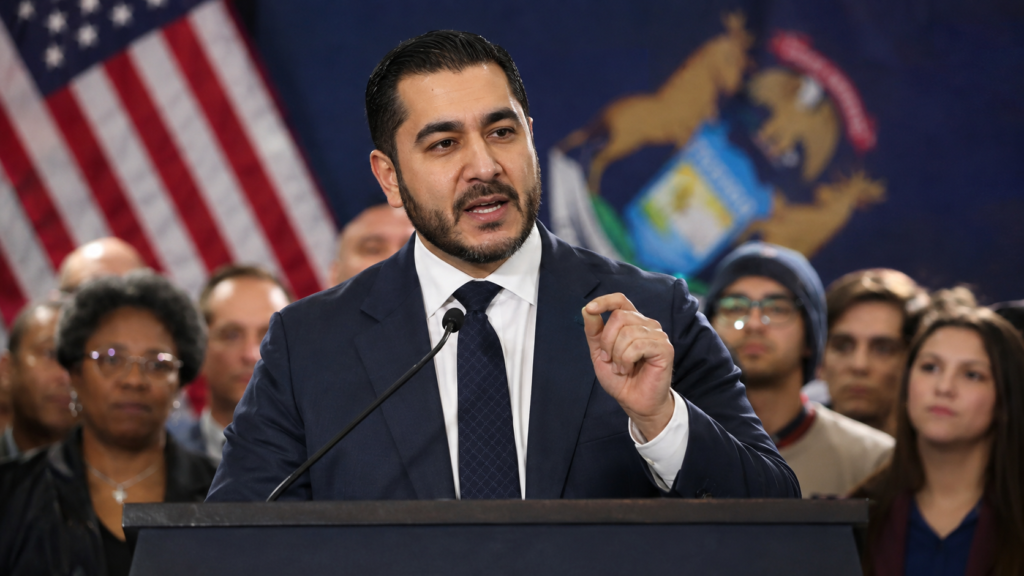
Abdul El-Sayed narrowly defeated U.S. Rep. Haley Stevens in Michigan’s Democratic primary for the U.S. Senate, securing the party’s nomination in one of the closest and most closely watched primary races of the 2026 election cycle.
When the Associated Press called the contest early Wednesday, El-Sayed led Stevens by 14,893 votes, just under one percentage point, with more than 1.5 million ballots counted. He will now face Republican nominee Mike Rogers in the November 3 general election.
For background on the candidates, voting dates and ballot structure, read this Michigan Primary Election 2026 guide.
Quick Facts
| Detail | Information |
| Candidate | Abdul El-Sayed |
| Age | 41 |
| Political party | Democratic |
| Profession | Physician and former public-health official |
| Primary opponent | Rep. Haley Stevens |
| Winning margin | Just under one percentage point when the race was called |
| Republican opponent | Mike Rogers |
| General election | November 3, 2026 |
| Seat | Open Michigan U.S. Senate seat |
El-Sayed entered the race after Democratic Sen. Gary Peters announced that he would not seek another term, creating an open-seat election in a major political battleground.
Who Is Abdul El-Sayed?
Abdul El-Sayed is a physician, author and former public-health official from Michigan.
He previously helped rebuild Detroit’s health department and later led Wayne County’s Department of Health, Human and Veterans Services. Before entering government, he studied medicine at Columbia University and completed doctoral studies at Oxford University as a Rhodes Scholar, according to his official biography.
El-Sayed first gained national political attention during his 2018 campaign for governor of Michigan. He lost that Democratic primary to Gretchen Whitmer but remained active through public-health work, writing, podcasts and political advocacy.
He formally filed his U.S. Senate candidacy in April 2025, according to Federal Election Commission records.
Michigan Democratic Primary Results
The contest between El-Sayed and Stevens remained too close to call on election night.
El-Sayed did not immediately declare victory, and major news organizations waited until early Wednesday, after nearly all ballots had been counted, before projecting him as the winner.
At the time the Associated Press called the race:
- El-Sayed led by 14,893 votes.
- His lead was just under one percentage point.
- More than 1.5 million ballots had been counted.
- The turnout was unusually high for a Michigan Democratic primary.
Final certified totals may differ slightly from the figures available when the race was called.
How Did Abdul El-Sayed Win?
El-Sayed’s campaign combined progressive policy positions with grassroots organizing, union support and an aggressive online-media strategy.
Focus on Healthcare and Affordability
His campaign focused heavily on healthcare costs, household expenses, campaign-finance reform and economic pressure on working families.
His major stated priorities include:
- Medicare for All
- Lower prescription-drug costs
- Affordable housing
- Restrictions on corporate money in politics
- Higher taxes on billionaire wealth
- Clean air and water
- Expanded access to education
These positions are described in greater detail on El-Sayed’s official campaign priorities page. Because that page is operated by his campaign, its claims should be presented as his policy proposals rather than independent analysis.
Progressive and Union Endorsements
El-Sayed received support from prominent progressive politicians, including Sen. Bernie Sanders and Rep. Alexandria Ocasio-Cortez.
He was also endorsed by the United Auto Workers, an influential labor union in Michigan. The UAW said its support was based partly on El-Sayed’s positions on healthcare, workers’ rights and corporate influence.
Grassroots and Online Organizing
The campaign said El-Sayed visited 110 cities, held more than 500 events and developed a volunteer network of approximately 12,000 people.
It also invested heavily in podcasts, online video and interviews with digital creators, helping the campaign reach younger and politically disengaged voters. These figures came from the campaign and were reported by the Associated Press.
How Much Outside Money Was Spent?
Outside spending became one of the central issues in the Democratic primary.
The Associated Press reported that outside groups supporting Stevens spent more than $60 million, including more than $30 million from the American Israel Public Affairs Committee and affiliated organizations.
El-Sayed repeatedly used that spending to support his argument that the election represented a contest between grassroots voters and major political donors.
However, the close final margin also shows that Stevens maintained substantial support among Democratic voters. The result should therefore not be interpreted as a decisive rejection of the party’s moderate wing.
What Are Abdul El-Sayed’s Political Positions?
El-Sayed generally campaigns as a progressive Democrat.
Healthcare
He supports Medicare for All and argues that the federal government should take a larger role in reducing medical and prescription-drug costs.
Economy
His campaign supports taxing billionaire wealth, strengthening labor protections, expanding affordable housing and limiting corporate influence over government.
Campaign Finance
El-Sayed has made reducing the role of large political donors and corporate money a central part of his campaign.
Foreign Policy
He has called for ending unconditional U.S. military assistance to Israel and has criticized U.S. policy toward the war in Gaza.
His foreign-policy position became a major dividing issue in the primary, while Stevens represented a more traditional Democratic approach toward U.S.-Israel relations.
Who Is Mike Rogers?
Mike Rogers is a former Republican member of the U.S. House of Representatives and the Republican nominee in Michigan’s 2026 Senate election.
Rogers previously represented Michigan in Congress and ran unsuccessfully for the U.S. Senate in 2024. He will now face El-Sayed in the November general election.
The campaign is expected to present voters with a clear ideological choice, with Rogers and Republican groups portraying El-Sayed as too progressive while Democrats focus on healthcare, affordability and opposition to the Trump administration.
Why Does the Michigan Senate Race Matter?
Michigan is expected to be one of the most important Senate battlegrounds of the 2026 midterm elections.
The state has supported both Republican and Democratic candidates in recent statewide elections. Donald Trump won Michigan in the 2024 presidential election, while Democrats have also won important Senate and state-level contests.
Democrats need to retain the Michigan seat while attempting to win additional Republican-held seats if they are to regain control of the Senate. That makes the El-Sayed–Rogers contest nationally significant.
Follow the broader 2026 elections coverage for updates on other races that could affect control of Congress.
Can Abdul El-Sayed Become the First Muslim U.S. Senator?
Yes. If El-Sayed wins the November general election, he would become the first Muslim elected to the United States Senate.
That possibility has attracted national attention, but his campaign has primarily emphasized healthcare, affordability and corporate influence rather than presenting the election only as a historic identity milestone.
What Happens Next?
El-Sayed’s immediate challenge is bringing Democratic voters together after an expensive and divisive primary.
Stevens conceded the contest and pledged to support him in the general election. State and national Democratic leaders also moved quickly to unite behind the nominee.
The coming months are likely to focus on:
- Healthcare and prescription-drug costs
- Inflation and household affordability
- El-Sayed’s progressive policy record
- Rogers’ previous congressional record
- Foreign policy and U.S. support for Israel
- Campaign spending and outside political groups
- Whether each candidate can attract independent voters
The Michigan general election will take place on November 3, 2026. Official registration, early-voting and absentee-ballot information is available through the Michigan Department of State.
Frequently Asked Questions
Q1. Did Abdul El-Sayed win the Michigan Senate primary?
Yes. El-Sayed narrowly defeated Rep. Haley Stevens and secured the Democratic nomination for Michigan’s open U.S. Senate seat.
Q2. What was Abdul El-Sayed’s winning margin?
When the Associated Press called the race, he led by 14,893 votes—just under one percentage point. Final certified totals may vary slightly.
Q3. Who will Abdul El-Sayed face in November?
He will face Republican nominee and former congressman Mike Rogers.
Q4. When is the Michigan Senate general election?
The general election is scheduled for Tuesday, November 3, 2026.
Q5. Has Abdul El-Sayed previously held elected office?
No. He has not previously held elected office. His government experience comes primarily from leadership roles in Detroit and Wayne County public-health agencies.
Q6. What are Abdul El-Sayed’s main policies?
His major proposals include Medicare for All, campaign-finance reform, affordable housing, reducing prescription-drug costs and increasing taxes on billionaire wealth.
Q7. Would Abdul El-Sayed be the first Muslim senator?
Yes. If elected in November, he would become the first Muslim elected to the U.S. Senate.
Final Takeaway
Abdul El-Sayed’s narrow primary victory gives Michigan Democrats a progressive nominee for one of the country’s most consequential Senate races.
His campaign overcame substantial outside spending and support for Stevens from many established Democratic figures. However, the close result means El-Sayed must now unite the party and expand his support beyond the voters who backed him in the primary.
The November contest against Mike Rogers will test whether El-Sayed’s healthcare-focused, anti-establishment platform can succeed in a politically divided swing state—and its outcome could help determine control of the U.S. Senate.