



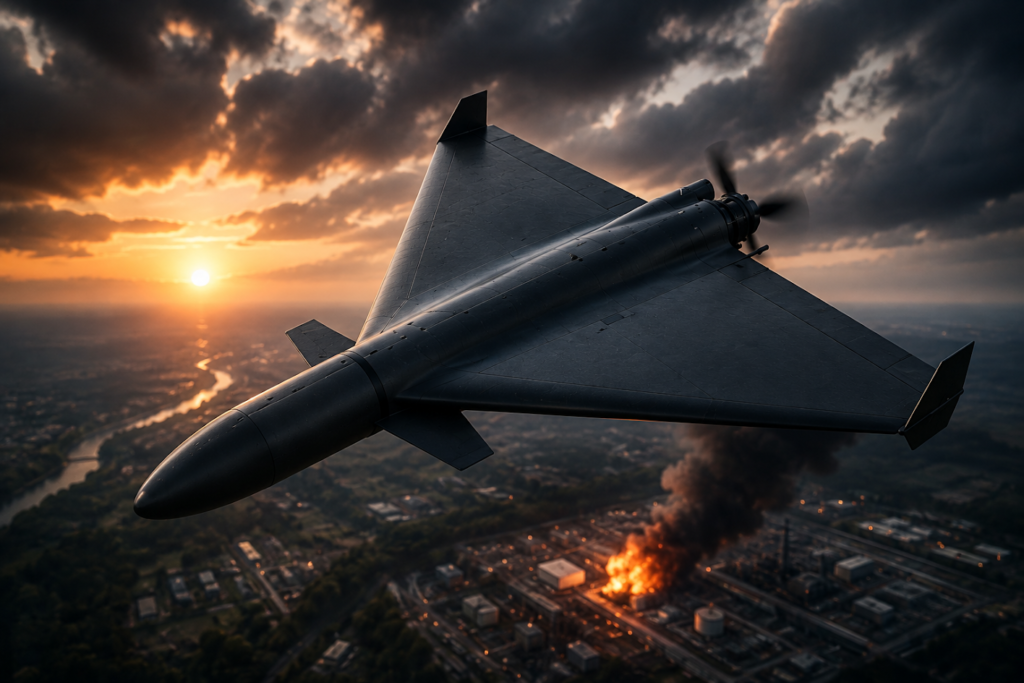
For more than a year, open-source analysts tracking the drone war in Ukraine kept spotting the same unidentified aircraft in wreckage photos and strike footage: a Shahed-style delta wing with an unusual pair of forward canards. Nobody could put a name to it. Then, in mid-August 2026, a Ukrainian defense outlet visited the factory that builds it, and the mystery aircraft finally got a name, the MICH-2000.
If you’ve searched “drone Ukraine war” recently, there’s a good chance the MICH-2000 is why. It’s now one of the most talked-about weapons in the Ukrainian long-range drone arsenal, credited with strikes deep inside Russian territory, including a hit on a strategic bomber at Engels air base. This article breaks down what’s actually known about the drone, where it came from, who flies it, and how it fits into the wider story of Ukraine’s defense technology push.
What Is the MICH-2000 Drone?
The MICH-2000 is a Ukrainian-built, one-way attack drone, a long-range strike UAV designed to fly deep into enemy territory and detonate on impact. According to reporting from the Ukrainian outlet Oboronka, which toured the production facility, the manufacturer states the drone has a maximum range of roughly 2,000 kilometers (about 1,240 miles) and can carry a warhead of between 25 and 60 kilograms.
Visually, the MICH-2000 resembles Iran’s Shahed-136, which is why it was so often mistaken for a Russian-launched Shahed rather than a Ukrainian weapon. Its giveaway feature is a pair of forward canards near the nose, a detail that separates it from the standard Shahed silhouette once you know to look for it.
The base version reportedly starts at around $48,000, with the manufacturer claiming roughly 85% of components are now sourced or produced inside Ukraine. A longer-range variant, sometimes referred to as MICH+, is also reportedly in development.
The Origin Story: From a Chinese Civilian Airframe to a Ukrainian Strike UAV
The MICH-2000’s backstory is arguably the most interesting part of the whole program, and it explains why the drone stayed hidden for so long.
A Buying Trip That Didn’t Go as Planned
In late 2023, a team of Ukrainian drone developers traveled to China hoping to purchase a civilian UAV platform, reportedly the ZTK-150, sold commercially as the Mugin-5 PRO, that Ukrainian units had already been adapting into makeshift strike drones. According to reporting from Euromaidan Press and Militarnyi, Chinese intermediaries initially discussed selling the full production technology, and Ukrainian buyers were interested. But when the Ukrainian team returned to close the deal, the factory’s management refused to sell.
Localizing Production in Ukraine
Rather than walk away, the Ukrainian team used what they had learned to build the airframe domestically. Test flights reportedly began in the summer of 2024, and the first three aircraft flew combat missions that October, after which the project moved into serial production. Today, the manufacturer says the platform is producing several thousand units a year, a fraction of the output some larger Ukrainian drone manufacturers have announced, but enough to sustain a steady campaign of strikes.
Who Flies the MICH-2000?
Unlike many Ukrainian long-range attack drones that multiple branches of the armed forces operate, the MICH-2000 reportedly has a single operator: the Security Service of Ukraine’s (SBU) Alpha Special Operations Center. According to Oboronka, the SBU’s Alpha unit operates the drone exclusively. This limited use likely helped keep the aircraft unidentified for more than a year because it rarely appeared in the same channels as systems used by multiple military units.
Notable MICH-2000 Strikes
Multiple Ukrainian and international outlets have attributed a string of high-profile strikes to the MICH-2000, based on statements from the SBU and the drone’s manufacturer. Reported targets include:
- Engels-2 air base, where a reported MICH-2000 strike hit a Tu-95MS strategic bomber on July 16. Satellite imagery later showed damage that matched the SBU’s claim that the strike destroyed the aircraft’s tail section.
- The port of Ust-Luga, described as the largest known single use of the drone, with reports of more than 20 MICH-2000 units reaching their targets simultaneously.
- An optical-mechanical plant in Azov, in Russia’s Rostov region.
- A Wildberries logistics hub in Russia’s Ryazan region.
- An electronic warfare system near a presidential residence in Gelendzhik.
- A Russian Baltic Fleet naval base.
It’s worth noting, as some specialist trackers have pointed out, that these performance claims and strike attributions largely originate with the manufacturer and the SBU. None of the figures, range, payload, or the full strike list, have been independently verified by a neutral third party, which is standard for a weapons program this new and this secretive.
Where the MICH-2000 Fits in Ukraine’s Drone Program
The MICH-2000 is one piece of a much larger Ukrainian defense industry effort to build long-range attack drones at scale. Alongside better-known systems like the Lyutyi and Fire Point’s FP-1, the latter reportedly targeting production in the tens of thousands per year, the MICH-2000 shows how Ukraine has repeatedly turned to reverse-engineering and rapid localization to offset restricted access to foreign components.
This pattern of drone warfare in Ukraine, cheap, mass-produced, one-way strike aircraft substituting for expensive cruise missiles, has become a defining feature of the conflict. It’s also reshaping how outside militaries think about unmanned aerial vehicle procurement.
The U.S. Connection: Camp Grayling and the Pentagon’s Drone Push
That influence is visible in the United States, too. The Pentagon’s Drone Dominance Program, run jointly by the Test Resource Management Center and the Defense Innovation Unit, has been holding competitive fly-offs explicitly designed around lessons from the Ukraine battlefield. A Phase II qualifying event held June 8–19, 2026, at Camp Grayling, Michigan, put 49 drone companies through day-and-night missions simulating long-range strike and close-quarters combat scenarios; 19 advanced to the program’s next round, known as Gauntlet II, at Fort Carson, Colorado.
The Army has since designated Camp Grayling a premier national test range and announced a dedicated electronic-warfare test event there for September 2026, built specifically to mimic the contested, jammed conditions seen in Ukraine. Notably, Ukrainian manufacturers themselves have entered this U.S. pipeline, a company called Ukrainian Defense Drones has already shipped an initial batch of drones to the U.S. for evaluation, and Ukrainian firm General Cherry is among the companies still competing in Gauntlet II. It’s a sign that Ukraine’s rapid-iteration approach to military UAV technology is increasingly viewed as a template worth studying, not just a wartime necessity.
Why the MICH-2000 Matters
A few reasons this particular drone has generated so much attention:
- It closes a range gap. A reported 2,000-km range puts most of European Russia within reach from Ukrainian territory.
- It’s cheap relative to its reach. A roughly $48,000 unit cost is a fraction of the price of a cruise missile with comparable range.
- It’s evidence of localization. The manufacturer says Ukrainian suppliers now provide 85% of the drone’s components, highlighting Ukraine’s broader effort to reduce dependence on foreign suppliers after China cut off access to the platform that inspired it.
- It stayed hidden for over a year. The SBU kept the program largely out of public view for more than a year. That is unusual in a conflict where analysts often identify new military hardware within weeks, and it shows how tightly the SBU controlled information about the drone.
Frequently Asked Questions
Q1: What is the MICH-2000 drone used for?
The SBU’s Alpha unit reportedly operates this one-way attack (kamikaze-style) drone for long-range strikes on military and infrastructure targets.
Q2: How far can the MICH-2000 fly?
The manufacturer states a maximum range of up to 2,000 km (about 1,240 miles), though this figure has not been independently verified.
Q3: Is the MICH-2000 the same as a Shahed drone?
No. It shares a similar delta-wing shape with Iran’s Shahed-136, but it’s a separate Ukrainian-built platform, distinguishable by forward canards near the nose.
Q4: When did the MICH-2000 become public knowledge?
A Ukrainian defense outlet publicly revealed the drone’s existence in mid-August 2026 after visiting and documenting its production facility. The manufacturer says the drone had already flown combat missions since October 2024.
Q5: How much does a MICH-2000 cost?
The manufacturer’s stated starting price for the base version is around $48,000.
Final Thoughts
The MICH-2000 is a useful case study in how drone warfare in Ukraine has evolved: take a civilian platform, adapt it under pressure, localize the supply chain, and keep it quiet as long as possible. Whether every manufacturer claim about its range, payload, or strike record holds up to future scrutiny remains to be seen, but its emergence, and the parallel U.S. effort at places like Camp Grayling to learn from the same battlefield, both point to a broader shift in how long-range attack drones are being designed, tested, and fielded.
Want to stay current on how the war in Ukraine is reshaping military UAV technology? Check back for continuing coverage of Ukraine’s defense industry and the Pentagon programs racing to keep pace.
Editorial Note
This article is based on publicly available reporting from Ukrainian and international defense outlets as of August 2026. Performance figures (range, payload, cost, unit numbers) and strike attributions originate primarily with the drone’s manufacturer and Ukrainian security services and have not been independently verified by neutral third parties. Details may be updated as more information becomes available or is officially confirmed.
Sources & References
- Ukrainska Pravda: “How a Chinese UAV has become a Ukrainian long-range weapon”
- Stars and Stripes: “Ukraine delivers first batch of drones to United States”
Disclaimer: This article covers an active military conflict and reports on unverified manufacturer and government claims regarding weapons systems. Figures and attributions may change as independent verification becomes available.