


Five New York Times Reporters Subpoenaed in Air Force One Leak Inquiry
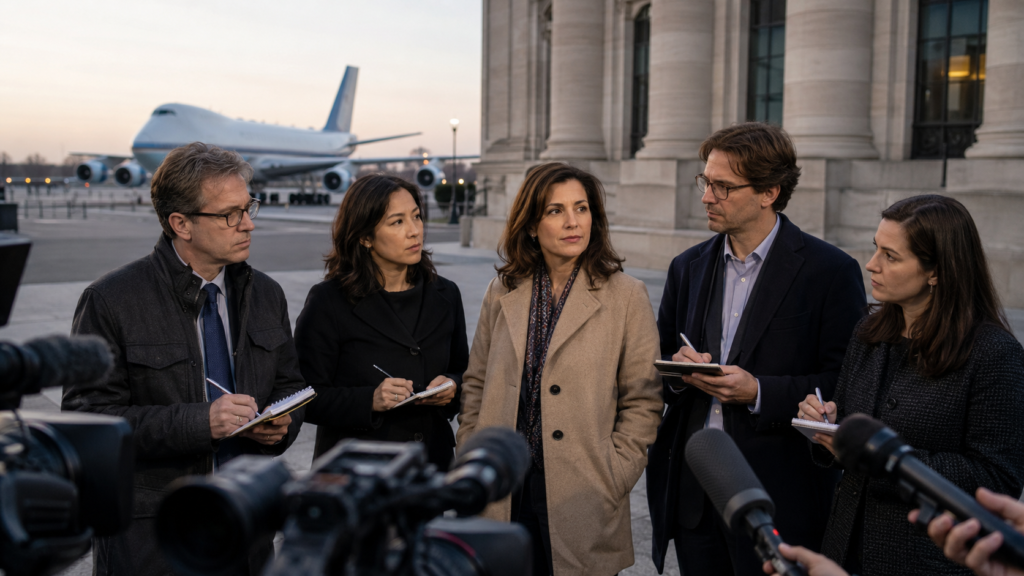
Five New York Times reporters, Tyler Pager, Eric Schmitt, Eric Lipton, Adam Goldman and Julian E. Barnes, were subpoenaed on July 10 by Manhattan U.S. Attorney Jay Clayton to testify before a federal grand jury in a leak investigation connected to their reporting on security concerns involving a Qatari-donated aircraft serving as Air Force One.
The reporters have not been accused or charged with a crime.
Key Facts
- Five New York Times journalists received subpoenas seeking testimony before a federal grand jury in Manhattan.
- The subpoenas were issued July 10, with appearances sought for July 15.
- The inquiry concerns alleged disclosures of classified information connected to reporting about the presidential aircraft.
- The United States Department of Justice says the reporters are not the criminal targets and that its focus is on people who allegedly leaked classified information.
- The New York Times has described the subpoenas as intimidation and says it will challenge them.
- A subpoena is a legal demand for testimony or evidence; it is not a criminal charge or a finding of wrongdoing.
Why Were NYT Reporters Subpoenaed?
The subpoenas seek testimony connected to a federal investigation into alleged leaks behind reporting about security issues involving the Qatari-donated presidential aircraft.
The Justice Department says it is pursuing people who disclosed classified information, not the reporters. Receiving a subpoena does not mean a journalist has been arrested, charged with a crime or found guilty.
What Happened?
According to The New York Times, federal agents delivered some subpoenas to reporters’ homes. The demands direct the journalists to appear before a federal grand jury in Manhattan on July 15 concerning an alleged violation of federal criminal law.
The subpoenas followed two Times reports published July 8 and July 10. The first said the United States Secret Service urged President Donald Trump to leave a NATO summit in Turkey aboard an older presidential aircraft.
The second reported that the recently retrofitted Boeing 747-8 lacked some defensive countermeasures available on the older aircraft.
Reuters reported that Clayton, the U.S. attorney for the Southern District of New York, issued the subpoenas.
Because federal grand jury proceedings are generally secret, the full scope of the investigation and the exact questions prosecutors want answered have not been made public.
Why Were the NYT Reporters Subpoenaed?
The Justice Department has not publicly detailed the evidence being sought.
In a statement reported by The Associated Press, the department said its concern is the unauthorized disclosure of classified information and emphasized that the journalists are not the targets.
A classified-information leak investigation examines whether someone entrusted with protected government information disclosed it without authorization.
What Did the Air Force One Report Claim?
The July 10 Times report, citing officials briefed on the retrofit, said the Qatari-donated jet did not have the same defensive countermeasures as the older presidential aircraft, including certain advanced antimissile capabilities.
It linked those concerns to the decision to use the older aircraft for part of Trump’s return from Turkey.
The aircraft had entered presidential service as a temporary “bridge” plane while two permanent replacements remained under development. Trump had flown aboard it before the reported switch.
The White House disputed suggestions that the aircraft was unsafe. Communications Director Steven Cheung said it had high-level security protections.
The Air Force said June 19 that officials took no risks with security, safety, or mission communications, while acknowledging tradeoffs on some less commonly used mission sets.
What Has the Justice Department Said?
In the statement carried by the AP, the department said it values the press’s role but must protect national secrets.
It said its targets are alleged leakers, not subpoenaed reporters.
Justice Department policy places special restrictions on compulsory process directed at news media, including high-level approval and consideration of alternative sources.
The public record does not establish whether every internal requirement was followed. The rules can inform a court’s view but do not necessarily create a standalone right for a journalist.
How Has The New York Times Responded?
The New York Times said the subpoenas were intended to intimidate independent news organizations.
David McCraw, the newspaper’s lead newsroom lawyer, said the Times would fight them. Executive Editor Joseph Kahn told staff that the organization would defend the reporters’ newsgathering rights.
The Times can ask a judge to quash, or cancel, the subpoenas as overly broad, unnecessary, issued in bad faith or improperly burdening First Amendment-protected journalism.
The outcome will depend on facts that may remain under seal.
What Does a Grand Jury Subpoena Mean?
A subpoena is an enforceable demand for testimony, documents or evidence.
A federal grand jury hears evidence in secret and decides whether probable cause exists to issue criminal charges.
Receiving one does not establish that the recipient is under investigation, charged, arrested or guilty.
The Justice Department says the reporters are not its criminal targets.
Can Journalists Be Forced to Reveal Their Sources?
Journalists can challenge federal subpoenas, but federal law does not provide an absolute privilege allowing them to refuse testimony.
Many states, including New York, have shield laws protecting confidential sources, but there is no comparably broad federal shield law that controls a federal grand jury.
Federal courts have recognized limited or qualified protections in some circumstances, weighing factors such as relevance, necessity, alternative sources and possible harassment.
Those protections are generally weaker in criminal grand jury proceedings than in civil cases.
If a court orders compliance and all appeals fail, continued refusal could lead to contempt sanctions; that is a possible outcome, not a current finding in this case.
Why Are Press-Freedom Groups Concerned?
The Reporters Committee for Freedom of the Press said authorities should use subpoenas against journalists only as a last resort after they exhaust all non-media options.
The National Press Club urged officials to withdraw the demands, and the White House Correspondents’ Association said it opposed efforts to pressure journalists into revealing their sources.
These advocacy statements are not court rulings, but the groups warn that compelled testimony can deter confidential sources.
What Happens Next?
The immediate question is whether the reporters will appear before the grand jury on July 15 or whether The New York Times will obtain judicial relief first.
The court may place any motion to quash, prosecutor response, or court order under seal because the matter involves a grand jury.
The court could narrow or cancel the subpoenas, require testimony, or allow more briefing.
Predictions about sanctions remain premature.
Brief Timeline
- July 8, 2026: The New York Times reports that a security precaution led Trump to use an older Air Force One when leaving Turkey.
- July 10, 2026: The Times publishes a follow-up report about reported differences in defensive countermeasures. Clayton issues subpoenas to five reporters the same day.
- July 11, 2026: The Times publicly discloses the subpoenas and says it will fight them. Press-freedom organizations issue objections.
- July 14, 2026: Reuters publishes a legal explainer on the protections and risks facing the reporters.
- July 15, 2026: The subpoenas seek the reporters’ testimony before a federal grand jury, subject to any legal challenge or schedule change.
Final Summary
Five New York Times reporters face federal grand jury subpoenas tied to an investigation into alleged classified leaks behind reporting about the Qatari-donated presidential aircraft.
The Justice Department says the journalists are not criminal targets, while the Times says the subpoenas are improper and plans to challenge them.
No one has charged any reporter with a crime, and the dispute now focuses on federal grand jury law, press protections, and the scope and purpose of the testimony demands.