


Key Facts About Glasgow 2026
| Detail | Information |
| Official dates | Thursday 23 July – Sunday 2 August 2026 |
| Host city and country | Glasgow, Scotland |
| Edition | 23rd Commonwealth Games (XXIII) |
| Expected athletes | Around 3,000 |
| Nations and territories | 74 |
| Sports | 10 |
| Integrated Para sports | 6 |
| Gold medal events | 215 (up to 1,168 medals awarded) |
| Main venues | 4, within an eight-mile city corridor |
| Opening ceremony | 23 July 2026, The Hydro (OVO Hydro), Glasgow |
Introduction
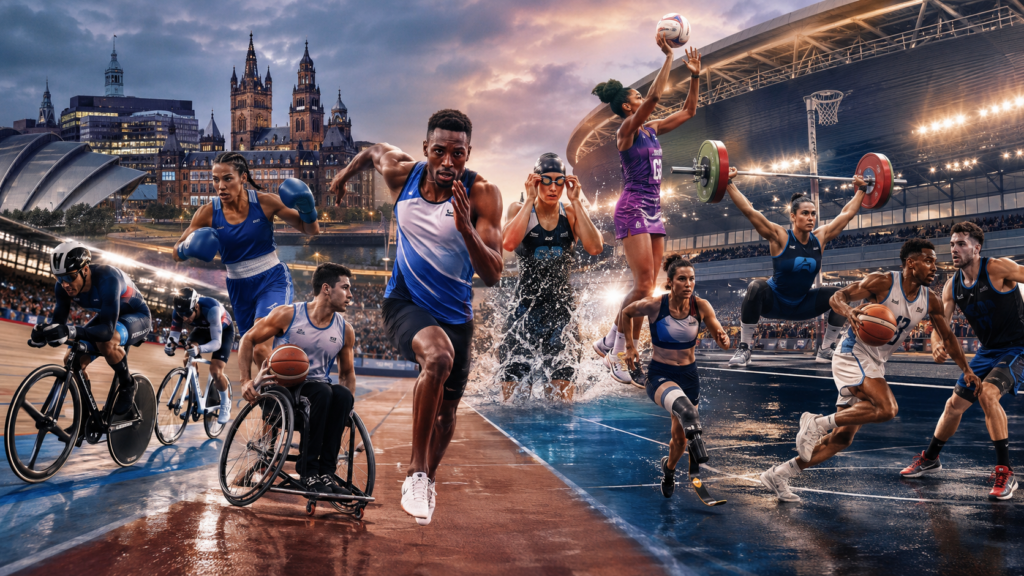
Commonwealth Games 2026 returns to Glasgow from 23 July to 2 August, 12 years after the city’s celebrated 2014 edition. Around 3,000 athletes from 74 nations and territories will compete across 10 sports and six integrated Para sports, contesting 215 gold medal events. Unlike previous editions, Glasgow 2026 uses a compact, four-venue model within an eight-mile corridor rather than building new stadiums. For spectators, that means a shorter, more concentrated Games with a heavier daily concentration of medal action, a first-of-its-kind indoor opening ceremony, and a broadcast picture that has shifted away from free-to-air television in several major markets. This guide sets out the confirmed dates, venues, sports, tickets and viewing options, with anything still subject to change clearly flagged.
When Are the Commonwealth Games 2026?
Glasgow 2026 runs for 11 days, from Thursday 23 July to Sunday 2 August 2026. The Opening Ceremony takes place on 23 July, with the first day of sport following on 24 July. Competition then continues daily through to the Closing Ceremony on 2 August, which coincides with the final day of sport. All times referenced by Glasgow 2026 use British Summer Time (BST, UTC+1), Glasgow’s local time zone during the Games.
Because Glasgow 2026 is a streamlined, single-city Games, organisers have described it as an 11-day event bookended by ceremonies, with 10 days of competition in between. As with any live multi-sport event, session times, added sessions and minor schedule adjustments can occur once competition is underway, so fans should always check the official day-by-day schedule for the latest version before travelling to a venue.
Where Are the 2026 Commonwealth Games Being Held?
Glasgow is hosting the Commonwealth Games for the second time, having previously staged a widely praised edition in 2014. Scotland has now hosted the Games four times in total, including Edinburgh’s 1970 and 1986 editions. Glasgow stepped in as host after the Australian state of Victoria withdrew from its hosting commitment in 2023, citing a sharp rise in projected costs, which meant Glasgow 2026 was organised on a considerably shorter timeline than usual.
That compressed preparation period shaped the Games’ defining feature: a compact venue model. Rather than building new facilities, organisers are using four existing venues within an eight-mile corridor of the city, Scotstoun Stadium, the Scottish Event Campus, Tollcross International Swimming Centre, and the Sir Chris Hoy Velodrome and Arena. Organisers have presented this as a deliberately leaner, lower-cost template intended to demonstrate a sustainable future format for the Commonwealth Games rather than a scaled-down version of past Games.
Commonwealth Games 2026 Schedule
The Glasgow 2026 programme is built around 133 sport sessions and 51 medal sessions across the 10-day competition window. The Opening Ceremony on 23 July is a ceremony-only day with no scheduled sport. Competition then begins in earnest on 24 July, when 3×3 basketball, bowls and Para bowls, boxing, Para powerlifting and swimming all get under way on the same day.
| Date | Major Events | Venue(s) | Medal Sessions |
| Thu 23 July | Opening Ceremony | The Hydro (SEC) | None, ceremony only |
| Fri 24 July | Swimming & Para Swimming begins; 3×3 Basketball begins; Bowls & Para Bowls begins; Boxing begins; Para Powerlifting begins | Tollcross; SEC Centre | Para Powerlifting medals awarded |
| 24–29 July | Swimming & Para Swimming programme | Tollcross International Swimming Centre | Daily swimming medal sessions |
| 24–29 July | 3×3 Basketball & 3×3 Wheelchair Basketball | SEC Centre | Finals late in this window |
| 24–28 July | Artistic Gymnastics (team, all-around and apparatus finals) | Sir Chris Hoy Velodrome and Arena | Daily gymnastics medal sessions |
| 24 July–2 Aug | Bowls & Para Bowls (indoor format) | SEC Centre | Spread across the Games |
| Throughout | Athletics & Para Athletics, Netball, Judo, Boxing, Weightlifting | Scotstoun Stadium; The Hydro; SEC Centre | Multiple sessions daily |
| 30 July–2 Aug | Track Cycling & Para Track Cycling | Sir Chris Hoy Velodrome | Daily medal sessions |
| Sun 2 August | Final day of competition; Closing Ceremony | Various venues | Final medal sessions of the Games |
This table summarises confirmed venue and date ranges; it is not a full session-by-session timetable. For exact daily start times and individual sport schedules, use the official Glasgow 2026 day-by-day schedule, which organisers update as sessions are confirmed and note is subject to change.
Complete List of Glasgow 2026 Sports
Glasgow 2026 features a streamlined 10-sport programme, built around two sports that are compulsory at every Commonwealth Games, Athletics and Swimming, plus eight further sports chosen by the host nation.
| Sport | Para Competition | Venue | Approx. Competition Dates |
| Athletics | Para Athletics | Scotstoun Stadium | Late July into early August |
| Swimming | Para Swimming | Tollcross International Swimming Centre | 24–29 July |
| Artistic Gymnastics | — | Sir Chris Hoy Velodrome and Arena | 24–28 July |
| Track Cycling | Para Track Cycling | Sir Chris Hoy Velodrome | 30 July–2 August |
| 3×3 Basketball | 3×3 Wheelchair Basketball | SEC Centre | 24–29 July |
| Bowls | Para Bowls | SEC Centre | 24 July–2 August |
| Boxing | — | SEC Centre | Late July into early August |
| Judo | — | SEC Centre | Late July |
| Netball | — | The Hydro | Late July into early August |
| Weightlifting | Para Powerlifting | SEC Centre | Late July |
Commonwealth Games hosts must include Athletics and Swimming, while the host nation chooses the remaining eight sports according to Commonwealth Sport’s criteria, including participation levels, cost, and operational complexity. Glasgow 2026 integrates six Para sports directly into the main sports programme, Para Athletics, Para Swimming, Para Bowls, Para Track Cycling, Para Powerlifting and 3×3 Wheelchair Basketball, which organisers describe as the largest Para sport medal programme in Commonwealth Games history. The Games also feature the biggest Track Cycling and Swimming programmes staged at a Commonwealth Games to date, an expanded 3×3 Basketball competition, and the return of the Commonwealth Mile on the athletics track for the first time since 1966. Several sports contested at recent Games, including cricket, hockey, badminton, wrestling, squash and rugby sevens, are not part of the 2026 programme.
Glasgow 2026 Venues
All Glasgow 2026 competition takes place across four venues within an eight-mile corridor of the city, alongside the Opening Ceremony site. Around 500,000 tickets are available in total.
Scotstoun Stadium
Scotstoun hosts Athletics and Para Athletics, the compulsory sport of the Games, in Glasgow’s south-west. Spectators can reach the stadium by public transport, and Glasgow 2026 recommends traveling by train, subway, or bus instead of driving because the venues offer limited parking during the Games. Accessibility features, including step-free access and accessible seating, are being provided at all venues, with venue-specific details published closer to competition dates. Check the official venue guide for the latest travel advice for this venue.
Scottish Event Campus
The Scottish Event Campus (SEC) is Glasgow 2026’s largest venue hub, hosting the Opening Ceremony, Netball, 3×3 Basketball and 3×3 Wheelchair Basketball, Bowls and Para Bowls, Boxing, Judo, and Weightlifting and Para Powerlifting across its component buildings.
- SEC Centre: the indoor exhibition-hall space used for bowls, boxing, judo, 3×3 basketball and wheelchair basketball, weightlifting and Para powerlifting.
- SEC Armadillo: part of the wider SEC campus alongside the Centre and the Hydro.
- The Hydro: the 13,000-plus-capacity arena hosting the Opening Ceremony on 23 July, and Netball for the remainder of the Games.
The SEC sits beside the River Clyde close to Glasgow city centre and is served by rail and the SEC Centre subway station. As with all venues, organisers advise booking public transport in advance and allowing extra journey time around session changeovers. See the official SEC venue page for accessibility and transport specifics.
Tollcross International Swimming Centre
Tollcross hosts Swimming and Para Swimming, one of the two compulsory sports, from 24 to 29 July. The venue, located in Glasgow’s east end, previously hosted swimming at the 2014 Commonwealth Games. Organisers recommend public transport for spectators, given limited on-site parking during sessions; consult the official venue information for current travel guidance and accessibility provisions.
Sir Chris Hoy Velodrome and Arena
This venue complex, also referred to as the Commonwealth Arena and Sir Chris Hoy Velodrome, hosts Track Cycling and Para Track Cycling (30 July–2 August) in the velodrome, and Artistic Gymnastics (24–28 July) in the adjoining arena. Named after Scottish Olympic and Commonwealth cycling champion Sir Chris Hoy, the venue is located in Glasgow’s east end. Public transport is the recommended way to reach the venue during the Games; check the official venue guide for accessibility details and the latest transport recommendations.
Commonwealth Games 2026 Opening Ceremony
The Glasgow 2026 Opening Ceremony takes place on Thursday 23 July 2026 at The Hydro, part of the Scottish Event Campus. For the first time in Commonwealth Games history, organizers will stage the opening ceremony indoors, using an arena instead of a stadium. According to The Scotsman, the ceremony will begin at 8 p.m. local time.
A Glasgow-based creative team is producing the ceremony. Louisa Mahon serves as the overall creative lead for ceremonies, Roxana Cole directs the show and staging, Emily-Jane Boyle oversees choreography, and Carole Millar leads costume design. Organisers have said the ceremony will bring in all 74 Commonwealth Games batons and feature Glasgow’s own story at its centre, supported by a volunteer cast of around 700 people. Confirmed musical performers reported by The Scotsman include Tom Walker, KT Tunstall, Nathan Evans and Saint PHNX, Callum Beattie, Nina Nesbitt, and Valtos, though fans should check official Glasgow 2026 channels for the final performer running order closer to the date.
How to watch: In the UK, the ceremony will be shown live on TNT Sports and streamed on HBO Max, with free-to-air coverage also confirmed on Channel 5. BBC Alba will provide Gaelic-language coverage from the opening to the closing ceremonies, available via BBC iPlayer. See the broadcasting table below for coverage in other countries.
Tickets: Opening Ceremony tickets are on sale through the official Glasgow 2026 ticketing portal, with reported prices ranging from roughly £34 to £95 depending on category. As with all Glasgow 2026 sessions, tickets are sold first come, first served rather than by ballot, so availability changes continuously, check the official site for the current status.
Participating Nations and Territories
Glasgow 2026 organizers expect athletes from 74 nations and territories, two more than competed at Birmingham 2022. Gabon and Togo will also join the Commonwealth Games movement for the first time. Participating nations and territories span five regions recognised by Commonwealth Sport: Africa, the Americas and Caribbean, Asia, Europe (including the UK’s home nations), and Oceania. Examples include Australia, Canada, England, India, Jamaica, Kenya, New Zealand, Northern Ireland, Scotland, South Africa and Wales, among many others.
This guide does not reproduce a full 74-nation list, since final delegation numbers can shift close to and during the Games. Team sizes vary enormously by nation, at Birmingham 2022, England’s delegation numbered 438 athletes while Montserrat sent five. Injuries, qualification changes, or late eligibility decisions may still alter the final athlete entries for Glasgow 2026. For the most reliable and current rosters, check updates from individual national Commonwealth Games associations and Glasgow 2026.
Athletes and Teams to Watch
The following athletes have been officially confirmed by their national teams or Games organisers as part of Glasgow 2026 selections.
England (Swimming and Athletics) Adam Peaty, now competing as Adam Ramsay-Peaty, is the three-time Olympic breaststroke champion and the oldest member of England’s 42-strong swimming squad. He is aiming to become the first British swimmer to win gold at four consecutive Commonwealth Games, having first competed in Glasgow in 2014. England’s athletics team includes sprinter Dina Asher-Smith, middle-distance runner Georgia Hunter-Bell and sprinter Amy Hunt.
India (Athletics, Weightlifting, Boxing) India’s roughly 125–130-strong contingent includes Olympic javelin champion Neeraj Chopra, Olympic weightlifting medallist Mirabai Chanu, and Olympic boxing medallist Lovlina Borgohain. India finished fourth in the medal table at Birmingham 2022 with 61 medals, including 22 gold, and will look to build on that in Glasgow.
South Africa (Swimming) Chad Le Clos, one of the most decorated swimmers in Commonwealth Games history and a multiple Olympic medallist, is confirmed among South Africa’s stars competing at Tollcross.
Jamaica (Athletics) Sprinter Shericka Jackson, a five-time Olympic medallist, is confirmed to compete for Jamaica on the track at Scotstoun.
Northern Ireland (Artistic Gymnastics) Olympic pommel horse champion Rhys McClenaghan leads Northern Ireland’s gymnastics squad, aiming to reclaim the Commonwealth title he won in 2018 after finishing runner-up in 2022. He is joined by teammates Eamon Montgomery and Ewan McAteer.
Australia and Canada: Australia is sending a squad of more than 250 athletes under Chef de Mission Petria Thomas, continuing an unbroken run of competing at every Commonwealth Games since 1930. Canada is sending more than 148 athletes across nine sports, including a record 34 Para athletes, according to CBC/Radio-Canada.
How to Watch the Commonwealth Games 2026
Broadcast rights for Glasgow 2026 have shifted significantly from previous editions. Warner Bros Discovery’s TNT Sports has taken over as the UK’s live broadcast partner from the BBC, which had covered the Games free-to-air for 18 consecutive editions since 1954. Coverage arrangements vary considerably by country.
| Country / Region | Live Broadcaster | Streaming Platform | Free Highlights |
| United Kingdom | TNT Sports (over 600 hours live; every event and medal session) | HBO Max | Channel 5 (daily highlights, live Opening Ceremony); BBC Alba (nightly live coverage and highlights via BBC iPlayer); BBC Radio 5 Live / BBC Sounds; talkSPORT |
| Australia | Seven Network | 7plus | — |
| New Zealand & Pacific | Sky Sport | Sky Go, Sky Sport Now | Three / ThreeNow (reported up to 23 hours of daily free-to-air coverage) |
| India & subcontinent | Sony Sports Network | SonyLIV | — |
| Canada | CBC/Radio-Canada (free-to-air) | CBC Gem, ICI TOU.TV | CBC Sports and Radio-Canada Sports digital coverage |
| United States | beIN SPORTS | beIN SPORTS Connect | — |
| Caribbean | RushSports partnership | RushSports platforms | — |
| Rest of Europe | Warner Bros Discovery (Eurosport) | HBO Max | — |
| Africa | TVMS, SuperSport | — | SABC (South Africa) |
| Asia (Southeast) | Asia-Pacific Broadcasting Union partners | — | RTM Malaysia, RTB Brunei, MediaCorp Singapore |
Broadcast availability, subscriptions and schedules vary by country and may change. Check the official broadcaster in your location.
For UK viewers specifically, this means most live coverage now sits behind a TNT Sports/HBO Max subscription, a change from the free-to-air model used for every previous Games since 1954. Channel 5 and BBC Alba both provide free-to-air options for UK audiences wanting to follow the Games without a subscription, though their coverage is more limited than TNT’s full live output.
Commonwealth Games 2026 Tickets
Tickets for Glasgow 2026 are on sale now through the official Glasgow2026.com ticketing portal, which redirects to the event’s Ticketmaster platform. Around 500,000 tickets are available in total across all 10 sports, six Para sports and four venues, including the Opening and Closing Ceremonies.
Key points confirmed by Glasgow 2026’s Help Centre:
- Sales method: Glasgow 2026 sells tickets on a first-come, first-served basis rather than through a ballot and charges customers immediately at checkout. Organizers gave Glasgow and Scottish residents exclusive pre-sale access before the general release.
- Pricing: Adult tickets start at £17 for non-medal sessions and £26 for medal sessions. Concession tickets for seniors aged 66 and older, children aged 18 months to 16 years, and eligible accessibility customers start at £12. Glasgow 2026 does not charge booking fees.
- Purchase limits: Glasgow 2026 limits purchases to four tickets for high-demand sports and 10 tickets for other sessions to distribute access more fairly among fans.
- Digital delivery: Customers can manage and receive their tickets through the official ticketing platform linked from Glasgow2026.com.
- Resale policy: Glasgow 2026 does not offer refunds. Organizers plan to launch an official resale platform and will announce further details later.
- Accessibility: Eligible customers can purchase wheelchair-bay tickets and one complimentary companion ticket online. Organizers process requests for additional companion tickets through the official contact form.
- Payment: The ticketing platform accepts all major debit and credit cards except American Express, Diners Club, and Laser.
- Assistance: A dedicated phone line, 0333 321 3126, is available for fans who cannot book online.
Scam warning: Buy only through Glasgow2026.com or its official Ticketmaster portal. Avoid third-party resale sites and unofficial sellers, since Glasgow 2026 tickets purchased outside official channels are not guaranteed to be valid or safe, and organisers have not confirmed an alternative resale route beyond their own forthcoming platform.
Para Sports at Glasgow 2026
Glasgow 2026 features six Para sports fully integrated into the main competition schedule, rather than staged as a separate event — organisers describe it as the largest Para sport medal programme in Commonwealth Games history.
- Para Athletics: contested alongside Athletics at Scotstoun Stadium.
- Para Swimming: contested alongside Swimming at Tollcross International Swimming Centre.
- Para Bowls: contested alongside Bowls at the SEC Centre, in an indoor format for the first time.
- Para Track Cycling: contested alongside Track Cycling at the Sir Chris Hoy Velodrome.
- Para Powerlifting: held at the SEC Centre.
- 3×3 Wheelchair Basketball: held at the SEC Centre, with the men’s and women’s tournaments expanded to eight teams each for 2026.
Integrating Para sport directly into the main programme means Para athletes compete in the same venues, on the same days, and often in the same sessions as their able-bodied counterparts, giving their events equal billing in ticketing, scheduling and broadcast coverage rather than treating them as a secondary programme.
How the Commonwealth Games Medal Table Works
The Commonwealth Games medal table ranks nations first by the number of gold medals won, then by silver, then by bronze, in the event of a tie on golds. Nations with equal medal counts across all three colours are typically listed alphabetically or jointly, depending on the results platform being used. For the most current standings once competition begins, the authoritative sources are the official Glasgow 2026 results platform and Commonwealth Sport’s own reporting channels.
This article does not publish a predicted medal table, as forecasts are not verified results. Once competition is underway, any medal-table figures included here will be clearly time-stamped and drawn from official results feeds.
What Makes Glasgow 2026 Different?
Several features distinguish Glasgow 2026 from recent editions of the Games:
- A streamlined sports programme. Ten sports and six integrated Para sports is a smaller core programme than recent Games, built around the two compulsory sports, Athletics and Swimming.
- Reuse of existing venues. All four competition venues already existed before the bid, reflecting the Games’ compressed preparation timeline and lower-cost model.
- A compact city footprint. Every venue sits within an eight-mile corridor, intended to bring fans closer to multiple sports without extensive travel between venues.
- The largest integrated Para sport programme in Commonwealth Games history, with six Para sports scheduled directly alongside their able-bodied equivalents.
- A shift in broadcast approach. For the first time since 1954, live UK coverage sits primarily behind a subscription broadcaster (TNT Sports/HBO Max) rather than free-to-air television, alongside free highlights packages on Channel 5 and BBC Alba.
- An indoor Opening Ceremony. Glasgow 2026 is the first Commonwealth Games to stage its Opening Ceremony inside an arena, at The Hydro, rather than in an outdoor stadium.
Travel and Visitor Information
Glasgow 2026 organisers describe the Games as having a “lighter, more flexible footprint” that uses the city’s existing transport network rather than requiring major new infrastructure. Key guidance from the official transport pages:
- Public transport: Glasgow 2026 recommends using trains, subways, and buses. These services will operate largely as normal, although peak periods may bring heavier crowds to city-center hubs, competition venues, and session changeovers.
- Getting around: Walking, cycling, and public transport offer the easiest ways to travel during the Games.
- Book ahead: Organizers advise spectators to buy public transport tickets in advance and review each venue’s spectator guide before traveling.
- Allow extra time: Expect busier routes and services, especially before and after competition sessions.
- Accessibility: Glasgow 2026 provides separate accessible travel guidance for spectators with additional needs. Check the official accessibility pages for venue-specific information.
- Parking: Several venues offer limited parking, so organizers encourage spectators to use public transport instead of driving.
Weather and travel costs: Glasgow usually experiences mild, changeable weather in late July and early August, so bring layered clothing and rain protection. Check a live forecast closer to your visit. Because hotel and flight prices change frequently, this article does not list them; consult travel providers directly for current rates.
Frequently Asked Questions
Q1. When are the Commonwealth Games 2026?
The Commonwealth Games 2026 run from Thursday 23 July to Sunday 2 August 2026 in Glasgow, Scotland. The Opening Ceremony takes place on 23 July, with competition running from 24 July through to the Closing Ceremony on 2 August.
Q2. Where are the Commonwealth Games 2026 being held?
Glasgow, Scotland, is hosting the Games for the second time, having also staged the 2014 edition. All competition takes place across four venues within an eight-mile corridor of the city: Scotstoun Stadium, the Scottish Event Campus, Tollcross International Swimming Centre, and the Sir Chris Hoy Velodrome and Arena.
Q3. How many sports are at Glasgow 2026?
Glasgow 2026 features 10 sports: Athletics, Swimming, Artistic Gymnastics, Track Cycling, 3×3 Basketball, Bowls, Boxing, Judo, Netball and Weightlifting. Athletics and Swimming are the two sports required at every Commonwealth Games.
Q4. Which Para sports are included?
Six Para sports are integrated directly into the main programme: Para Athletics, Para Swimming, Para Bowls, Para Track Cycling, Para Powerlifting and 3×3 Wheelchair Basketball. Organisers describe this as the largest Para sport medal programme in Commonwealth Games history.
Q5. How many countries are competing?
Around 74 nations and territories are expected to compete at Glasgow 2026, two more than at Birmingham 2022, with Gabon and Togo joining for the first time. Final delegation numbers can still change before and during the Games.
Q6. How many athletes will compete?
Glasgow 2026 is expected to feature around 3,000 athletes from across the Commonwealth. Delegation sizes vary hugely by nation, from several hundred athletes for larger teams to single-figure squads for the smallest territories.
Q7. Where can I find the full Commonwealth Games schedule?
The full, continuously updated day-by-day schedule is published on the official Glasgow 2026 schedule page. This is the authoritative source for exact session times, as schedules can be adjusted once competition begins.
Q8. How can I watch the Commonwealth Games 2026?
Coverage varies by country. In the UK, TNT Sports and HBO Max hold live rights, with free highlights on Channel 5 and BBC Alba. Other confirmed broadcasters include Seven Network (Australia), Sky Sport (New Zealand), CBC/Radio-Canada (Canada), Sony Sports Network (India) and beIN SPORTS (United States). Always check your local official broadcaster, as arrangements differ by market.
Q9. Are Commonwealth Games 2026 tickets still available?
Tickets are on general sale now via the official Glasgow2026.com ticketing portal, sold first come, first served rather than by ballot. Availability changes continuously as sessions sell out, so check the official site directly for current stock, and avoid unofficial resale sites.
Q10. Where is the opening ceremony taking place?
The Opening Ceremony is at The Hydro in Glasgow on 23 July 2026, reportedly starting at 8pm. This is the first time a Commonwealth Games Opening Ceremony has been staged indoors, inside an arena rather than a stadium.
Q11. Which venues are being used?
Four venues host all competition: Scotstoun Stadium (Athletics), Tollcross International Swimming Centre (Swimming), the Scottish Event Campus including The Hydro (Netball, Opening Ceremony, Bowls, Boxing, Judo, 3×3 Basketball, Weightlifting), and the Sir Chris Hoy Velodrome and Arena (Track Cycling and Artistic Gymnastics).
Q12. When will the Commonwealth Games 2026 medal table be updated?
Once competition begins on 24 July, medal tables update after each day’s medal sessions. The Glasgow 2026 website and Commonwealth Sport publish the official real-time medal table. This article time-stamps all medal figures and uses data from those official sources.
Final Thoughts
Glasgow 2026 brings the Commonwealth Games back to Scotland’s largest city for an 11-day event running from 23 July to 2 August, built around a leaner, four-venue model and the largest integrated Para sport programme in the Games’ history. With around 3,000 athletes from 74 nations chasing 215 gold medals, and confirmed stars including Adam Peaty, Neeraj Chopra, Chad Le Clos and Rhys McClenaghan, there is plenty for fans to follow, whether in person at Scotstoun, Tollcross, the SEC or the Sir Chris Hoy Velodrome, or via broadcasters around the world. Schedules, ticket availability, broadcast details and results will continue to develop throughout the Games, and this article will be updated as official information changes.