


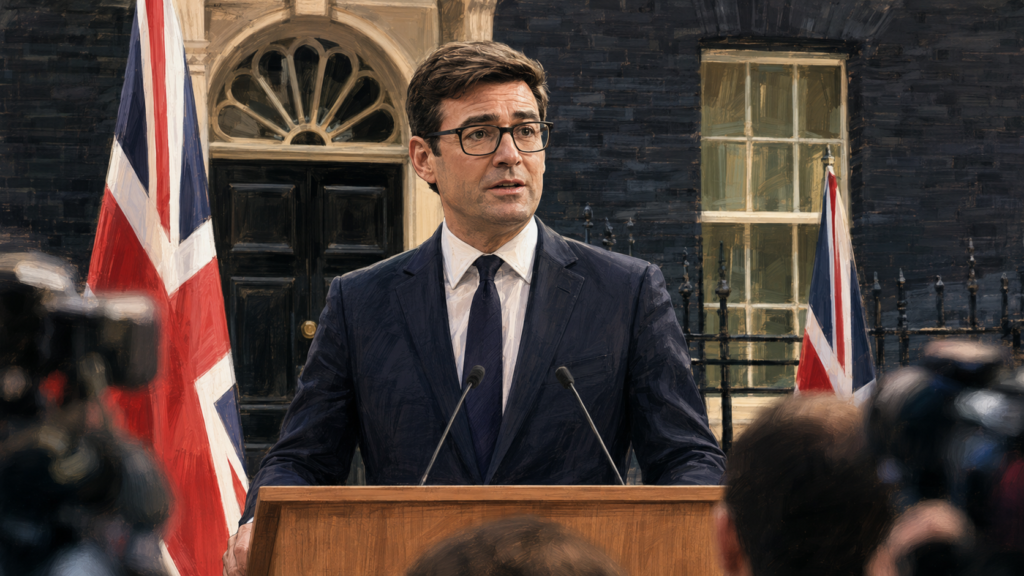
Britain has a new leader. On Monday, July 20, 2026, Andy Burnham was confirmed as the United Kingdom’s new Prime Minister after Keir Starmer formally resigned, traveling to Buckingham Palace to tender his resignation to King Charles III. Shortly afterward, Burnham made the same journey, was invited by the King to form a new government, and returned to Downing Street to deliver his first address as Prime Minister.
For many Britons, the change of leadership feels like the latest chapter in a turbulent decade of politics. Burnham becomes the UK’s seventh Prime Minister in ten years, a statistic that says a lot about the volatility of the country’s political landscape since the 2016 Brexit vote. This article breaks down exactly what happened, who Andy Burnham is, why Starmer stepped down, and what comes next for the UK government.
What Happened: Andy Burnham Becomes Prime Minister
The transition unfolded in a matter of hours. Starmer delivered a farewell speech outside 10 Downing Street before heading to Buckingham Palace, where he formally resigned as Prime Minister. In his closing remarks, he said he was leaving with pride in what his government had achieved and reflected on turning Labour around after the party’s heavy defeat in 2019.
Soon after, Burnham made his own trip to the palace, where the King invited him to form a government, the traditional constitutional step that officially makes someone Prime Minister. Back at Downing Street, Burnham used his first remarks in office to acknowledge public frustration with politics, saying that his generation of politicians needed to “raise our game” and admitting that things “have not been good enough.”
It’s worth noting for readers outside the UK: Britain does not elect its Prime Minister directly. Voters elect local Members of Parliament, and the leader of the party that commands a majority in the House of Commons typically becomes Prime Minister. This means a governing party can change its leader, and therefore its PM, without triggering a general election, which is exactly what happened here.
Andy Burnham Downing Street: The First Speech
Burnham’s inaugural address focused on a theme he has championed for years: shifting power away from Westminster and toward local communities. He pledged what he described as one of the biggest transfers of power the UK has seen, promising to devolve decisions on tax, infrastructure, and job creation to regional authorities. He also used the moment to praise his predecessor, saying he intended to build on the foundation Starmer had laid.
Why Did Keir Starmer Resign?
Starmer’s resignation didn’t come out of nowhere. He had announced in June that he planned to step down, following months of falling approval ratings and mounting criticism over the economy and the pace of progress on immigration. Labour also lost ground to a populist anti-immigration party in the May local elections, which intensified pressure from within his own party.
Starmer’s tenure wasn’t without accomplishments. In his final Prime Minister’s Questions, he pointed to his government’s support for Ukraine on the international stage, along with domestic wins like stronger protections for working people, a reduction in child poverty, and increased defense spending. Still, voters largely felt he had failed to deliver the “palpable change” he promised after Labour’s 2024 landslide win. He also faced criticism for appointing Peter Mandelson, a close associate of the late Jeffrey Epstein, as UK ambassador to Washington, a decision he later reversed by firing Mandelson.
Who Is Andy Burnham? Career and Background
Andy Burnham isn’t a newcomer to British politics, far from it. Born in Aintree, near Liverpool, in 1970, and raised in Culcheth between Manchester and Liverpool, he studied English at Fitzwilliam College, Cambridge, entered Parliament in 2001, and went on to hold senior cabinet positions under Tony Blair and Gordon Brown
During his time in government, Burnham served in several high-profile roles, including Chief Secretary to the Treasury, Culture Secretary, and Health Secretary. He also represented the Leigh constituency, a former mining area, as a Member of Parliament for 16 years, an experience that shaped his long-standing focus on regional inequality in the UK.
In 2017, Burnham stepped away from Westminster to become Mayor of Greater Manchester, a role he held for nearly a decade and was re-elected to in 2021. As mayor, he became known for major regional projects like the Bee Network, Greater Manchester’s integrated public transport system, and for his continued campaigning on the Hillsborough disaster and its aftermath, an issue close to many in the northwest of England.
To return to national politics ahead of the leadership transition, Burnham stepped down as mayor and won a by-election in Makerfield, Greater Manchester, in June 2026, becoming a sitting Member of Parliament again. With no rival candidates entering the race, he was elected Labour leader unopposed once he cleared the threshold of support required from Labour MPs.
Andy Burnham Labour Party Leadership and “Manchesterism”
Burnham’s political brand has often been described using the term “Manchesterism”, a philosophy built around greater public control of essential services like housing, water, energy, and transport, alongside a push to devolve power away from central government and toward cities and regions. Supporters say this reflects lessons learned from his years running Greater Manchester; critics argue it’s more of a general political outlook than a fully detailed governing agenda.
His broader platform includes ideas such as equalizing capital gains tax with income tax and reviewing how landlords are taxed, as part of a wider conversation about how the UK raises revenue. He has also spoken previously about the need for constitutional reform, reflecting his long-held belief that too much decision-making power sits in Westminster rather than in the communities affected by those decisions.
Reaction to Britain’s New PM
Not everyone welcomed the transition smoothly. Reform party leader Nigel Farage was quick to call for a new general election, arguing that Burnham lacked a genuine mandate to lead the country after winning just a single by-election. This reflects a broader debate happening across the UK about whether leadership changes without a general election, while legal and constitutional, leave voters feeling shut out of the process.
Even so, this kind of leadership change is far from unprecedented in recent UK politics. The country has seen several Prime Ministers take office through internal party leadership contests rather than general elections over the past decade, contributing to the sense of political instability that has followed the Brexit vote.
What Comes Next for the UK Government
With Burnham now in Downing Street, attention will shift to how quickly he can turn his campaign themes into concrete policy. His early priorities appear to include:
- Devolving greater power over tax, infrastructure, and job creation to local and regional authorities
- Addressing public frustration over the cost of living and economic stagnation
- Responding to pressure on immigration policy following recent local election losses
- Rebuilding trust with voters who feel Labour hasn’t delivered enough visible change
Whether Burnham can translate his popularity as a regional leader into success on the national stage remains to be seen. His challenge will be balancing the expectations of a party under pressure with a public that has grown increasingly skeptical of Westminster politics in general.
Frequently Asked Questions
Q1. Who is Andy Burnham?
Andy Burnham is a British Labour politician who served as Mayor of Greater Manchester from 2017 to 2026 and previously held several UK government cabinet posts, including Health Secretary and Culture Secretary.
Q2. Why did Keir Starmer resign as Prime Minister?
Starmer resigned following months of declining approval ratings, criticism over the economy and immigration policy, and pressure from within the Labour Party after local election losses in May 2026.
Q3. How did Andy Burnham become Prime Minister without a general election?
Under the UK’s parliamentary system, the leader of the party with a majority in the House of Commons becomes Prime Minister. When Labour changed its leader, Burnham became Prime Minister without a nationwide vote.
Q4. What are Andy Burnham’s main policies?
Burnham has focused on devolving power from Westminster to local regions, greater public control over essential services, and potential tax reforms, including equalizing capital gains tax with income tax.
Q5. Is Andy Burnham the UK’s first Prime Minister to take office without a general election recently?
No. The UK has seen several leadership transitions handled through internal party votes rather than general elections over the past decade, making Burnham the seventh Prime Minister in ten years.
Final Thoughts
The transition from Keir Starmer to Andy Burnham marks another significant shift in UK politics, continuing a pattern of leadership change that has defined the post-Brexit decade. Burnham brings a distinct regional perspective to Downing Street, shaped by his years leading Greater Manchester, along with decades of experience in national government. Whether his vision for devolved power and economic reform can restore public confidence in Westminster is the question that will define the months ahead.
As this story develops, expect ongoing coverage of Burnham’s early policy moves, his first Cabinet appointments, and how the opposition responds to Britain’s newest Prime Minister.