


Summary: Michigan voters will cast primary ballots on August 4, 2026, to choose party nominees for governor, U.S. Senate, Congress, the state legislature and other offices.
Source note: This nonpartisan voter guide is based on information from the Michigan Department of State, Michigan Bureau of Elections, and the official 2026 primary candidate listing. It does not endorse any candidate or political party.
Key Facts About the Michigan Primary Election 2026
| Detail | Information |
| Election date | Tuesday, August 4, 2026 |
| Early voting | July 25 through August 2, 2026 |
| Election Day polling hours | 7 a.m. to 8 p.m. local time |
| Online and mail registration deadline | July 20, 2026 |
| In-person registration | Available through 8 p.m. on Election Day |
| Absentee ballots due | By 8 p.m. on August 4, 2026 |
| General election | November 3, 2026 |
| Official voter portal | Michigan.gov/Vote |
Michigan’s official election calendar confirms that the statewide primary will take place on August 4, with the constitutionally required early-voting period running from July 25 through August 2.
When Is the Michigan Primary Election 2026?
The Michigan Primary Election will be held on Tuesday, August 4, 2026. Polling places will be open from 7 a.m. until 8 p.m. local time. Any eligible voter who is in line by 8 p.m. has the right to remain in line and cast a ballot.
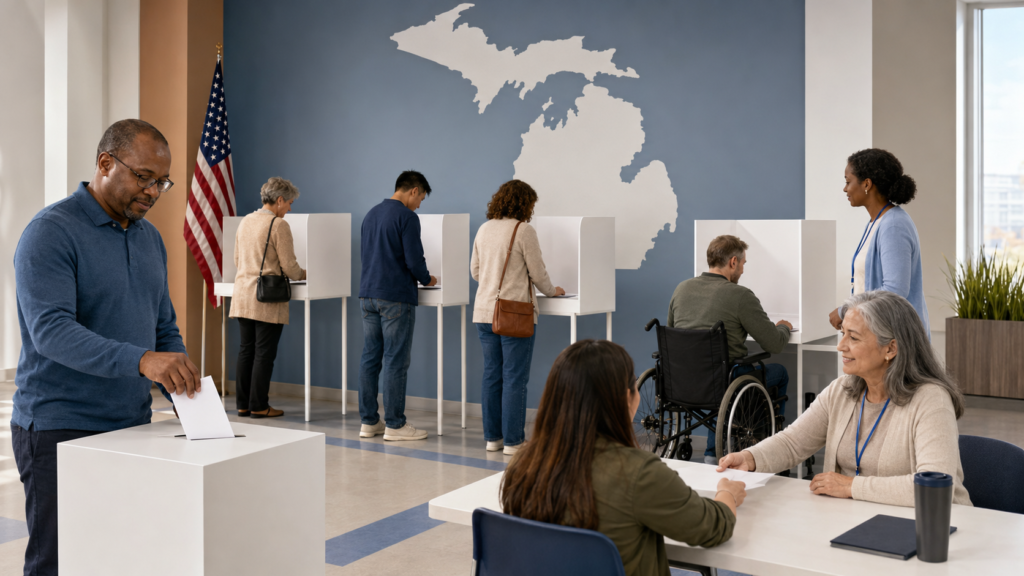
Early in-person voting begins on Saturday, July 25, and continues through Sunday, August 2. Voters must use an early-voting location assigned to their area, which may differ from their normal Election Day polling place. Locations and hours can be checked through the Michigan Voter Information Center.
What Is Being Decided in the August Primary?
The primary determines which candidates will represent their political parties in the November 3 general election.
Depending on where a voter lives, the ballot may include contests for:
- Governor
- U.S. Senate
- U.S. House of Representatives
- Michigan Senate
- Michigan House of Representatives
- Judicial positions
- County and local offices
- Local proposals
The official candidate report includes statewide, congressional, legislative and judicial races. Because local ballots differ, voters should view their personalized sample ballot at Michigan.gov/Vote before voting.
Michigan Governor Candidates
The active candidates shown in Michigan’s official August primary listing include:
Democratic Primary
- Jocelyn Benson
- Christopher Robert Swanson
Republican Primary
- Mike Cox
- John James
- Perry Johnson
- Aric Nesbitt
The official report also identifies candidates who have withdrawn or been disqualified. Those names have not been included in this active-candidate summary. Candidate status can change through legal or administrative decisions, so readers should check the official Michigan candidate listing before voting.
Michigan U.S. Senate Candidates
The active candidates listed for the six-year U.S. Senate term are:
Democratic Primary
- Abdul El-Sayed
- Mallory McMorrow
- Haley Stevens
Republican Primary
- Mike Rogers
The primary winners will advance to the November 3 general election. The candidate listing is maintained by the Michigan Department of State and should be treated as the primary source for official ballot status.
Congressional and State Legislative Races
Michigan voters will also choose party nominees in the state’s 13 congressional districts. The ballot includes contests for all districts, although the number of candidates varies significantly by location and political party.
State Senate and Michigan House races are also included. Voters should not rely on a statewide article alone to determine who will appear on their ballot. The most accurate option is to enter their registration information at Michigan.gov/Vote and open the official sample ballot for their precinct.
Readers can also follow our [Michigan election results coverage]([INTERNAL RESULTS URL]) and [2026 U.S. midterm election guide]([INTERNAL MIDTERM URL]) as the campaign develops.
Can Michigan Voters Choose Candidates From Both Parties?
No. Michigan voters do not register by political party, but during the statewide August primary they may vote for candidates in only one party column.
A voter cannot select a Democratic candidate in one race and a Republican candidate in another race on the same primary ballot. Votes cast across multiple party columns may not be counted in the partisan section of the ballot. Nonpartisan offices and proposals can still be completed where they appear.
This differs from the November general election, when voters may select candidates from different political parties.
How to Register to Vote in Michigan
The deadline to register online or by mail for the August primary was July 20, 2026. However, eligible Michigan residents who missed that deadline can still register in person.
From July 21 through Election Day, new registrations and address changes must be completed at the voter’s city or township clerk’s office. The voter must provide proof of Michigan residency. Registration remains available until 8 p.m. on August 4, provided the voter is in line by the deadline.
After registering on Election Day, a voter may:
- Request and complete an absentee ballot at the clerk’s office; or
- Travel to the assigned polling place and vote there, provided there is enough time.
Acceptable residency documents may include a Michigan driver’s licence or state ID, utility bill, bank statement, lease, paycheque or another official document displaying the voter’s current name and address.
How Early Voting Works
Early voting gives registered voters an Election Day-style voting experience before August 4. Voters receive a ballot, mark it privately and insert it directly into a tabulator at the early-voting site.
Michigan requires at least nine consecutive early-voting days for statewide and federal elections. For this primary, the mandatory period runs from July 25 through August 2, although some communities may provide additional days or hours.
Early-voting locations are not always the same as Election Day polling places. Voters should confirm their assigned site and operating hours before travelling.
How to Vote by Absentee Ballot
Every registered Michigan voter may request an absentee ballot without providing a reason.
Absentee ballots for the August election became available on June 25. Applications can be submitted online, by mail or in person through the voter’s local clerk. The online and mailed application deadline is 5 p.m. on Friday, July 31, although election officials advise applying much earlier to allow time for delivery.
A registered voter may request an absentee ballot in person at the clerk’s office until 4 p.m. on Monday, August 3.
Completed absentee ballots must generally be received by the voter’s local clerk by 8 p.m. on August 4. A postmark alone is not sufficient for most voters. Military and overseas ballots follow different return rules.
Voters can return a ballot through:
- The prepaid mail envelope
- An official ballot drop box in their jurisdiction
- Their local clerk’s office
- An assigned early-voting site
- Their polling place on Election Day, where permitted
Because Election Day is approaching, voters using the postal service should consider delivery time and may prefer an official drop box or clerk’s office.
Do Voters Need Photo Identification?
Michigan voters are asked to present an acceptable photo ID when voting in person. However, a voter who does not possess an ID or forgot to bring one may still cast a regular ballot after signing an affidavit confirming that they are not in possession of photo identification.
Accepted identification can include a Michigan driver’s licence, state ID, U.S. passport, military ID, student ID, tribal ID or another qualifying government-issued photo document.
Where Can Voters Find Their Polling Place?
Voters can use the Michigan Voter Information Center to:
- Check registration status
- Find an Election Day polling place
- Find an assigned early-voting site
- View a sample ballot
- Locate a city or township clerk
- Request or track an absentee ballot
Voters should check shortly before travelling because polling locations can occasionally change.
Accessibility and Language Assistance
Polling places and early-voting sites are required to provide accessible voting options. At least one Voter Assist Terminal must be available, and voters may request curbside voting or assistance where needed.
Michigan also offers an accessible electronic absentee ballot for voters with qualifying print disabilities. Election information and voting materials are available in multiple languages through the Department of State’s language-services pages.
When Will Michigan Primary Results Be Available?
Election results cannot be calculated or publicly released before polls close at 8 p.m. on August 4. Initial unofficial results will appear after polling ends, but close contests may take longer as absentee, early and Election Day ballots are processed.
Unofficial statewide results will be available through the Michigan Department of State, while local results may also appear on county and municipal election websites. Results remain unofficial until the relevant canvassing boards complete certification.
Fresh Global News will update its [Michigan Primary Election 2026 results page]([INTERNAL RESULTS URL]) as official totals become available.
Frequently Asked Questions
Q1. When Is the Michigan Primary Election 2026?
The Michigan Primary Election is Tuesday, August 4, 2026. Polling places will be open from 7 a.m. to 8 p.m. local time, and voters in line by 8 p.m. may remain in line and vote.
Q2. When Does Early Voting Start in Michigan?
The mandatory early-voting period begins Saturday, July 25, and ends Sunday, August 2, 2026. Voters should check Michigan.gov/Vote for their assigned early-voting location and hours.
Q3. Can I Still Register to Vote?
Yes. Online and mail registration closed on July 20, but eligible residents may register in person at their local clerk’s office through 8 p.m. on Election Day with proof of residency.
Q4. Can I Vote for Democrats and Republicans on the Same Primary Ballot?
No. Michigan voters must vote in only one party column during the August statewide primary. Selecting partisan candidates from multiple parties may invalidate those partisan votes.
Q5. Who Is Running for Michigan Governor?
The official active-candidate list includes Democrats Jocelyn Benson and Christopher Robert Swanson, and Republicans Mike Cox, John James, Perry Johnson and Aric Nesbitt. Candidate status should be rechecked before publication or voting.
Q6. Who Is Running for the U.S. Senate in Michigan?
The official list includes Democrats Abdul El-Sayed, Mallory McMorrow and Haley Stevens, along with Republican Mike Rogers. The party nominees will advance to the November general election.
Q7. When Must Absentee Ballots Be Returned?
Most absentee ballots must reach the voter’s local clerk by 8 p.m. on August 4. Ballots arriving after that deadline generally will not be counted, except under separate rules for eligible military and overseas voters.
Q8. Do I Need Photo ID to Vote?
Voters are asked to show photo identification, but a person without an ID may still vote after signing an affidavit.
Final Thoughts
The August 4 Michigan primary will determine the party nominees for major statewide, congressional and legislative races ahead of the November 3 general election. With online registration now closed, unregistered voters must visit their local clerk in person, while registered voters can vote early from July 25 through August 2, use an absentee ballot or vote at their polling place on Election Day.
Election information can change, particularly candidate status, local voting hours and ballot details. Voters should confirm their personalized information through Michigan.gov/Vote before casting a ballot.