


AI smart glasses are no longer a fringe idea confined to tech demos and concept videos. Over the past two years, major technology companies have poured resources into eyewear that can see, listen, and respond using artificial intelligence, and the pace of announcements has only picked up in 2026. From camera-equipped frames that answer spoken questions to lens-based displays that show navigation directions, this category of wearable technology is being positioned by some in the industry as a possible successor, or at least a companion, to the smartphone.
This article explains what AI smart glasses actually are, how they work, why companies like Meta and Google are investing heavily in them, and why many industry watchers remain cautious about calling them the “next smartphone.” As with any fast-moving technology category, specific prices, features, and release timelines can change quickly, so readers should always confirm current details on official company websites before making a purchase decision.
What Are AI Smart Glasses?
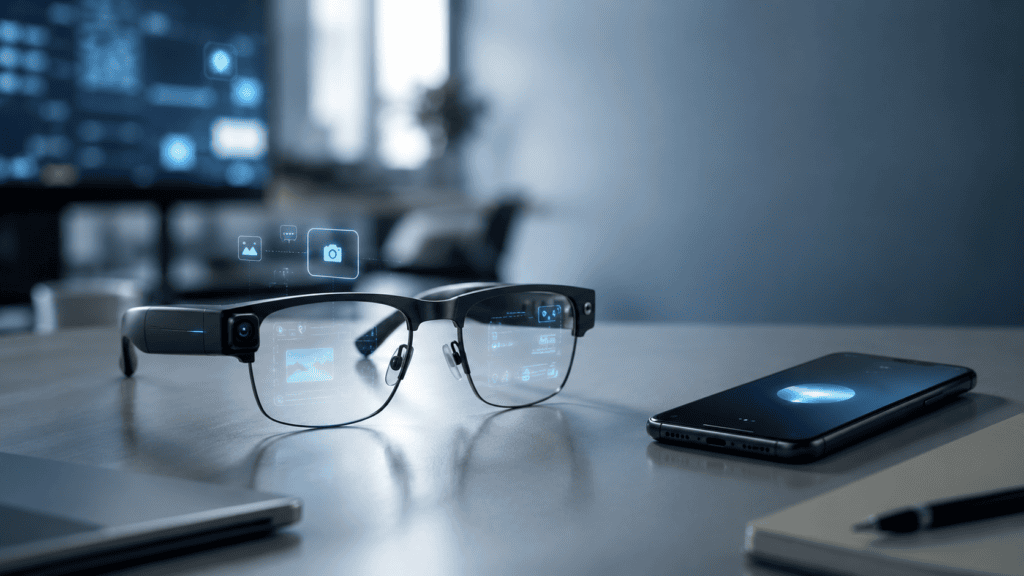
AI smart glasses are wearable eyewear that combine traditional glasses or sunglasses frames with small embedded sensors, typically a camera, microphones, speakers, and a connection to an AI assistant. Unlike older “smart glasses” that mainly displayed basic notifications or took photos, today’s AI-powered models are built around conversational AI assistants that can interpret what the wearer sees and hears, then respond with useful information.
Some models are audio-only, meaning they have no visual display and rely entirely on voice interaction and audio feedback through built-in speakers. Others include an in-lens display, sometimes called a waveguide display, that can project simple visuals, such as directions, captions, or notifications, directly into the wearer’s field of view.
What it means: The key shift from earlier smart glasses to today’s AI smart glasses is the addition of a capable AI assistant that can understand context, what the wearer is looking at, where they are, and what they’re asking, rather than just performing fixed, pre-programmed functions.
How AI Smart Glasses Work
AI smart glasses generally combine several components:
- Microphones for voice commands and calls
- Speakers (often open-ear, so sound doesn’t fully block outside noise)
- A camera for photos, video, and visual recognition
- A wireless connection (typically Bluetooth) to a paired smartphone
- An AI assistant, connected to cloud-based large language models, that processes requests
- Optional in-lens display technology, such as waveguide optics, for glasses that show visual information
When a wearer speaks a wake phrase or taps the frame, the device captures audio (and sometimes a camera image) and sends it to an AI assistant for processing. The assistant can then answer questions, describe what the camera sees, translate spoken language, give directions, or read out notifications, all without the wearer needing to hold or look at a phone.
What it means: Much of the “intelligence” in AI smart glasses does not live on the device itself. Most processing happens through a connected smartphone app or cloud servers, which is why a reliable network connection and paired phone are usually still required for full functionality.
Why Major Tech Companies Are Investing in Smart Glasses
Several of the world’s largest technology companies have entered or are entering the AI smart glasses market:
| Company | Platform / Brand | Notable Approach |
| Meta | Ray-Ban Meta (with EssilorLuxottica), Oakley Meta | Camera-first audio glasses and a display model, sold through established eyewear brands |
| Android XR, in partnership with Samsung, Warby Parker, and Gentle Monster | Gemini AI assistant integration, audio-first launch with a display model planned later | |
| Others | Various XR and AI glasses makers | Competing on price, gaming-focused displays, and enterprise use cases |
Meta’s Ray-Ban collaboration was among the first to combine a recognizable, mainstream eyewear brand with built-in AI and camera features, which helped normalize the look of the product. Google has since confirmed it is developing its own Android XR smart glasses in partnership with eyewear companies including Warby Parker and Gentle Monster, with its Gemini AI assistant as the core intelligence layer. Other technology companies, including hardware and chip suppliers, are also active in this space, supplying the processors and display technology that make lightweight AI glasses possible.
What it means: The involvement of multiple major companies signals genuine long-term investment, not just a single company’s experiment. However, competition between platforms also means standards, app ecosystems, and features may vary significantly between brands for the next few years, so early buyers should expect a period of fragmentation before the category matures.
For a broader look at how this fits into the wider wearable landscape, see our related coverage on AI gadgets shaping 2026.
Core Features Driving Interest in AI Smart Glasses
Voice Assistants and Hands-Free Interaction
The primary appeal of AI smart glasses is hands-free access to an AI assistant. Instead of pulling out a phone, users can ask questions, set reminders, or make calls through voice commands alone.
Camera-Based Visual Understanding
Built-in cameras allow the AI assistant to “see” what the wearer sees. This can be used for tasks like identifying an object, reading a sign, or getting more context about a location, in addition to standard photo and video capture.
Real-Time Translation Possibilities
Several AI glasses platforms have demonstrated or announced real-time spoken translation features, where the assistant listens to a foreign language and provides a translated response through the speakers or, in display-equipped models, as on-screen captions.
Notifications and Quick Information
Audio or visual notifications, messages, calendar alerts, or navigation cues can be delivered directly through the glasses, reducing the need to check a phone screen.
Navigation and Productivity Uses
Turn-by-turn walking directions, hands-free calling, and message summarization are commonly cited productivity use cases, particularly for commuters and travelers.
Augmented Reality and Display Features
Some AI smart glasses, unlike audio-only models, include small in-lens displays capable of showing simple graphics such as directional arrows, captions, or notification text layered over the wearer’s real-world view. This is a lighter-weight form of augmented reality compared to full mixed-reality headsets.
What it means: Not all “AI smart glasses” offer the same capabilities. Buyers should check carefully whether a specific model is audio-only or includes a display, since this significantly affects both price and functionality.
AI Smart Glasses vs. Normal Smart Glasses
The term “smart glasses” has existed for over a decade, but earlier versions were often limited to basic functions like photo capture or simple notification mirroring, with little to no conversational intelligence.
| Feature | Older Smart Glasses | AI Smart Glasses |
| Assistant | Minimal or none | Conversational AI assistant (e.g., Gemini, Meta AI) |
| Camera use | Basic photo/video | Visual recognition and contextual understanding |
| Interaction | Manual controls, limited voice commands | Natural voice conversation |
| Translation | Rare | Real-time translation in select models |
| Display | Usually none | Optional in-lens display in premium models |
What it means: The “AI” in AI smart glasses generally refers to the addition of a large-language-model-based assistant that can interpret context and hold a natural conversation, not just execute fixed commands.
AI Smart Glasses vs. Smartphones
Despite the excitement, AI smart glasses and smartphones serve overlapping but distinct purposes today.
Where AI smart glasses may offer an advantage:
- Hands-free voice interaction without reaching for a device
- Faster access to contextual information (e.g., “what am I looking at?”)
- Discreet notifications without checking a screen
- Accessibility support, including translation and audio description
Where smartphones remain stronger:
- Larger, higher-resolution screens for browsing, video, and typing
- Broader and more mature app ecosystems
- Longer battery life
- Lower cost relative to features offered
- More storage and computing power on-device
- Established familiarity with nearly every daily digital task
What it means: AI smart glasses are best understood today as a companion device that extends what a paired smartphone can do, rather than a standalone replacement. Whether that changes in the future is a possibility worth watching, not a certainty.
Why Smartphones Are Still Hard to Replace
Smartphones benefit from more than a decade of infrastructure: mature operating systems, millions of apps, large, high-resolution touchscreens, powerful batteries, and near-universal familiarity among consumers of all ages. AI smart glasses, by comparison, are constrained by the physical limits of a glasses frame, there is only so much battery, processing power, and display technology that can fit into something worn comfortably on the face.
Most current AI smart glasses also depend on a paired smartphone for full functionality, meaning they extend the phone experience rather than eliminate the need for one. Analysts and technology commentators have generally framed smart glasses as a potential long-term evolution of personal computing, rather than an imminent smartphone replacement, and it is important to treat that framing as an open possibility, not a settled outcome.
Privacy and Safety Concerns
Cameras and microphones built into everyday eyewear raise real privacy questions that regulators, companies, and consumers are actively grappling with:
- Bystander consent: People nearby may not know they are being recorded, since a camera embedded in glasses is far less obvious than a handheld phone.
- Recording indicators: Manufacturers have added visual indicators, such as small LED lights, to signal when a camera is active, though awareness and effectiveness of these indicators vary.
- Data handling: Voice and image data captured by AI glasses is often processed via cloud servers, raising questions about how long that data is stored and how it may be used to improve AI models.
- Public and workplace restrictions: Some venues, workplaces, and public institutions have introduced or are considering rules restricting camera-equipped wearables.
- Regulatory attention: Consumer protection and data privacy bodies in multiple regions have signaled interest in how AI wearables collect and handle personal data.
What it means: Privacy is not a hypothetical concern for this category, it was a central reason earlier smart glasses attempts struggled to gain public acceptance. How manufacturers address consent, transparency, and data use will likely shape whether AI smart glasses achieve mainstream trust.
Buying Concerns for Early Users
Anyone considering AI smart glasses today should weigh several practical limitations:
- Battery life: Compact frames limit battery size, and heavy use of camera or display features can drain a charge within hours rather than a full day.
- Price: Depending on brand and features, AI smart glasses can range from moderately priced audio-only models to significantly more expensive display-equipped versions.
- Comfort and design: Added electronics can increase weight and change how glasses fit and feel over long wear.
- App and feature support: Software ecosystems for AI glasses are still developing, and third-party app support varies widely between platforms.
- Display quality: In-lens displays are typically small, limited in brightness range, and not intended for extended screen-heavy tasks.
- Real-world usefulness: Some features that look impressive in a demo, such as live translation or object identification, may perform inconsistently depending on lighting, accents, background noise, or connectivity.
- Prescription and vision needs: Buyers who need prescription lenses should confirm compatibility with their optician or the manufacturer before purchasing.
Because pricing, availability, and features in this category change frequently, readers should always verify current specifications directly on official manufacturer websites before buying.
For comparison with another fast-growing wearable category, see our coverage of smart rings versus smartwatches.
What Ordinary Consumers Should Watch Next
Several developments over the coming months are likely to shape how AI smart glasses evolve:
- Additional major manufacturers confirming official release dates, pricing, and specifications
- Expansion of third-party app support and developer tools for AI glasses platforms
- Improvements to battery life and display brightness in next-generation models
- Clearer privacy policies and stronger built-in recording indicators
- Broader availability of prescription-compatible frames
- Regulatory guidance on data collection from wearable cameras and microphones
Consumers who are curious but cautious may want to wait for a second or third generation of these products, when battery life, pricing, and software support are likely to be more mature.
Fresh Global News Analysis
The current wave of interest in AI smart glasses reflects a broader shift in how technology companies are thinking about personal computing: less about a single all-purpose device, and more about a network of specialized wearables working together with a smartphone.
AI smart glasses currently succeed best at narrow, hands-free tasks, quick questions, navigation prompts, translation, and light notifications, rather than replacing the broad functionality of a smartphone. Multiple major technology companies now offer or have announced competing products, which suggests confidence in long-term demand, but the market itself is still young. Battery limitations, privacy questions, and inconsistent app support remain real barriers to mainstream adoption.
Whether AI smart glasses eventually become as essential as smartphones is genuinely uncertain and will likely depend on how quickly companies can improve battery life, resolve privacy concerns, and build a mature software ecosystem. For now, they are best viewed as an emerging complementary device, a promising but still-developing category worth watching rather than a confirmed smartphone successor.
Key Takeaways
- AI smart glasses combine cameras, microphones, and AI assistants in an eyewear form factor, going beyond older smart glasses that lacked conversational intelligence.
- Multiple major technology companies are actively developing competing AI glasses platforms, signaling strong long-term industry interest.
- Core use cases include hands-free voice assistance, visual recognition, real-time translation, navigation, and notifications.
- Smartphones remain stronger in screen size, app ecosystem maturity, battery life, and overall cost-effectiveness.
- Privacy concerns around always-available cameras and microphones remain a significant and unresolved challenge for the category.
- Early buyers should weigh battery life, price, comfort, and app support carefully, and always confirm current details through official manufacturer sources.
- Whether AI smart glasses become the next dominant gadget trend after smartphones remains an open question, not a confirmed outcome.
Conclusion
AI smart glasses represent one of the most closely watched developments in wearable technology today, backed by significant investment from major players in the industry. They offer genuine hands-free convenience, contextual AI assistance, and emerging augmented reality features that older smart glasses could not deliver. At the same time, real limitations around battery life, privacy, price, and app support mean AI smart glasses are, for now, a complement to the smartphone rather than a proven replacement for it. As more products launch throughout 2026 and beyond, consumers interested in this category should follow official company announcements closely, weigh the practical trade-offs carefully, and treat claims about AI smart glasses replacing smartphones as a possibility to watch, not a certainty to expect.
Frequently Asked Questions
Q1. What are AI smart glasses?
AI smart glasses are wearable eyewear equipped with cameras, microphones, and an AI assistant that can answer questions, recognize what the wearer sees, and perform hands-free tasks like navigation or translation.
Q2. How are AI smart glasses different from regular smart glasses?
Regular smart glasses typically offered basic functions like photo capture with limited or no AI intelligence. AI smart glasses add a conversational AI assistant capable of understanding context and natural speech.
Q3. Will AI smart glasses replace smartphones?
Not currently. Most AI smart glasses depend on a paired smartphone for full functionality and lack the larger screen, app ecosystem, and battery life of a phone. Whether they could reduce smartphone reliance over time remains an open possibility rather than a confirmed trend.
Q4. Are AI smart glasses safe for privacy?
Privacy is a genuine concern, since built-in cameras and microphones can record without being as obvious as a smartphone camera. Manufacturers have added indicators like LED lights, but consumers should review each brand’s privacy policy carefully.
Q5. How much do AI smart glasses cost?
Pricing varies by brand and features, with audio-only models generally less expensive than versions that include an in-lens display. Because pricing changes frequently, buyers should check official company websites for current prices.
Q6. What should I check before buying AI smart glasses?
Consider battery life, comfort, prescription lens compatibility, privacy policies, supported apps, and whether the model includes a display. Confirm all specifications on the official manufacturer’s product page before purchasing.