



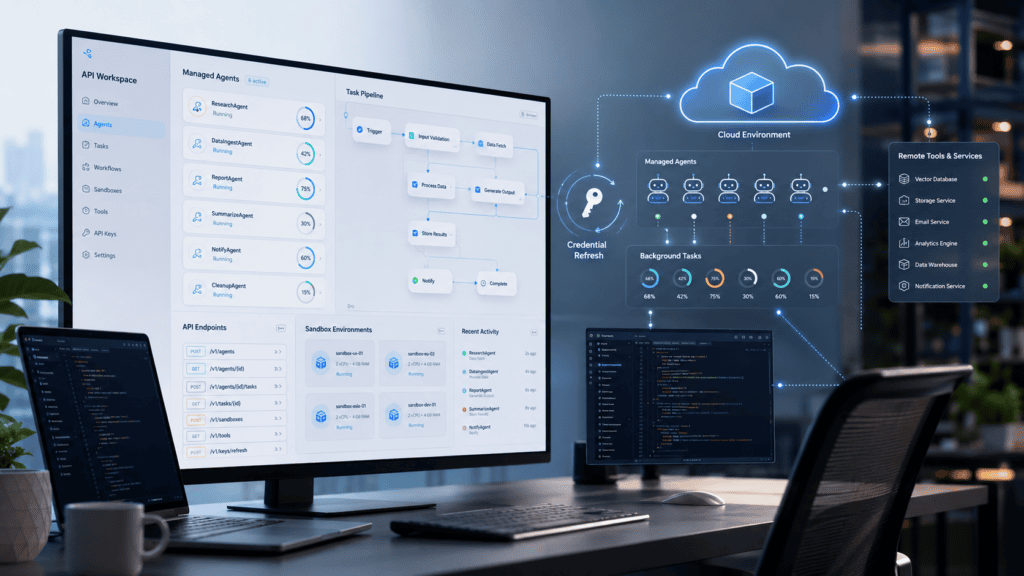
Google has announced an expansion of Managed Agents in the Gemini API, giving developers new ways to build AI agents that can handle longer, more complex jobs. The update to Google Gemini API managed agents adds background execution, remote MCP server support, custom function calling, and credential refresh across interactions.
Google says the changes respond directly to developer feedback about building agents for real production use, rather than short demos. Together, these additions help Gemini API agents stay more stable when tasks take minutes instead of seconds and when they need to connect with external systems to complete work.
Direct Answer
Google added four new capabilities to Managed Agents in the Gemini API: background execution for long-running tasks, support for remote MCP servers, custom function calling alongside built-in tools, and credential refresh for expiring tokens. The update allows developers to build agents that keep working even after a client disconnects, connect to private company tools, and stay authenticated during multi-step tasks. Google DeepMind, which develops the Gemini models, positions this as a step toward more dependable, production-ready AI agents. The features are available through the Gemini Interactions API.
Developer Snapshot
- Product: Gemini API Managed Agents
- Company: Google / Google DeepMind
- Main update: Background execution and expanded tool support
- Who it helps: Developers building AI agents
- Main benefit: More reliable production-ready agent workflows
What are Managed Agents in the Gemini API?
Managed Agents allow developers to hand off complex work to Gemini without managing every step themselves. Instead of writing custom code to coordinate reasoning, tool use, and file handling, a developer calls a single endpoint through the Gemini Interactions API.
From there, Gemini can reason through a task, run code, install software packages, manage files, and use various tools, all inside a secure cloud sandbox. This setup is designed to reduce the amount of infrastructure a developer needs to build just to get an agent running.
What is background execution?
One common problem with AI agents is that some tasks simply take a while. If an agent needs several minutes to research a topic, write code, or process files, keeping an HTTP connection open the entire time can be unreliable. Connections can drop, time out, or fail for reasons unrelated to the actual task.
Background execution addresses this by letting long tasks run asynchronously on Google’s servers. When a developer starts a task, they can request it to run in the background and receive an interaction ID in return. The developer can then check on progress or reconnect later, instead of keeping a single connection open the whole time. Google says this change helps agents behave more like reliable background workers instead of fragile processes that depend on a constant connection.
Why remote MCP server support matters
The Model Context Protocol, or MCP, is an open standard that lets AI systems connect to outside tools and data sources in a consistent way. With this update, Managed Agents can connect directly to remote MCP servers.
In practical terms, this means an agent can reach private company tools, internal databases, or other APIs without a developer having to build a custom bridge or proxy system for each one. For companies that already maintain internal tools, this can shorten the amount of custom integration work needed to connect those tools to a Gemini-powered agent.
How custom function calling works
Not every capability an agent needs will exist as a built-in sandbox tool. Custom function calling lets developers define their own tools and add them alongside Gemini’s existing built-in options, such as code execution or web search.
According to Google, built-in tools can run automatically inside the sandbox during an interaction. Custom functions work differently: when the agent needs a custom function, the interaction pauses and asks the client application to run that function using its own logic, then return the result. This approach gives developers more control over sensitive or business-specific actions, while Gemini continues to handle general reasoning and built-in tool use.
What credential refresh means
Agents that run for a while, or that reconnect to the same environment across multiple interactions, often need to use access tokens or API keys. Developers often use short-lived credentials as a common security practice, but those tokens or keys can expire in the middle of a task.
Credential refresh lets developers update tokens, keys, or network settings during an ongoing interaction without losing the existing environment. The sandbox keeps its file system and installed packages intact even after developers refresh the underlying credentials. This helps prevent routine token expiration from forcing a task to restart from scratch.
Why this update matters for AI developers
For developers building agents, these changes are aimed at closing some practical gaps that come up once an agent moves from prototype to production:
- Better handling of long-running workflows without connection failures
- Easier integration with existing tools through remote MCP servers
- Fewer broken sessions caused by timeouts or dropped connections
- A more production-ready foundation for deploying agents
- Stronger support for connecting agents to enterprise and internal systems
Google says these additions help agents function more like dependable background processes in real development environments, instead of forcing developers to create workarounds for basic reliability issues.
Who should pay attention?
This update is most relevant to:
- AI application developers building agent-based features
- Developer tool builders creating platforms on top of the Gemini API
- Enterprise AI teams connecting agents to internal systems
- Automation platforms that rely on long-running or multi-step tasks
- Teams that maintain internal APIs and want agents to reach them securely
- Companies building broader agentic workflows into their products
Bottom line
This update is another incremental step toward making AI agents more workable for everyday software development and business automation. Background execution, remote MCP support, custom functions, and credential refresh each solve a practical problem for developers. These features help teams build agents for real-world use instead of just adding a new type of capability.
Google does not present this update as a replacement for existing developer tools. The update also does not remove the need for standard engineering practices. Developers using Managed Agents still need to plan for security, testing, and ongoing monitoring. This is especially important when agents connect to internal systems or access credentials.
AI Summary
- Google expanded Managed Agents in the Gemini API.
- New features include background execution, remote MCP servers, custom functions, and credential refresh.
- The update helps developers build more reliable AI agents for long-running and tool-connected workflows.
- The features are aimed at production-ready agent applications.
Frequently Asked Questions
Q1. What are Gemini API Managed Agents?
Managed Agents are a Gemini API feature that let developers build AI agents through a single endpoint. Gemini handles reasoning, code execution, file management, and tool use inside a secure cloud sandbox on the developer’s behalf.
Q2. What is background execution in Gemini API?
Background execution lets long-running agent tasks run asynchronously on Google’s servers instead of requiring an open HTTP connection the whole time. Developers receive an interaction ID and can check progress or reconnect later.
Q3. What is remote MCP server integration?
Remote MCP server integration lets Managed Agents connect to outside tools, databases, or internal APIs using the Model Context Protocol standard. This can reduce the custom integration work needed to link an agent to existing systems.
Q4. Why does credential refresh matter?
Access tokens and API keys are often short-lived and can expire during longer tasks. Credential refresh lets developers update these credentials mid-interaction while keeping the same sandbox environment and files intact.
Q5. Who can use Google Gemini API Managed Agents?
Managed Agents are aimed at developers building AI-powered applications, including individual developers, developer tool companies, and enterprise teams working on internal automation and agentic workflows.
This update makes Gemini API Managed Agents more useful for developers building AI-powered tools, automation systems, and enterprise agents. By addressing long-running tasks, external tool connections, custom actions, and credential handling in one set of features, Google is aiming to make agent development on the Gemini API more practical for teams moving from experimentation toward production.