



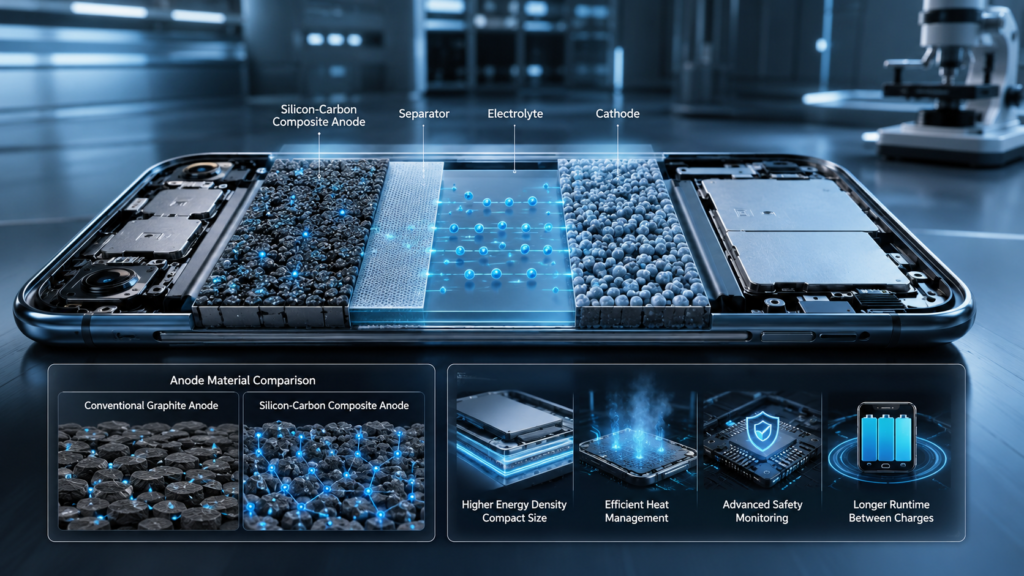
A silicon-carbon battery is a lithium-ion battery that uses a silicon-containing carbon composite in its anode instead of relying only on a conventional graphite-based anode.
Silicon can store substantially more lithium by weight than graphite at the material level. When engineers incorporate a controlled amount of silicon into an anode, it can help increase a battery cell’s energy density. In a smartphone, this may allow a larger battery capacity within a similar amount of space, a thinner design with comparable capacity, or a different balance between battery size and internal components.
However, a silicon-carbon battery is not an entirely new battery chemistry. It remains part of the lithium-ion family. Its defining difference is the use of silicon-containing material in the anode, although manufacturers may also adjust binders, electrolytes, electrode structures, charging controls, and thermal systems to manage silicon’s behaviour.
Silicon-carbon technology, therefore, offers meaningful advantages, but it does not automatically guarantee faster charging, a longer lifespan, or better safety.
Quick Answer: What Is a Silicon-Carbon Battery?
A silicon-carbon battery is a lithium-ion battery with an anode that combines silicon-based material with carbon.
Silicon has a much higher theoretical charge-storage capacity than graphite, but it also expands significantly as it absorbs lithium. Combining silicon with carbon and using supporting cell-engineering techniques can capture some of silicon’s capacity advantage while limiting mechanical stress and capacity loss.
For smartphone users, the practical benefit is usually the possibility of fitting more battery capacity into a limited internal space.
Key Takeaways
- A silicon-carbon battery is a type of lithium-ion battery, not a separate battery chemistry.
- Its anode contains silicon-based material combined with carbon instead of relying only on conventional graphite.
- Silicon offers much higher theoretical capacity than graphite at the anode-material level.
- Practical improvements at the complete-cell level are smaller than the theoretical material-level difference.
- Silicon expands and contracts during charging cycles, creating engineering challenges involving cracking, electrode swelling and capacity degradation.
- Charging speed depends on the complete charging system, not the anode material alone.
- Safety and lifespan depend on cell design, manufacturing quality, thermal control, battery-management software, and usage conditions.
How Does a Silicon-Carbon Battery Work?
A silicon-carbon battery works according to the same basic principle as a conventional rechargeable lithium-ion battery.
A lithium-ion cell normally contains:
- A positive electrode, called the cathode
- A negative electrode called the anode
- An electrolyte through which lithium ions move
- A separator that helps keep the electrodes apart while allowing ion movement
- Current collectors and protective control systems
During charging, lithium ions move from the cathode through the electrolyte and become stored in the anode. When the device is being used, the ions move back toward the cathode while electrons travel through the external circuit and power the phone.
The main difference is the anode material.
Conventional lithium-ion batteries commonly use graphite-based anodes. Silicon-carbon batteries add silicon-based material to the carbon structure because silicon has a far higher theoretical specific capacity than graphite.
Research reviews place silicon’s theoretical capacity commonly at roughly ten times that of graphite at the active-material level. However, this does not mean a complete silicon-carbon battery stores ten times as much energy. The cathode, electrolyte, casing, separator, safety components, electrode loading and usable voltage all affect the energy density of the finished cell.
Why Is Silicon Mixed With Carbon?
Pure or silicon-dominant anodes are difficult to use in ordinary consumer batteries because silicon changes volume considerably as lithium enters and leaves the material.
This expansion and contraction can:
- Create mechanical stress
- Crack silicon particles
- Damage electrical connections
- Destabilize the solid-electrolyte interphase
- Consume active lithium and electrolyte
- Increase electrode swelling
- Accelerate capacity loss
Researchers and manufacturers use carbon composites, specialized binders, electrolyte additives, particle structures and other engineering techniques to reduce these effects.
Commercially practical silicon-containing batteries generally use a limited amount of silicon or silicon-derived material rather than replacing the entire graphite anode with pure silicon. The exact composition is often proprietary and can vary considerably between manufacturers.
Silicon-Carbon Battery vs Traditional Lithium-Ion Battery
A silicon-carbon battery is itself a lithium-ion battery. The useful comparison is therefore between a silicon-containing anode battery and a conventional graphite-anode lithium-ion battery.
| Feature | Silicon-Carbon Lithium-Ion Battery | Conventional Graphite-Anode Battery | What It Means for Users |
| Anode material | Silicon-containing carbon composite | Primarily graphite-based material | Silicon may increase usable anode capacity |
| Battery family | Lithium-ion | Lithium-ion | Both use the same broad rechargeable battery family |
| Practical energy density | Can be higher, depending on full-cell design | Mature and well established | A phone may offer more capacity without a proportional increase in thickness |
| Material expansion | Greater engineering challenge | Lower expansion at the anode-material level | Silicon-containing electrodes require careful mechanical and chemical management |
| Manufacturing | More complex in many implementations | Highly mature and widely scaled | Complexity may affect cost and production consistency |
| Cycle life | Varies by silicon content and cell design | Supported by extensive commercial experience | Battery-health results cannot be assumed from the anode label alone |
| Charging speed | Determined by the complete cell and charging system | Determined by the complete cell and charging system | Silicon-carbon does not automatically mean faster charging |
| Safety | Depends on complete cell and device design | Depends on complete cell and device design | Neither label alone proves that a battery is safer |
| Commercial data | Growing but implementation-specific | Extensive long-term commercial data | Model-specific documentation is important |
The silicon-containing anode is the defining feature, but it may not be the only cell-design difference. Manufacturers can also alter the binder, electrolyte, porosity, electrode thickness, charging limits, and thermal-management strategy to make the cell practical.
Main Benefits of Silicon-Carbon Batteries
1. Potentially Higher Energy Density
The main advantage is the potential to store more energy within a limited volume.
Because silicon has a greater theoretical capacity than graphite, adding it to an anode can improve the energy-storage potential of the negative electrode. A well-designed complete cell may therefore provide more capacity without requiring the same proportional increase in physical size.
Practical gains are much smaller than silicon’s theoretical material-level advantage because the anode is only one part of a complete battery. Researchers evaluating commercial viability emphasize that electrode swelling, cathode capacity, operating voltage, calendar ageing, safety, and cost all affect the real improvement.
2. More Flexibility for Phone Design
A higher-density cell can give smartphone designers more options.
Manufacturers may use the available space to:
- Increase battery capacity
- Reduce the phone’s thickness
- Make room for camera hardware
- Add a larger cooling system
- Rearrange internal components
- Balance capacity against weight
The final result depends on the complete device design. A silicon-carbon battery does not necessarily mean that a phone will be thinner or last longer than every phone using a graphite-based battery.
3. Larger Capacity in Compact Devices
Portable electronics have strict limits on internal space. A modest improvement in battery energy density can be valuable in devices where the display, camera system, processor and cooling components compete for space.
This is why silicon-containing anodes are attracting attention for smartphones, wearables, electric vehicles and other volume- or weight-sensitive applications.
Possible Disadvantages and Limitations
Silicon Expansion
Silicon expands substantially when it becomes lithiated and contracts when lithium is removed.
This does not automatically mean that the entire phone battery will visibly swell. Several related but different effects must be distinguished:
- Expansion of individual silicon particles
- Expansion of the anode layer
- Reversible cell “breathing” during charging
- Permanent electrode swelling
- Gas-related abnormal battery swelling
Material expansion can contribute to cell-design challenges, but a visibly swollen phone battery may also involve ageing, electrolyte decomposition, internal damage or manufacturing defects.
Capacity Degradation
Repeated expansion and contraction can damage silicon particles and the interfacial layers around them. This may consume active material and contribute to capacity loss over time.
Modern designs attempt to manage the problem through silicon-carbon composites, engineered particle structures, flexible binders, electrolyte additives and controlled charging behaviour.
Manufacturing Complexity
Silicon-containing anodes can require more complex materials and manufacturing controls than mature graphite-anode production.
Costs are not identical across every supplier. They depend on the silicon material, production method, cell format, manufacturing scale, quality requirements and supporting cell technologies.
A silicon-carbon battery may contribute to a device’s cost, but it is rarely the only reason one phone costs more than another.
Limited Model-to-Model Comparability
“Silicon-carbon battery” is not a single standardized design.
Two manufacturers may use:
- Different silicon percentages
- Different silicon compounds
- Different particle structures
- Different binders
- Different electrolytes
- Different charging limits
- Different cell formats
As a result, one phone’s performance cannot reliably predict the lifespan, safety or charging characteristics of another phone using the same broad marketing term.
Silicon-Carbon Battery Lifespan
There is no universal lifespan figure for every silicon-carbon battery.
Battery longevity can be affected by:
- Silicon content and structure
- Electrode and electrolyte design
- Manufacturing consistency
- Charge and discharge rates
- Operating temperature
- Time spent near full charge
- Depth of discharge
- Battery-management software
- Device cooling
- Calendar age
Battery lifespan is often discussed in terms of equivalent full cycles. For example, using 50% of the battery on one day and 50% on another can together represent approximately one equivalent full cycle. It does not require a single uninterrupted discharge from 100% to 0%.
Manufacturers may define battery-health targets differently. A common approach is to specify the number of cycles after which the battery is expected to retain a stated percentage of its original capacity, but buyers should check the documentation for the exact phone.
How to Help Preserve Battery Health
Regardless of anode material, these habits may reduce avoidable battery stress:
- Avoid exposing the phone to extreme heat.
- Do not charge a phone under pillows or insulating materials.
- Use compatible, compliant charging equipment.
- Enable optimized or adaptive charging when available.
- Avoid damaging, bending or puncturing the device.
- Replace a battery that becomes visibly swollen or physically damaged.
- Follow the manufacturer’s storage and charging guidance.
Heat, high charge rates and long periods at extreme states of charge can affect lithium-ion ageing, but the result depends heavily on the cell and its charging controls. Fast charging should therefore not be described as universally harmful without considering temperature and system design.
Are Silicon-Carbon Batteries Safe?
Silicon-carbon batteries should be evaluated as lithium-ion batteries with a more demanding anode design.
Available research identifies safety as one of several practical issues that must be considered when increasing silicon content. It would be inaccurate to claim that every silicon-carbon battery is either inherently safer or inherently more dangerous than every graphite-anode battery.
Safety depends on the complete product, including:
- Cell chemistry and construction
- Separator quality
- Electrolyte formulation
- Electrode design
- Manufacturing quality control
- Battery-management system
- Charging protections
- Thermal management
- Mechanical protection
- Safety testing and certification
- User handling
A modern phone normally uses a battery-management system to monitor conditions such as voltage, current and temperature. It can reduce or interrupt charging when conditions move outside permitted limits.
However, no control system can make a lithium-ion battery completely risk-free. Damage, manufacturing defects, extreme temperatures, internal short circuits and unsuitable charging equipment may create hazards.
A battery that becomes unusually hot, develops an odour, leaks, changes shape or pushes against the phone’s display should not be charged or punctured. Follow the manufacturer’s safety instructions and arrange professional inspection or replacement.
Do Silicon-Carbon Batteries Charge Faster?
Not automatically.
Charging speed depends on the interaction of several components:
- Charger power output
- Cable capability
- Phone charging circuitry
- Battery voltage and cell configuration
- Allowed charge rate
- Battery-management software
- Temperature
- Cooling system
- State of charge
- Charging curve
Manufacturers usually reduce charging power as a battery approaches full capacity or becomes too warm. This is why a phone advertised with a high peak wattage does not maintain that maximum rate during the entire charging session.
Some phones combine silicon-carbon batteries with high-powered charging systems, but these are separate engineering choices. The presence of silicon in the anode alone does not establish the charging speed.
Do Silicon-Carbon Batteries Give Better Battery Life?
They can support better battery life when they enable a phone to carry more usable energy without a major increase in size.
However, the term “battery life” can refer to two different things:
- Runtime: How long the phone operates between charges.
- Lifespan: How long the battery retains useful capacity over months and years.
A higher-capacity battery can improve runtime, but software efficiency, display brightness, processor load, signal strength, background activity and thermal behaviour also matter.
A larger capacity does not automatically prove a longer service lifespan. Long-term health depends on the complete cell design and how the phone manages it.
Which Phones Use Silicon-Carbon Batteries?
The list of phones using silicon-carbon or silicon-enhanced anodes changes frequently. Terminology also varies between brands and regions.
Manufacturers may describe the technology as:
- Silicon-carbon battery
- Silicon-carbon anode
- Silicon-enhanced anode
- Silicon composite anode
- Si/C anode
- Silicon-oxygen anode
- High-silicon battery
For the most accurate answer about a particular phone, check:
- The manufacturer’s current specification page
- Official launch materials
- Battery technology announcements
- Regulatory or certification documents where available
- Reliable technical reviews or teardowns
- Manufacturer support documentation
A large battery in a thin phone may suggest the use of higher-density cell technology, but capacity and dimensions alone do not prove that the device uses a silicon-carbon anode.
Should You Buy a Phone With a Silicon-Carbon Battery?
A silicon-carbon battery can be a useful advantage when you want a phone that combines a slim design with a relatively large battery capacity.
It may be especially attractive to:
- Frequent travellers
- Heavy video viewers
- Mobile gamers
- Navigation users
- People who spend long periods away from chargers
- Buyers who prefer thin devices without sacrificing capacity
However, the battery label should not be the only reason to buy a phone.
Also evaluate:
- Independently tested runtime
- Heat under sustained use
- Software-update policy
- Warranty coverage
- Battery-health features
- Charging behaviour
- Repairability
- Replacement cost
- Service-centre availability
- Overall device quality
A well-optimized phone with a conventional graphite-anode battery may deliver a better real-world experience than a poorly optimized phone with a silicon-carbon battery.
What to Check Before Buying
Battery Capacity
Check the official milliamp-hour rating, but remember that mAh alone does not provide a perfect comparison between batteries operating at different voltages.
Watt-hours provide a more direct measure of stored energy when the necessary voltage information is available.
Independent Battery Testing
Look for reviews that test:
- Web browsing
- Video playback
- Gaming
- Standby drain
- Camera use
- Mobile-network use
- Charging time
- Temperature
Real-world testing is more useful than judging the phone from the battery material alone.
Charging System
Confirm:
- Maximum supported charging power
- Whether the required charger is included
- Supported charging protocols
- Wireless-charging support
- Typical full-charge time
- Heat during charging
Thermal Management
A high-capacity battery does not compensate for poor heat control. Reviews of sustained gaming, recording, navigation and fast charging can reveal whether the phone becomes uncomfortable or throttles performance.
Battery-Health Features
Useful software features may include:
- Optimized charging
- Charge limits
- Adaptive overnight charging
- Temperature warnings
- Battery-health percentage
- Cycle-count display
- Charging diagnostics
Warranty and Replacement
Check:
- Battery warranty period
- Capacity-retention terms
- Exclusions
- Authorized replacement options
- Estimated replacement cost
- Repair availability in your country
Replacement requirements vary by model and jurisdiction. Some devices may be serviced by authorized centres, qualified independent repair providers or approved self-repair programmes.
Frequently Asked Questions
Q1. Is a silicon-carbon battery the same as a solid-state battery?
No.
A silicon-carbon battery describes the material used in the anode of a lithium-ion cell. A solid-state battery is defined primarily by replacing the conventional liquid or gel-like electrolyte with a solid electrolyte.
A battery could theoretically combine a silicon-containing anode with a solid electrolyte, but the terms describe different parts of battery design.
Q2. Is a silicon-carbon battery better than a normal lithium-ion battery?
A silicon-carbon battery is a lithium-ion battery.
Compared with a conventional graphite-anode lithium-ion battery, it may offer higher energy density. Whether the finished product is better depends on runtime, lifespan, safety controls, heat, charging, quality, warranty and device optimization.
Q3. Can silicon-carbon batteries swell?
Silicon particles and silicon-containing electrodes expand during lithiation. Manufacturers design the cell to manage this behaviour.
Visible or abnormal battery swelling is a separate device-level problem that may involve ageing, gas generation, internal damage or defects. A visibly swollen phone battery should be treated as a safety issue.
Q4. Are silicon-carbon batteries expensive?
They may be more complex to manufacture than mature graphite-anode batteries, but production cost varies by design, supplier, materials and manufacturing scale.
The battery is only one component affecting a phone’s retail price.
Q5. Can a silicon-carbon battery be replaced?
In many phones, the battery can be replaced by a qualified repair provider, but the process and availability vary by model.
Check the manufacturer’s repair documentation and local service options before purchasing.
Q6. Does a silicon-carbon battery lose capacity over time?
Yes.
All rechargeable lithium-ion batteries lose some usable capacity through cycle ageing and calendar ageing. The rate depends on the cell design, temperature, charging behaviour and usage conditions.
Q7. Does a silicon-carbon battery charge faster?
Not necessarily.
Fast charging depends on the battery’s permitted charge rate, charger, cable, charging circuitry, cooling and software. Silicon-carbon technology alone does not determine charging speed.
Q8. Can silicon-containing anodes be used in electric vehicles?
Yes, silicon-containing anodes are an active area of research and commercial development for electric vehicles and other high-energy applications.
Their adoption depends on practical energy density, cycle life, calendar life, swelling, safety, cost, and manufacturability rather than theoretical capacity alone.
Final Verdict
A silicon-carbon battery is a meaningful development within lithium-ion technology.
Its silicon-containing anode can improve energy-storage potential and help manufacturers fit more battery capacity into space-constrained devices. That can produce real benefits for smartphones, especially when a manufacturer wants to combine a slim body with a large battery.
The technology also introduces engineering challenges. Silicon expands during charging, and practical cells must manage mechanical stress, interfacial instability, ageing, manufacturing consistency, and heat.
For buyers, the most important lesson is simple: do not judge a phone from the battery label alone.
Compare independently tested runtime, charging behaviour, heat, warranty, software support, and repair options. A well-engineered silicon-carbon battery can be a valuable feature, but the quality of the complete device determines the real experience.
Editorial Verification Note
This article explains silicon-containing lithium-ion anodes at a consumer level. Battery composition, capacity, charging performance, lifespan, and safety vary by manufacturer and device.
Product-specific information should be checked against current official documentation before publication. Safety-critical wording should also be reviewed by a suitably qualified battery or electrical-engineering professional when such a reviewer is available.
Last technical review: July 2026